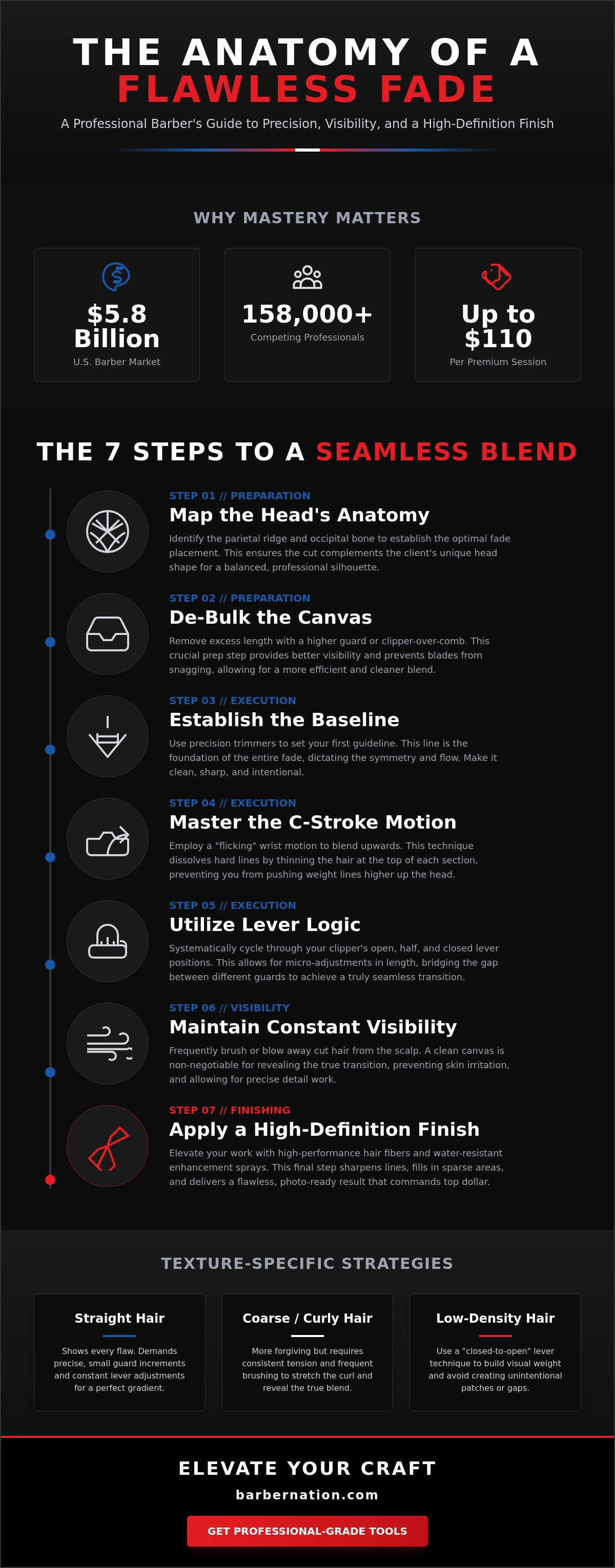
A flawless fade is not merely a service; it is a signature of your dedication to the craft. You understand that the difference between a standard cut and a premium, high-definition finish often comes down to a single, stubborn weight line that disrupts the transition. With over 158,000 barbers currently competing in a $5.8 billion U.S. market, achieving that elusive, blurry blend is how you command the top-tier prices that reach up to $110 per session. If you have ever struggled with inconsistent textures or slow service times due to poor workstation visibility, you are not alone in your pursuit of excellence.
We are here to help you refine your technique and reclaim your time. By implementing these professional barbering tips for fades, you will learn to integrate high-performance tool settings with a workspace layout designed for absolute clarity. We will explore the three pillars of a master-level cut: mechanical precision, constant visibility, and high-definition finishing. Prepare to elevate your technical skills and increase your client retention through a commitment to superior results and professional growth.
Key Takeaways
- Identify the parietal ridge and occipital bone to map out a precise fade placement tailored to the client's unique head shape.
- Master the C-stroke motion and establish high-contrast baselines to eliminate harsh lines and achieve a seamless, professional blend.
- Implement these professional barbering tips for fades by maintaining a clean scalp and workspace to reveal true transitions and avoid skin irritation.
- Utilize high-performance hair fibers and water-resistant sprays to deliver a high-definition finish that sets your work apart.
- Invest in ergonomic, professional-grade equipment to optimize your shop efficiency and ensure a long, successful career in the craft.
Preparing the Canvas: Sectioning and Hair Texture Analysis
Begin every service by analyzing the structural landscape of the scalp. A master barber views the head not as a uniform surface, but as a map of ridges and valleys. You must identify the parietal ridge and the occipital bone to determine the optimal placement for the transition. These landmarks act as the definitive boundaries for your blend. If you place a high fade too far above the parietal ridge on a client with a narrow head shape, you risk creating an unbalanced silhouette that lacks professional polish. Mapping these zones ensures your work complements the client's natural anatomy.
Clear communication is the hallmark of a professional. Explain your fade logic to the client during the initial consultation. This sets expectations and justifies your technical choices. Whether they request a high-contrast look or one of the different types of taper fades, your goal is to align their vision with their specific cranial structure. Before you reach for your clippers, analyze the hair growth patterns. Cowlicks and whorls require a strategic change in clipper direction to ensure an even cut. One of the most effective barbering tips for fades is to de-bulk the canvas first. Removing excess length with a higher guard or clipper-over-comb allows for better visibility and prevents your blades from dragging through dense hair.
To better understand how these preparation steps lead to a smooth finish, watch this helpful video:
Mapping the Head Shape for Precision
Adjusting the height of the fade based on the client's unique anatomy is what separates a routine service from an elevated craft. Bone indentations often create natural dark spots that mimic unblended hair. You must compensate for these shadows by stretching the skin or adjusting your lever slightly more than usual in those specific zones. Use your shop lighting to your advantage. Step back and look at the reflection in the mirror; the mirror often reveals structural inconsistencies that are invisible to the naked eye when you are standing too close. With over 130,000 barber shops in the United States, this level of attention to detail is how you distinguish your station from the competition.
Texture-Specific Fading Strategies
Common industry advice often suggests starting every cut with a #2 guard, but this rigid approach fails to account for varying hair densities. Low-density hair requires a conservative approach with the lever to avoid creating gaps that look like mistakes. Your prep work determines the speed of your final blend. When the canvas is properly sectioned and de-bulked, your guards move with maximum efficiency. Consider these texture-specific barbering tips for fades to improve your results:
- Straight Hair: Shows every technical flaw; requires precise, small increments in guard sizes and frequent lever play.
- Coarse or Curly Hair: Forgives minor blending errors but needs consistent tension and frequent brushing to see the true transition pattern.
- Low-Density Hair: Use a "closed-to-open" lever technique to build visual weight where the hair is naturally sparse.
The Anatomy of a Flawless Blend: Step-by-Step Mechanics
Execution begins the moment you set your first guideline. You must establish a clean baseline with precision trimmers to create the high-contrast foundation that defines a premium fade. This initial mark is the most important line you will draw; it dictates the symmetry and flow of the entire cut. Once your baseline is set, transition to your primary clipper to begin the blending process. Mastering the "C-stroke" motion is your primary defense against creating new harsh lines. This flicking gesture thins the hair at the top of each section, ensuring that you are dissolving weight rather than simply moving it higher up the head.
Lever logic dictates the rhythm of your blend. You must understand how to cycle through open, half, and closed positions to bridge different lengths. An open lever provides the maximum length for any given guard, while a closed lever offers the shortest, most aggressive cut. While many professionals prefer up-fading to build contrast from the bottom up, down-fading is often a more efficient strategy for managing bulk on dense textures. For the most intricate detailing, use only the corner of the blade. This surgical approach allows you to pick out specific dark spots without disturbing the surrounding transition. These barbering tips for fades rely on your ability to see the hair as a three-dimensional sculpture.
Maintaining professional standards is about more than just the cut. Adhering to strict sanitation and disinfection standards ensures your tools perform at their peak and your clients remain safe. A clean, well-oiled blade moves through hair with significantly less resistance, which directly impacts the quality of your blend.
Mastering the Guard System
Bridging the gap between a #1.5 and a #0.5 guard is the "danger zone" where many fades lose their flow. You must ensure guard consistency across your kit; mixing brands can lead to slight length variations that disrupt a smooth transition. Use clipper-over-comb for the final bridge into the top length. This technique allows you to create a tailored silhouette that a standard guard cannot achieve. It provides the professional touch that justifies premium shop rates.
The Art of Lever Play
Micro-adjustments are the secret to removing "ghost lines" that only appear under specific lighting. Click the lever halfway to soften a transition before committing to a fully closed position. Control your pressure throughout the process. Applying excessive force can irritate the scalp and unintentionally change the effective cutting length of the guard. If a stubborn line remains, use the Turbojet Fadeblaster to clear debris and reveal the exact source of the weight. This clarity allows you to troubleshoot the blend with total precision and speed.
Maintaining Precision Visibility: The Role of Cleanliness in Fading
Precision is impossible without absolute visibility. As you work through your guidelines, tiny hair fragments settle on the scalp and create a false sense of density. This debris often hides the true transition of the fade, leading many professionals to over-cut areas that are already perfectly blended. By the time you realize the "dark spot" was actually just loose hair, you've already created a gap in the silhouette. Mastering professional barbering tips for fades requires you to treat cleanup as a technical step rather than a post-service chore. A clean canvas allows you to see the scalp-to-hair ratio with surgical clarity, ensuring every lever adjustment is based on reality rather than visual noise.
Repetitive brushing is a common pitfall that compromises the quality of a skin fade. Traditional fade brushes, while popular, can cause significant skin irritation and redness when used too aggressively. This inflammation masks the natural skin tone, making it difficult to judge the contrast of the blend. To maintain a high-performance workflow, you must minimize physical contact with the scalp while maximizing debris removal. An organized station further enhances this efficiency. Positioning your tools in an ergonomic arc reduces unnecessary reaching and speeds up your chair turn. In an industry where budget chains average $23 to $28 per cut, your ability to provide a fast, premium service is what allows you to command independent shop rates of $65 or more.
The Evolution of Cleanup: Beyond the Neck Brush
Professional air dusters are rapidly replacing traditional brushes as the gold standard for precision work. Unlike a brush that simply moves hair from one side of the head to the other, targeted air removes clippings entirely without touching the client's skin. This technology allows you to reveal dark spots in real-time, providing immediate feedback on your blend. You can elevate your cleanup with the BarberNation Turbojet Fadeblaster to ensure your visibility remains unobstructed throughout the most technical stages of the cut. This tool integration is a definitive marker of a modern master who values both speed and skin health.
Maintaining Your High-Performance Equipment
Your tool kit is a reflection of your commitment to the craft. High-performance equipment, such as cordless air dusters and brushless motor clippers, requires a disciplined daily maintenance routine. Clear hair from your blades and duster filters every evening to prevent mechanical strain and ensure long-term reliability. Superior tool hygiene does more than extend the life of your equipment; it builds immense client trust. When a client sees a pristine, well-maintained station, they recognize they're in the hands of a professional who respects the art of grooming. You can explore the full BarberNation Turbojet collection for your shop to find the high-definition tools necessary for a world-class finish.
Elevating the Finish: Enhancement Techniques for Sharp Fades
A master's finish extends beyond the mechanical reach of the blade. In a global industry valued at over $40 billion in 2025, clients increasingly demand a "High-Definition" look that provides immediate visual impact. While some critics dismiss enhancements as social media illusions, professional barbers recognize them as a sophisticated tool for correcting natural irregularities in hair density. Utilizing these barbering tips for fades allows you to deliver a crisp, symmetrical silhouette that lasts well beyond the chair. High-definition finishing involves the strategic application of color and fibers to reinforce the vertical bars and the C-wash, creating a look of absolute structural perfection.
Precision application is the key to maintaining the integrity of the craft. Use enhancement pencils to lightly define the edges before applying semi-permanent sprays. This creates a guide for your razor work and ensures the lines remain sharp. You must blend these enhancements into the natural transition of the hair to avoid a "painted-on" appearance. A successful enhancement should be invisible to the untrained eye, serving only to amplify the precision of your existing blend. This level of detail justifies the premium rates found in high-end shops, where men's haircuts can reach $110 per session. To achieve these results, you must invest in the same caliber of equipment used by industry leaders. Elevate your professional results with BarberNation’s exclusive tool collection to ensure every finish meets the highest standards of the trade.
Applying Fade Fusion for Precision Styling
Success with water-resistant hair fibers begins with proper shade selection. You must match the enhancement to the darkest part of the client's natural hair, not the skin tone, to ensure a realistic result. Apply the fibers in light, controlled layers rather than one heavy pass. This building process creates a three-dimensional effect that mimics natural hair growth. To ensure longevity, lock the fibers in place with a high-performance holding spray. This prevents the enhancement from running or smudging during daily activities, maintaining the "fresh out of the shop" look for up to 48 hours.
The BarberNation Approach to Edge-Ups
Combine enhancement sprays with meticulous razor work for maximum visual "pop." Use a straight razor to clear the fine hair around the enhanced line, which creates a clean, high-contrast border. Always remember that less is more; the goal is to enhance the barbering, not replace it. Educate your clients on how to maintain their look between visits. Advise them on gentle cleansing techniques that preserve the enhancement while keeping the scalp healthy. This professional guidance reinforces your position as a mentor in their grooming journey and builds the long-term loyalty necessary to thrive in a competitive market.
The Professional Journey: Continuous Growth and Master Tools
Your tool kit is the most visible reflection of your commitment to the craft. In a market where the professional hair trimmers segment is projected to grow to USD 3.12 billion by 2034, your equipment choices signal your status as a serious professional. Entry-level tools may suffice during your initial training, but a master barber requires high-performance machinery that matches their technical evolution. This investment is about more than just cutting hair; it is about the psychology of the premium experience. When a client pays the national average of $41, or up to $110 in high-end markets, they expect a service that feels exclusive and technologically advanced. Superior tools provide the stability and reliability you need to maintain these high standards every day.
Longevity in this industry depends on your physical health. Investing in ergonomics is a strategic move to extend your career and prevent the fatigue that leads to technical errors. Professional-grade clippers and accessories are designed with weight distribution and grip in mind, allowing you to execute complex transitions without straining your joints. These barbering tips for fades are only effective if you have the stamina to perform them consistently from your first appointment to your last. By prioritizing your workspace ergonomics, you ensure that your passion for excellence remains sustainable for decades.
Upgrading Your Professional Kit
Transitioning from corded to cordless equipment is a significant milestone in your professional journey. Cordless freedom allows you to move around the chair with total agility, improving your line of sight and overall shop efficiency. High-performance tools like the Turbojet Fadeblaster pay for themselves through the time saved during the cleanup phase of each cut. Reducing your service time by even five minutes per client can significantly increase your daily revenue. You can find the equipment necessary to optimize your station by exploring the BarberNation Turbojet collection, which is built by professionals for professionals.
Developing Your Signature Style
Mastery requires you to take inspiration from industry leaders while refining your unique technical touch. Use social media to showcase your "Master Barber" status by posting high-definition results that highlight your precision. Consistent, high-quality work is the foundation of a powerful personal brand that drives client retention. Whether you are meeting the 600-hour competency requirements in Florida or navigating a decade of experience, your growth should never stagnate. Stay at the forefront of the industry by adopting the latest technological advancements and trends. It is time to take the next step in your professional journey. Elevate your craft with BarberNation professional tools and join the community of masters where professional excellence meets exclusive quality.
Take Command of Your Professional Future
Mastering a blurry fade requires a disciplined fusion of technical mechanics and environmental control. You've explored how precise head mapping and the strategic use of lever logic eliminate stubborn weight lines. You also understand that visibility is the silent partner of precision; using air technology to clear debris is now a standard for the modern professional. These barbering tips for fades provide the blueprint for a superior service that justifies premium shop rates and secures long-term client loyalty. Every adjustment you make with the corner of your blade is a step toward perfecting an elevated art form.
Your professional journey is defined by the tools you choose to master. Success in a competitive shop environment depends on equipment that offers both durability and high-performance results. Elevate your craft and shop efficiency with BarberNation Professional Tools. Our equipment is designed by professionals for professionals, featuring high-performance cordless technology to maximize your mobility during complex cuts. We support your ongoing growth with free domestic shipping on all orders to ensure you stay equipped for excellence. Take pride in your work and continue to push the boundaries of the craft. Professional excellence meets exclusive quality every time you step behind the chair.
Frequently Asked Questions
How do I get rid of the bottom line in a skin fade?
Eliminate the bottom line by using the corner of your blade with a fully closed lever. Flick the clipper upward in a short, controlled C-stroke to soften the transition. If the line persists, adjust the lever to the halfway position to bridge the gap. These barbering tips for fades allow you to remove harsh guidelines without creating new ones higher up the head. Precision detailing at this stage defines the contrast of your final blend.
What is the best way to clean my clippers between clients?
Disinfect your clippers using a high-performance cooling spray that meets official sanitation and disinfection standards. First, remove all visible hair debris with an air duster to prevent mechanical strain on the motor. Apply the disinfectant and allow it to sit for the manufacturer's recommended contact time, which is typically 10 minutes for full efficacy. Maintaining your tools ensures they remain sharp and reliable for every client on your schedule.
Can I use hair enhancements on every client?
Apply enhancements whenever a client requires corrected density or a more defined silhouette. While not every cut needs them, the 2025 global market trend shows a massive demand for high-definition finishes. Use enhancements to fill in natural gaps or sharpen the vertical bars. Always prioritize a natural look by choosing a shade that matches the client's hair color rather than their skin tone to ensure a professional result.
How long should a professional fade take to complete?
Aim to complete a professional-grade fade within 30 to 45 minutes. Efficiency is critical for maintaining a profitable chair turn, especially in independent shops where rates average $35 to $65 per session. Master your sectioning and de-bulking early in the service to save time during the final blending stages. Using high-performance tools and a structured workflow allows you to maintain quality while increasing your daily client volume.
Why does my fade look patchy in certain lighting?
Patchy fades often result from bone indentations or inconsistent hair density rather than poor technique. Dark spots appear where the scalp dips, such as near the occipital bone or parietal ridge. You must compensate for these shadows by stretching the skin or using a lighter lever setting in those specific zones. Check your work in the mirror frequently; the reflection often reveals lighting inconsistencies that are invisible from a direct angle.
Is an air duster better than a traditional neck brush?
A professional air duster is superior to a neck brush because it removes hair debris without irritating the skin. Brushes often move hair around or trap it against the scalp, which hides the true transition of your blend. Using targeted air reveals the scalp clearly and prevents the redness associated with repetitive brushing. This technological upgrade is a hallmark of a master who values both technical precision and client comfort.
How do I prevent skin irritation during a close taper?
Prevent skin irritation by maintaining sharp, well-oiled blades and avoiding excessive pressure. Repetitive brushing during a skin fade can cause inflammation that masks the natural contrast of the blend. Use a light touch and let the clipper's motor do the work. If you notice sensitivity, adjust your technique to use an air duster for cleanup. This protects the scalp and ensures your client enjoys a premium, irritation-free experience.
What guards are essential for a standard mid-fade?
Secure a complete set of guards ranging from #0.5 to #2 to execute a standard mid-fade. You must have the #0.5 and #1.5 system guards to bridge the most difficult gaps in the transition. Consistency across your guard brands is essential to avoid slight length variations that can ruin a smooth blend. Using these essential tools alongside our barbering tips for fades ensures you have the mechanical range to handle any hair texture.