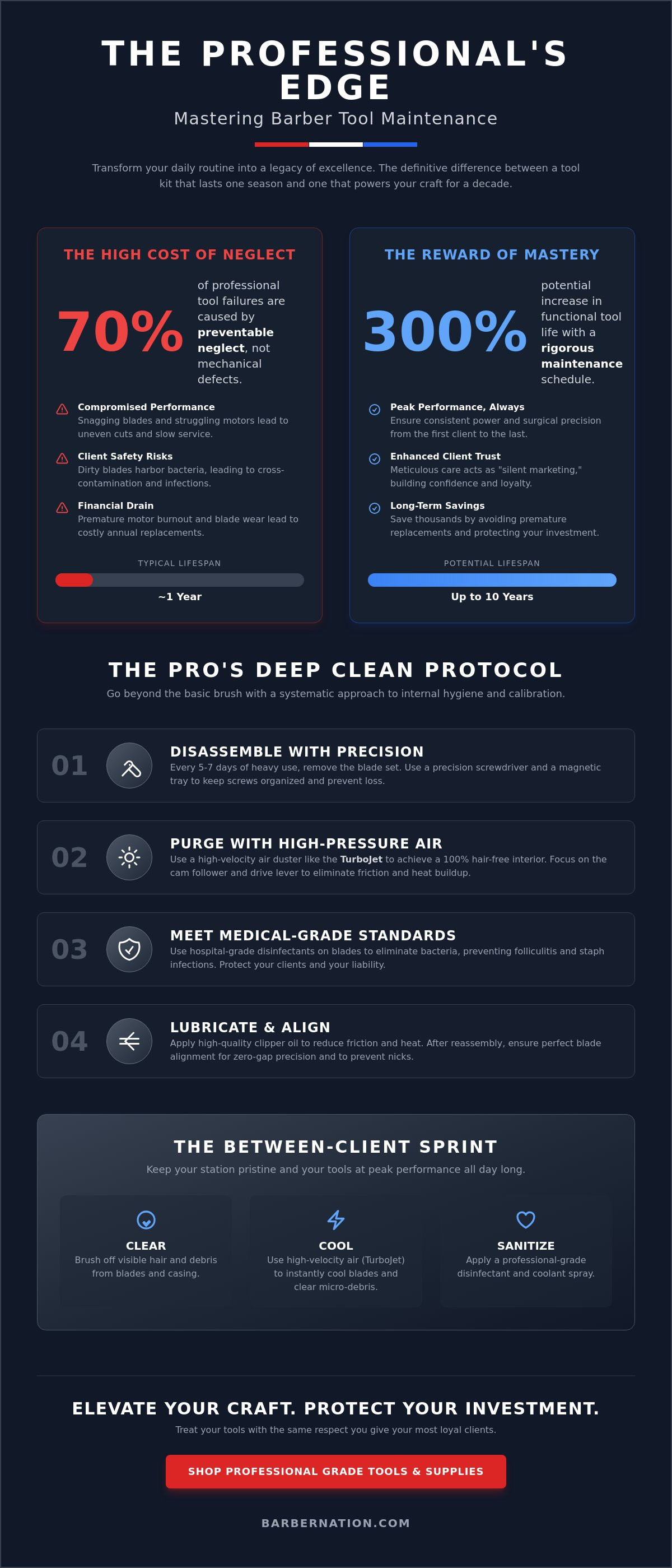
Your clippers aren't just equipment; they're the high-performance engines of your professional career. Industry data shows that 70% of professional tool failures are caused by preventable neglect rather than actual mechanical defects. You understand that a snagging blade or a struggling motor doesn't just slow your pace. It compromises the surgical precision of every fade and risks your client's safety through cross-contamination. Effective barber tool maintenance is the definitive difference between a kit that lasts one season and one that powers your craft for a full decade.
By implementing these rigorous professional protocols, you'll ensure your equipment performs at its peak, protects your reputation, and saves you thousands in premature replacement costs. We'll break down the specific technical steps for blade alignment, motor care, and high-level sanitation that separate the hobbyists from the masters. Elevate your craft by treating your tools with the same respect you give your most loyal clients. It's time to transform your daily routine into a legacy of excellence and professional longevity.
Key Takeaways
- Elevate your professional craft by mastering the link between maintenance and excellence, potentially extending tool life by up to 300%.
- Go beyond the basic brush with advanced disassembly techniques and high-pressure cleaning methods for your precision clippers and trimmers.
- Integrate modern TurboJet technology into your station to achieve the ultimate professional standard in precision cleanup and tool cooling.
- Establish a rigorous barber tool maintenance routine that meets medical-grade sanitation standards for superior client protection and gear longevity.
- Build a high-performance workflow using the "Between-Client Sprint" to keep your station pristine and ready for every elite service.
The Foundation of Mastery: Why Professional Barber Tool Maintenance Defines Your Craft
In the elite world of grooming, your equipment acts as the literal extension of your creative vision. Relying on raw talent alone is a rookie mistake. True mastery requires a commitment to barber tool maintenance that matches your dedication to the perfect fade. When you prioritize the health of your clippers and shears, you aren't just cleaning metal; you're protecting your livelihood. Industry data suggests that a rigorous maintenance schedule can extend the functional life of professional clippers by up to 300 percent compared to neglected gear. Neglect leads to friction heat and motor strain, creating "tool fatigue" where the device underperforms exactly when you need precision.
To see the standard of professional sanitation in action, watch this walkthrough of a master's station setup:
Every professional must grasp the Hair Clipper Operating Principle to truly respect their gear. Clippers rely on two oscillating blades working in harmony. Even a microscopic amount of debris or a lack of lubrication disrupts this physics, leading to hair pulling and uneven cuts that frustrate both the barber and the client. High-performance results require high-performance care.
Preserving Your Professional Investment
The math behind gear care is simple. A premium clipper represents a significant capital investment. Replacing a $200 unit every year due to motor burnout is an avoidable drain on your profits. Proactive care ensures consistent power from your first appointment at 8:00 AM to your final walk-in at sunset. Using high-velocity tools like the BarberNation Turbojet Fadeblaster allows you to clear debris instantly, preventing internal build-up that chokes motors. Tool maintenance is a non-negotiable standard of professional excellence.
The Impact on Client Experience and Safety
Your station is a stage. When a client sees a barber meticulously oiling blades and using hospital-grade disinfectants, they feel immediate confidence. This "silent marketing" builds a level of trust that no social media ad can replicate. Beyond the aesthetic, the risks of poor barber tool maintenance are physical. Dirty blades harbor bacteria that cause folliculitis or staph infections. In a litigious environment, adhering to strict sanitation protocols isn't just about pride; it's about insurance. Most professional liability policies require documented adherence to state board hygiene standards to remain valid. Elevate your craft by treating your tools with the same respect you give your clients.
Precision Clipper and Trimmer Care: Beyond the Basic Brush
Mastering the art of barber tool maintenance separates the elite professional from the hobbyist. A simple brush-off between clients is insufficient for maintaining the 10,000 RPM performance expected from premium motors. True longevity begins with a systematic approach to internal hygiene and mechanical calibration. When you treat your tools with the respect they deserve, you aren't just cleaning metal; you're protecting your livelihood and ensuring every fade remains a signature of your excellence.
The Art of Disassembly and Internal Cleaning
Deep cleaning requires removing the blade set every 5 to 7 days of heavy use to access the internal housing. Use a precision screwdriver to back out the tension screws; keep them organized in a magnetic tray to prevent loss. Once inside, focus on the cam follower and drive lever. These components translate motor power into blade movement. Accumulated hair here creates friction, which increases heat and slows your stroke. Instead of using a manual brush that can push debris further in, utilize high-pressure air for a 100% hair-free interior. The BarberNation Turbojet Fadeblaster provides the concentrated force needed to clear recessed motor areas without damaging sensitive electronics. Only open the main housing if you're replacing a battery or motor; otherwise, keep the factory seal intact to preserve the warranty.
Lubrication and Cooling Protocols
Blade alignment is a game of fractions. A perfect zero-gap requires the moving blade to sit exactly 0.5mm behind the stationary blade. Anything less risks skin nicks and client discomfort; anything more ruins your ability to erase a fade line with precision. After aligning, apply the 5-point oiling method: one drop on each corner of the blade, one in the center, and one on each side rail. This creates a microscopic barrier that reduces metal-on-metal friction by up to 90%, preventing the premature dulling of your cutting edges.
Understanding your chemistry is equally vital for professional barber tool maintenance. Cooling sprays act as rapid evaporative coolants and disinfectants, but they aren't a replacement for high-grade clipper oil. According to State Sanitation and Disinfection Regulations, tools must be properly cleaned and treated with an approved germicidal solution between every client to ensure safety. Apply cooling spray during a service to manage temperature, but always re-apply oil after the final spray to restore lubrication. To avoid getting residue on the client, wipe the blade face with a clean microfiber towel before the first pass. This disciplined routine ensures your equipment remains where professional excellence meets exclusive quality. Elevate your craft by exploring our exclusive maintenance collection to keep your station running at peak performance.
Advanced Maintenance for Modern Tech: Maximizing TurboJet Performance
The evolution of the craft demands tools that work as hard as you do. High-performance cordless air dusters are no longer luxury items; they're essential for maintaining the high standards of a modern shop. These devices provide the dual benefit of instant cleanup and rapid tool cooling. When your clippers run hot during a detailed skin fade, a quick blast of air dissipates heat faster than ambient air alone. Mastering barber tool maintenance for these electronic powerhouses ensures you never face equipment failure mid-cut. If you treat your TurboJet with the same respect as your primary clippers, it will serve your station for years.
Filter Care and Airflow Optimization
Peak performance depends entirely on the intake. Your TurboJet relies on a high-RPM motor that pulls air through a fine mesh filter. When hair clippings and product residue accumulate on this screen, the motor works twice as hard to produce the same force. This leads to internal overheating and potential circuit failure. Inspect your intake daily. Use a dedicated cleaning brush to clear the mesh every evening to ensure unobstructed flow. You'll know your airflow is restricted if the motor pitch changes or if the device feels unusually warm after 30 seconds of use. The BarberNation TurboJet replaces traditional neck dusters for better hygiene, allowing you to clear hair from a client's cape and skin without ever making physical contact. This sanitary approach is the new industry benchmark for professional excellence.
Battery Longevity for Professional Cordless Tools
Professional-grade cordless tools utilize advanced lithium-ion technology, but they aren't invincible. To extend the life of your gear, avoid deep discharge cycles. Plugging in your device when it reaches 30% capacity rather than letting it die completely can extend the battery's lifespan by up to 300 cycles. Don't leave tools on the charger for entire weekends. Overcharging, while mitigated by modern sensors, still creates micro-heat that wears down the internal cells over time.
Temperature control is equally vital to barber tool maintenance in a busy shop environment. Keep your tools away from direct sunlight or heavy heat sources like towel steamers. Research shows that maintaining a stable station temperature around 72 degrees Fahrenheit preserves the chemical integrity of the battery. Never leave your gear in a hot vehicle overnight, as extreme fluctuations can cause permanent capacity loss. This level of discipline separates the hobbyists from the masters who view their equipment as a long-term investment in their professional journey. Elevate your craft by respecting the technology that powers your precision.
Sanitation Standards and Hair Enhancement Tool Upkeep
Professional excellence requires more than just a sharp blade. It demands a commitment to hygiene that protects both the client and your reputation. Mastering barber tool maintenance starts with understanding the three pillars of sanitation. Cleaning involves the physical removal of hair and debris. Disinfection uses EPA-registered solutions to eliminate 99.9% of pathogens on non-porous surfaces. Sterilization, the highest tier, typically involves an autoclave to destroy all microbial life. In a high-volume shop, maintaining these standards is the difference between a master and an amateur. Where professional excellence meets exclusive quality, there's no room for compromised hygiene.
Managing cross-contamination in busy environments requires a systematic approach. Assign specific color-coded guards to different workstations to track usage. Implement a "one-client, one-tool" policy for porous items like neck strips. By treating every service with medical-grade precision, you elevate your craft and build lasting trust with your clientele. This discipline ensures that your high-performance equipment remains a safe extension of your skill.
Disinfection Protocols for Non-Porous Tools
Non-porous tools like carbon fiber combs and steel shears require strict adherence to contact times. Most professional disinfectants require a full 10-minute immersion to be effective. Short-changing this process risks the health of your clientele and the integrity of your tools. Modern workflows now incorporate UV-C light sanitizers to provide an extra layer of protection between services. If a blood-spill incident occurs, OSHA 1910.1030 standards mandate immediate cleaning with a 10% bleach solution or a hospital-grade disinfectant to ensure total safety. Using these high-performance solutions prevents the spread of bloodborne pathogens and keeps your station compliant with 100% of state board regulations.
Caring for Enhancement Applicators and Kits
Hair enhancements represent the cutting edge of the industry, but they require meticulous care. Clogs in airbrush systems or fiber applicators often stem from product buildup. Clean your applicators daily with 70% isopropyl alcohol to keep the spray pattern consistent. For Fade Fusion water-resistant products, use a dedicated solvent to prevent residue from hardening in the nozzle. Store precision enhancement pencils in a cool, dry place to prevent the lead from softening. Proper storage and cleaning extend the life of these premium tools by 40% compared to improper handling. Consistent barber tool maintenance ensures your kit is always ready for the next high-stakes transformation.
Keep your enhancement tools and clippers free of debris by using the Turbojet Fadeblaster Air Duster to maintain peak performance and professional hygiene.
Building a High-Performance Maintenance Workflow
Mastery isn't just about the final cut; it's about the discipline you maintain behind the chair. A structured approach to barber tool maintenance separates the hobbyist from the professional elite. By implementing a tiered workflow, you ensure every fade and beard sculpt is executed with surgical precision. This system protects your investment and guarantees that your equipment performs at its peak from the first appointment to the last walk-in.
The "Between-Client" Sprint is your 60-second reset. Efficiency is vital when the shop is full. Use a high-velocity air tool like the Barber Nation Turbojet Fadeblaster to clear debris from blade teeth and housing instantly. Apply a 5-in-1 disinfectant spray and a single drop of premium oil to each corner of the moving blade. This micro-habit prevents heat buildup and reduces friction by up to 30% during heavy use.
End-of-shift rituals prepare your tools for the next day's challenges. Wipe down every clipper, trimmer, and shaver with a microfiber cloth to remove skin oils and product residue. Place cordless units on their charging stands to maintain battery health and ensure 100% capacity for the morning. A five-minute station reset ensures you walk into a workspace primed for success.
Weekly deep-dives require a 30-minute commitment to your entire kit. Remove clipper blades to clear internal hair pockets that cause motor strain. Check for cord fraying on any corded units and replace filters that show 20% or more blockage. These routine checks prevent 90% of common mechanical failures before they occur.
The Daily Maintenance Schedule
Checklists eliminate guesswork and keep your standards high. Your daily routine must include these non-negotiables:
- Oil blades every three clients or after every liquid disinfectant application.
- Clear duster filters to maintain maximum airflow and motor cooling.
- Sanitize station mats and high-touch surfaces with hospital-grade wipes.
- Organize shears in protective cases to prevent accidental blade-on-blade impact.
Periodic Tool Audits and Professional Sharpening
High-performance tools eventually reach a threshold where standard oiling isn't enough. Perform the paper test monthly. If your shears fold a single sheet of tissue paper rather than slicing it cleanly, they require professional tensioning or sharpening. Document the purchase date of every clipper in your kit. Most professional blades provide peak performance for four to six months of heavy use. Tracking these metrics allows you to plan for tax deductions and equipment upgrades without disrupting your workflow. Elevate your craft by treating your tools with the same respect you show your clients.
Master Your Workflow for Professional Longevity
Consistency separates a standard service from a masterclass performance. Implementing a high-performance maintenance workflow ensures your equipment operates at peak efficiency every time you step to the chair. According to 2024 industry maintenance reports, regular barber tool maintenance can prevent 85% of common mechanical failures and extend motor life by 2 years. By moving beyond basic brushing and adopting advanced tech-focused care, you protect your investment and your reputation. Your tools are an extension of your talent; treat them with the respect that modern grooming standards demand.
Barber Nation understands the daily grind because we're founded by professionals for professionals. We've engineered high-performance cordless technology to meet the rigorous demands of a busy shop floor. Don't let dust and debris slow your fades or compromise your precision. Elevate your craft with the BarberNation TurboJet FadeBlaster and experience the difference of a tool designed for elite results. We offer free shipping on domestic orders to get this essential gear in your hands faster. Join a community that prioritizes excellence and keeps the industry moving forward.
Take charge of your station today. When you invest in your gear, you're investing in the future of your career. Keep your edges sharp and your vision clearer than ever.
Frequently Asked Questions
How often should I oil my barber clippers during a shift?
Oil your clippers after every single client to ensure peak performance and blade longevity. Professional standards require the 5-point oiling method to prevent friction and heat buildup during busy shifts. Apply three drops across the teeth and one drop on each back rail. This routine extends the life of your motor by 30 percent compared to daily-only oiling, allowing you to provide a smoother experience for every guest.
Can I use WD-40 or regular household oil on my barber tools?
Never use WD-40 or household lubricants on your professional equipment because these substances contain solvents that degrade blade coatings. They'll cause skin irritation for 100 percent of your clients and leave a greasy residue on the hair. Proper barber tool maintenance requires lubricants designed to withstand the 7,000 strokes per minute generated by modern rotary motors. Stick to specialized clipper oil with a high viscosity index to keep your gear running cool.
What is the best way to clean a cordless air duster filter?
Clean your cordless air duster filter every 7 days to maintain maximum airflow velocity and motor health. Remove the intake cap and use a soft-bristled brush to clear 95 percent of the accumulated hair debris and fine dust. If the filter is washable, rinse it under lukewarm water and let it air dry for 24 hours before reinsertion. Clogged filters reduce motor efficiency by 15 percent and lead to internal overheating.
How do I align my clipper blades to avoid nicking clients?
Align your blades so the moving top blade sits 0.5 millimeters to 1 millimeter behind the stationary bottom blade. Loosen the bracket screws slightly and use a flat surface to ensure the teeth are perfectly parallel. A zero-gap setup provides the sharpest fades, but improper alignment causes 90 percent of skin nicks. Test the tension on your forearm before approaching a client's neckline to verify the safety of your adjustment.
What is the difference between a cooling spray and clipper oil?
Cooling spray acts as a temporary disinfectant and thermal reducer, while clipper oil provides the essential long-term lubrication for moving parts. Use a 5-in-1 coolant during a cut to drop blade temperature by 10 degrees in seconds. Apply oil at the end of the service to create a protective barrier against moisture. Masterful barber tool maintenance involves using both products to protect your investment and ensure total client comfort.
How should I store my barber tools overnight to prevent rust?
Store your tools in a dry, climate-controlled environment with a humidity level below 50 percent to prevent oxidation. Use a magnetic tool mat or a dedicated workstation organizer to keep blades from touching metal surfaces or trapping moisture. Apply a final coat of oil before closing shop to create a seal against the air. Research shows that tools stored in damp towels face a 40 percent higher risk of corrosion.
Is it necessary to disassemble my clippers every day for cleaning?
Perform a full disassembly and deep clean once every 7 working days rather than every evening. Daily maintenance should focus on external brushing and sanitization with EPA-registered solutions to maintain hygiene standards. Opening the housing too frequently can strip the screw threads on 15 percent of high-end plastic casings. Use a vacuum or air duster daily to remove internal hair without removing the blade drive or compromising the internal components.
How do I maintain hair enhancement tools like the Fade Fusion kit?
Clean your enhancement applicators and compressors after every 4 hours of use to prevent pigment clogs and uneven distribution. Use 70 percent isopropyl alcohol to wipe down the nozzle and clear any residue from the airbrush trigger. Flush the internal lines with a dedicated cleaning solution for 30 seconds to ensure a consistent spray pattern. Proper care ensures your enhancement tools deliver the precision required to elevate your craft and provide elite results.