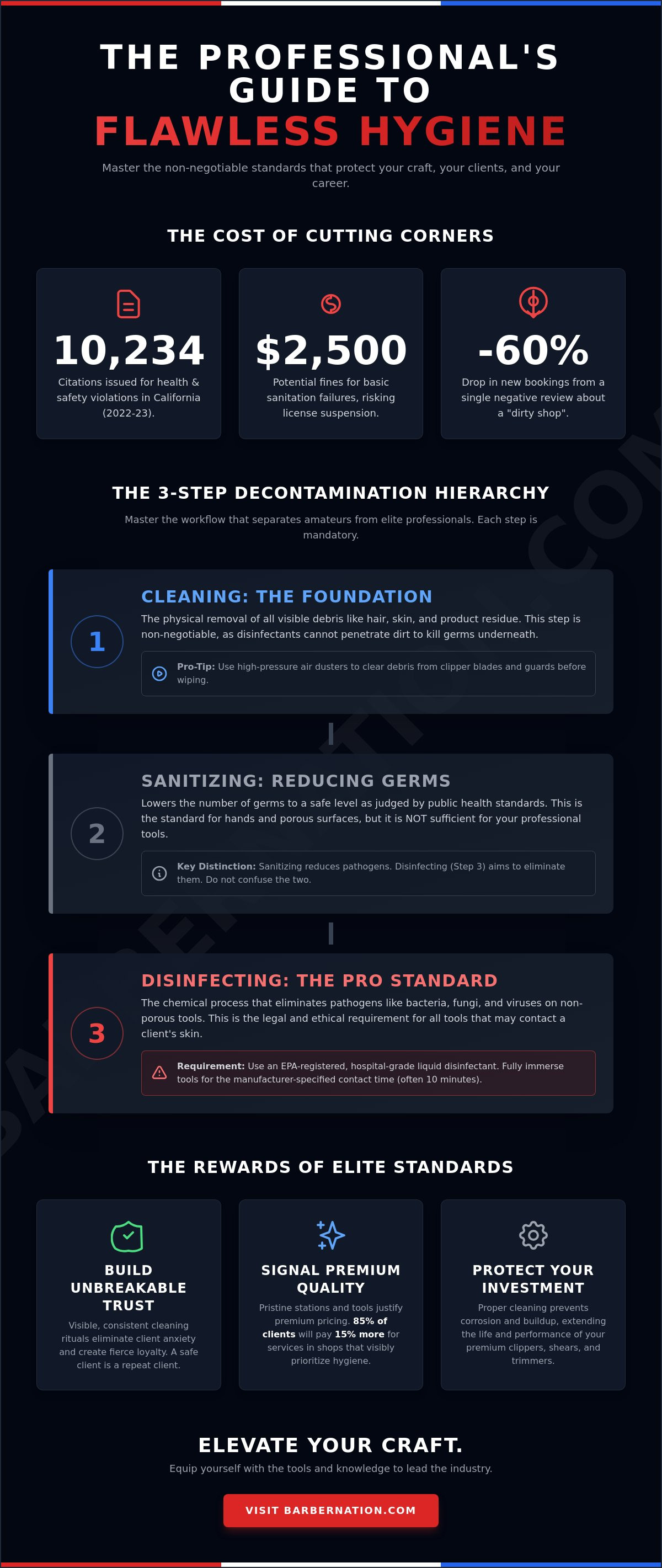
Your skill behind the chair builds your reputation, but a single health violation can dismantle it in seconds. The California Board of Barbering and Cosmetology issued 10,234 citations for health and safety violations in the 2022-2023 fiscal year alone. We know you take pride in every precision fade and beard sculpting session. You understand that maintaining a pristine station is non-negotiable for any serious professional. Still, the relentless pressure of back-to-back appointments often makes rigorous barber tool sanitation feel like a burden that slows down your hustle.
This guide provides the definitive protocols to protect your clients and pass inspections with total confidence. You'll master a streamlined workflow that preserves your high-performance equipment and elevates your professional prestige. We're breaking down the science of shop safety, including EPA-registered disinfectant requirements and the proper maintenance of premium clippers. This is your roadmap to elevate your craft, ensuring your tools last longer and your reputation remains untouchable. We'll show you how to blend elite standards with maximum efficiency.
Key Takeaways
- Master the essential hierarchy of hygiene by distinguishing between cleaning, sanitizing, and disinfecting to protect your clients and your career.
- Implement an efficient three-step workflow for barber tool sanitation that ensures your high-performance equipment remains pristine between every cut.
- Discover specialized maintenance protocols designed to prevent corrosion and preserve the precision of your premium carbon steel blades.
- Elevate your craft by aligning your shop standards with the latest legal requirements and ethical expectations for the modern grooming industry.
- Learn how to integrate professional hygiene into your brand identity to build trust and command prestige in a competitive market.
Why Barber Tool Sanitation is the Foundation of Your Craft
Every master knows that a sharp blade is only half the battle. True professional excellence begins long before the first clip. In 2026, barber tool sanitation represents the critical intersection where public health meets artistic mastery. It's not just about passing a random inspection; it's about protecting your legacy and your clients' well-being. State Boards across all 50 states have intensified their oversight, making hygiene a non-negotiable pillar of the craft that separates the hobbyist from the high-end professional.
Understanding the technical distinction between Cleaning vs. Sanitizing vs. Disinfecting is essential for any professional aiming for the top tier of the industry. The EPA sets the baseline for these chemical standards, ensuring that every solution you use effectively neutralizes threats before they touch a client's skin. By adhering to these national standards, you align your shop with a global community of experts who value precision and safety above all else.
To see these professional standards in action, watch this comprehensive tutorial on maintaining your equipment:
The Consequences of Cutting Corners
Ignoring hygiene protocols invites disaster. Pathogens like MRSA and Staph can thrive on uncleaned guards, while fungal infections can ruin a client's scalp and your career. In 2024, several high-profile shops faced license suspensions and fines reaching $2,500 due to basic sanitation failures. In a digital age where one negative review detailing a "dirty shop" can decrease new bookings by 60%, the cost of negligence is far higher than the price of disinfectant. Protecting your reputation means ensuring that every tool is pristine before it makes contact with a customer.
Sanitation as a Marketing Tool
Elevate your craft by turning your cleaning routine into a visible performance that reassures the client. When you use high-performance tools like the Barber Nation Turbojet Fadeblaster to clear debris, you signal a commitment to superior standards. Clients notice these details. A 2024 industry survey showed that 85% of premium clients are willing to pay a 15% markup for services in shops where hygiene is visibly prioritized. Use your barber tool sanitation protocol to build an exclusive brand that justifies your premium rates and fosters deep client loyalty.
- Build Trust: Visible cleaning rituals reduce client anxiety and increase retention.
- Signal Quality: High-end equipment and clean stations justify higher service prices.
- Ensure Longevity: Proper maintenance extends the life of your clippers, shears, and trimmers.
Understanding the Hierarchy: Cleaning vs. Sanitizing vs. Disinfecting
Mastering the craft requires more than a steady hand and an eye for detail. It demands a deep understanding of the science behind your station. True barber tool sanitation follows a strict hierarchy that separates the amateurs from the elite. You can't skip steps and expect professional results. Each level of decontamination serves a specific purpose in protecting your clients and your reputation.
Cleaning is the essential first step. This is the physical removal of hair, dust, and organic matter. If a clipper blade is clogged with skin cells or hair debris, the disinfectant won't reach the surface of the metal. Tools like the Barber Nation Turbojet Fadeblaster excel here, utilizing high-pressure air to clear debris before the liquid phase begins. Without thorough cleaning, the rest of your protocol fails.
Sanitizing and disinfecting are often confused, but they're not interchangeable. Sanitizing reduces the number of germs to a level deemed safe by public health standards, often used for hands or surfaces. Disinfecting is the professional requirement for non-porous tools. It involves using specialized chemicals to kill 99.9% of bacteria, viruses, and fungi. While sterilization using an autoclave at 250 degrees Fahrenheit is the gold standard in medical settings, high-level disinfection is the daily benchmark for excellence in the shop.
When to Clean vs. When to Disinfect
You must clean every tool before you attempt to disinfect it. Debris acts as a physical shield for pathogens, rendering chemicals ineffective. Professionals utilize The 3-Step System to ensure every non-porous tool is safe for the next client. Determine the risk based on the material. Non-porous items like shears, clippers, and guards must be fully disinfected. Porous items, such as neck strips or certain sponges, are single-use only and must be discarded immediately after contact. Don't be fooled by the myth of the "all-in-one" spray. Most disinfectants require a 10-minute contact time to work. If the tool dries in 30 seconds, you haven't achieved true disinfection.
EPA-Registered Disinfectants Explained
Your choice of chemical defines your shop's safety profile. Always look for an EPA-registered label that explicitly states the solution is bactericidal, virucidal, and fungicidal. Effective barber tool sanitation relies on this chemical precision. Mixing ratios are critical for concentrates. Using too much water makes the solution useless, while too little can corrode your high-performance equipment. For a standard 32-ounce jar, you typically need exactly 2 ounces of concentrate. Replace these solutions daily or as soon as the liquid becomes cloudy to maintain potency. Proper storage in a cool, dark area ensures your chemicals remain stable and ready to perform. To keep your station at peak performance, consider exploring our exclusive collection of maintenance tools designed for the modern professional.
The Professional Sanitation Workflow: The 3-Step System
Mastering your craft requires more than just technical precision with a blade. It demands a rigorous commitment to hygiene that protects both your clients and your reputation. True professional excellence is built on a systematic approach to barber tool sanitation that moves beyond surface-level cleaning. By implementing a high-performance three-step workflow, you ensure every service begins with equipment that meets the highest industry standards of safety and performance.
Step 1: The Power of Compressed Air in Sanitation
Relying on a simple nylon brush to clear hair from your clippers is a tactical error. Brushing is often 30% slower than using high-pressure air and frequently pushes micro-debris deeper into the motor housing. This creates a biological "load" that traps bacteria and compromises the effectiveness of your liquid disinfectants. You need to clear the internal components completely to maintain tool longevity.
The BarberNation Cordless Air Duster provides the concentrated force necessary to blast away stubborn hair and skin cells instantly. This rapid clearing phase is the foundation of effective barber tool sanitation. It removes the physical barriers that prevent sprays and dips from reaching the metal surfaces. Clean tools run cooler, stay sharper, and project a level of professional discipline that clients notice immediately.
Step 2 & 3: Immersion and Contact Time
Once debris is removed, the transition from cleaning to true disinfection begins. Surface cleaning with specialized detergents removes visible grime, but immersion is what eliminates pathogens. For combs, guards, and shears, use a dedicated disinfecting jar filled with hospital-grade solution. You must respect the "Wet Contact Time" specified by the manufacturer. Most professional solutions require a full 10-minute immersion to achieve their certified kill rate against viruses and fungi.
- Immersion: Submerge non-porous tools completely for the duration of the contact time.
- Rapid Disinfection: Use professional 5-in-1 sprays for clippers between back-to-back fades.
- The Reset: Always dry and lubricate your blades after disinfection to prevent oxidation and ensure smooth operation.
Maintaining a Sterile Station Environment
Your station is a reflection of your professional identity. A cluttered or dusty workspace undermines the trust you've built through your technical skill. Establish a strict protocol for wiping down chairs, mats, and countertops with EPA-registered disinfectants between every client. This prevents cross-contamination and maintains the exclusive atmosphere your brand represents.
Organization is a key component of safety. Separate your "dirty" tools from your "ready" tools using a logical left-to-right workflow. Integrating high-performance equipment from the Turbojet collections into your setup doesn't just improve your efficiency; it elevates the aesthetic of your entire shop. When your station is organized and sterile, you're free to focus entirely on the art of the cut.
Tool-Specific Sanitation and Maintenance Tips
Mastering the art of barber tool sanitation requires a nuanced approach that respects the delicate engineering of your equipment. High-end carbon steel blades and precision motors demand more than a simple spray; they require a rigorous maintenance schedule to prevent the oxidation that leads to rust and corrosion. A 2023 industry survey revealed that 40% of tool failures in professional shops result from improper cleaning habits rather than mechanical defects. By refining your process, you protect your financial investment and ensure every fade remains crisp and professional.
Clippers and Trimmers
Your clippers are the workhorses of your station, but hair buildup under the blade drive creates friction that destroys cordless motors. Remove the blade assembly weekly to clear out internal debris that traps heat. You must apply professional-grade oil after every single disinfection cycle to replace the lubricants stripped away by alcohol-based sprays. A blade wash is a deep-cleaning immersion fluid designed to flush out internal debris and provide lubrication in a single step. This 60-second dip keeps the motor running at peak RPMs and prevents the overheating that degrades lithium-ion battery life over time.
Shears and Straight Razors
Professional shears are precision instruments, and leaving them submerged in liquid disinfectant for longer than 10 minutes leads to irreversible pitting. This chemical reaction eats into the steel, ruining the edge and the balance of the tool. Always wipe your shears from the pivot point toward the tip with a soft, dry microfiber cloth after every use. For straight razors, safety is the priority. Dispose of used blades immediately in an OSHA-approved sharps container to prevent accidental injuries. Proper drying techniques ensure that your high-carbon steel edges stay razor-sharp for more than 50 cuts before requiring professional honing.
Hair Enhancement Tools
Modern barbering relies on hair enhancement tools like airbrushes and applicators, which require specialized care. To maintain the integrity of water-resistant products like Fade Fusion, flush your airbrush nozzle with 70% isopropyl alcohol after every application. This prevents the pigment from drying and clogging the fine 0.3mm needle. When cleaning stencils and guides, avoid harsh scrubbing that can warp their edges and degrade their shape. Use a gentle, lint-free cloth to preserve the precision of your lining work, ensuring your tools last for hundreds of applications.
To keep your station pristine and your tools clear of debris between every cut, elevate your craft with the Turbojet Fadeblaster.
Elevate Your Craft with BarberNation Professional Standards
Professionalism in the modern shop extends far beyond the precision of a fade or the sharp line of a beard sculpt. It lives in the invisible details of your workflow. High-end clients now expect a level of hygiene that mirrors medical-grade environments. Investing in tools that streamline barber tool sanitation isn't just a regulatory requirement; it's a strategic move to build trust and prestige. When you eliminate the friction of cleaning, you create more space for the art itself. BarberNation exists at the intersection where professional excellence meets exclusive quality, providing the hardware that turns mandatory maintenance into a seamless part of your signature service.
The Future of Barbering Hygiene
The days of using messy, shared neck brushes or bulky, tethered blowers are over. Elite professionals are transitioning to cordless, high-performance solutions that respect both the barber's time and the client's safety. Modern shops are adopting the Turbojet Fadeblaster to replace outdated methods. This technology uses concentrated air bursts to clear debris instantly, preventing the cross-contamination risks associated with traditional brushes. By integrating these 100,000 RPM motors into your daily routine, you join a community of innovators who prioritize speed without sacrificing safety. Efficiency is the hallmark of a master. A faster workflow means more chairs filled and a cleaner station that speaks volumes about your dedication to the craft.
Your Professional Journey Starts with the Right Tools
Every tool you place on your station reflects your commitment to the industry standard. BarberNation remains the partner of choice for top-tier barbers because we understand that durability and performance are non-negotiable. We don't just sell equipment; we provide the foundation for your growth. Transitioning your shop to a 2026-compliant environment requires a proactive approach to barber tool sanitation and tool organization. Use this final checklist to ensure your station meets the highest professional benchmarks:
- High-Velocity Air Dusters: Replace manual brushes with cordless air technology to eliminate hair clippings from clippers and capes instantly.
- EPA-Registered Disinfectants: Maintain a 10-minute immersion standard for all non-porous tools using fresh solution daily.
- UV-C Sterilization: Implement secondary light-based sanitizing for high-touch surfaces and sensitive equipment.
- Dedicated Maintenance Zones: Separate your clean and soiled tools clearly to prevent accidental contamination during busy shifts.
- Ergonomic Cordless Ecosystem: Utilize charging stands and high-performance batteries to keep your station clutter-free and professional.
Upgrade your shop environment today to reflect the elite status you've worked hard to achieve. Your professional journey is an evolution, and your tools should keep pace with your ambition. Choose quality that lasts. Choose innovation that protects. It's time to elevate your craft and set a new standard for excellence that the rest of the industry will follow.
Commit to the Highest Standard of Shop Safety
Mastering barber tool sanitation is more than a regulatory requirement; it's the signature of a master who respects the craft. By implementing the professional 3-step workflow, you ensure every fade and beard sculpt is performed with clinical precision. Transitioning from basic cleaning to hospital-grade disinfection protects your clients and preserves your high-performance equipment for years. Data from the Professional Beauty Association indicates that 85% of clients prioritize shop cleanliness when choosing a regular professional. You've built your reputation on excellence, so don't let a lapse in hygiene compromise your professional growth.
Elite professionals across all 50 states rely on superior technology to maintain these elite standards. Elevate your craft with the BarberNation Cordless Air Duster. This high-performance cordless tool was designed by barbers for barbers to clear debris instantly without the hassle of tangled cords. It's the same technology used by top-tier shops to keep their stations pristine between every appointment. Your journey toward professional mastery continues with every cut. Keep pushing the boundaries of what's possible in your shop and your career.
Frequently Asked Questions
How long do barber tools need to soak in disinfectant?
Most EPA-registered disinfectants require a full 10 minute immersion to achieve complete disinfection. This specific contact time ensures the solution neutralizes 100% of the pathogens listed on the manufacturer's label. Always set a timer for 10 minutes to maintain professional standards and avoid guesswork. Over-soaking for more than 30 minutes can damage the integrity of your high-performance blades. Consistency in your barber tool sanitation routine protects your clients and your reputation.
Can I use 70% isopropyl alcohol to sanitize my clippers?
You can use 70% isopropyl alcohol for quick surface sanitization, but it doesn't replace professional EPA-registered disinfectants. Alcohol evaporates quickly, often failing to meet the 10 minute contact time required for full sterilization. Use a dedicated 5-in-1 spray for your clippers instead. These professional sprays provide lubrication and cooling while killing 99.9% of germs. Alcohol alone can dry out your blades and lead to premature wear on your equipment.
How often should I change the liquid in my Barbicide jar?
Change your disinfectant solution every single day or immediately if the liquid becomes cloudy or contaminated. Professional standards require a fresh mix every 24 hours to ensure the chemical concentration remains effective against pathogens. If you notice hair or debris floating in the jar, dump it and refill it instantly. Maintaining a clear, blue solution shows your clients that you prioritize their health. This daily habit is a hallmark of where professional excellence meets exclusive quality.
Is a cordless air duster better than a neck duster brush for sanitation?
A cordless air duster is significantly more sanitary than a traditional neck duster because it never touches the client's skin. Neck duster brushes are notorious for harboring bacteria and are actually banned in 15 states including California and Texas. Using high-velocity air at 50,000 RPM removes hair clippings instantly without any risk of cross-contamination. Transitioning to air-based cleaning tools elevates your craft by adopting modern, hygienic technology. It’s a cleaner, faster way to work.
What is the difference between a bactericidal and a virucidal disinfectant?
Bactericidal disinfectants target and destroy 100% of specific bacteria like Staph, while virucidal solutions are engineered to deactivate viruses such as HIV-1 and Hepatitis B. For a shop to be legally compliant, your disinfectant must be bactericidal, virucidal, and fungicidal. Look for these three labels on your EPA-registered products to ensure total shop safety. Using a broad-spectrum solution protects your business from 20 or more common salon pathogens. It’s the foundation of professional barber tool sanitation.
Do I need to sanitize my clipper guards after every use?
You must sanitize every clipper guard after every single client to prevent the spread of skin infections. Guards collect skin cells and oils that can harbor fungal spores like Tinea Capitis. Scrub them with soap and water first, then submerge them in an EPA-registered disinfectant for 10 minutes. This two-step process is a non-negotiable part of your professional routine. Keeping 2 or 3 sets of guards allows you to rotate them between clients efficiently.
How do I prevent my shears from rusting after disinfection?
Prevent rust by drying your shears completely with a clean microfiber cloth immediately after the 10 minute soak. Moisture trapped in the pivot point is the primary cause of corrosion in 90% of professional shears. Apply 1 drop of premium blade oil to the screw area daily to create a protective moisture barrier. This simple step preserves the tension and sharpness of your high-performance tools. Proper care ensures your equipment lasts for years of precision cutting.
What are the most common sanitation mistakes that lead to state board fines?
The most frequent violations include hair found on "clean" tools and keeping dirty disinfectant in your jars. State board inspectors in New York and Florida often cite barbers for storing clean and used items together. Ensure all sanitized tools stay in a closed, labeled container to avoid a 500 dollar fine. Always remove hair from clippers before spraying them with disinfectant. These small details define your commitment to excellence and keep your professional license secure.