
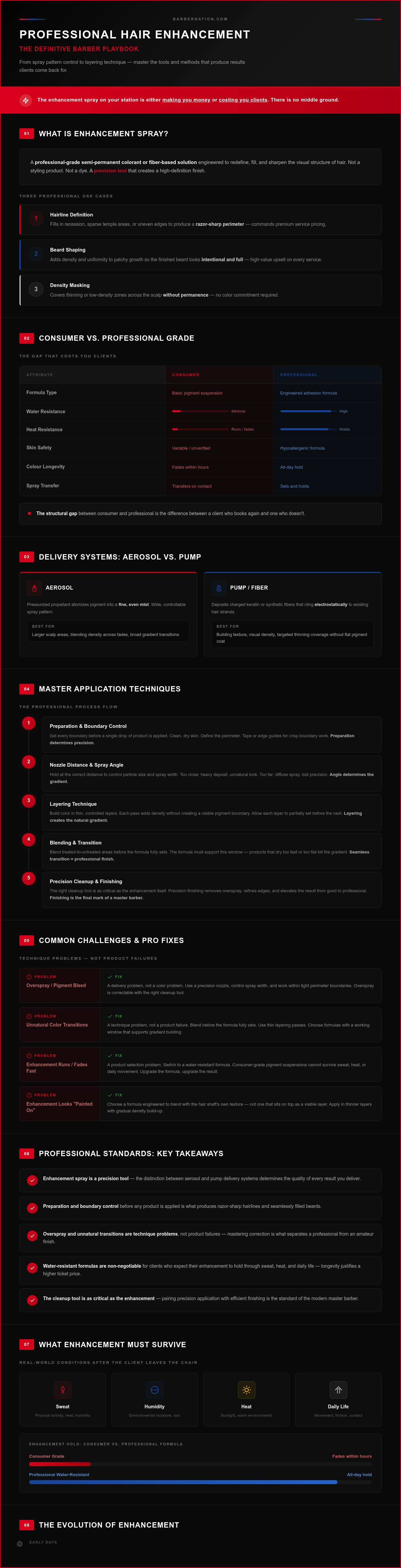
The enhancement spray sitting on your station is either making you money or costing you clients. There's no middle ground. Every professional knows the frustration: a beautifully executed fade, a crisp lineup, and then an enhancement that looks painted on, runs at the first sign of heat, or sprays unevenly across a fresh cut. The result? A client who doesn't come back.
You already know enhancement is part of the modern service menu. Clients expect it, and the best in the trade have learned to deliver it with the same precision they bring to every clipper stroke. The problem isn't the concept; it's the technique and the product behind it.
This guide gives you both. You'll master the technical application methods that produce razor-sharp hairlines and seamlessly filled beards, and you'll understand exactly what to look for in a professional-grade, water-resistant enhancement spray built to hold through sweat, heat, and real life. From spray pattern control to layering technique, what follows is the definitive professional playbook for enhancements that look natural, last longer, and justify a higher ticket price on every service.
Key Takeaways
- A professional-grade enhancement spray is a precision tool, not a cosmetic shortcut — understanding the difference between aerosol and pump-applied formulas determines the quality of every result you deliver.
- Razor-sharp hairlines and seamlessly filled beards depend on preparation and boundary control before a single drop of product is applied.
- Overspray and unnatural color transitions are solvable technique problems, not product failures — and mastering the correction process is what separates a professional finish from an amateur one.
- Water-resistant formulas like Fade Fusion are non-negotiable for clients who expect their enhancement to hold through sweat, heat, and daily life — longevity is what justifies a higher ticket price.
- The right cleanup tool is as critical as the enhancement itself — pairing precision application with efficient finishing is the standard of the modern master barber.
What is Enhancement Spray in Professional Barbering?
At its core, an enhancement spray is a professional-grade semi-permanent colorant or fiber-based solution engineered to redefine, fill, and sharpen the visual structure of hair. It's not a styling product. It's not a dye. It sits in its own category: a precision tool designed to create what the industry calls a high-definition finish, the kind of crisp hairline and seamlessly filled beard that photographs like a studio shot and holds through a full day of real life.
The professional application spans three distinct use cases. First, hairline definition: filling in recession, sparse temple areas, or uneven edges to produce a razor-sharp perimeter. Second, beard shaping: adding density and uniformity to patchy growth so the finished beard looks intentional and full. Third, density masking: covering thinning areas or low-density zones across the scalp without the permanence or commitment of a color treatment. Each use case commands a premium service price when executed with professional-grade product and technique.
The distinction between a consumer-level "black spray" and a professional water-resistant formula is not cosmetic. It's structural. Consumer products use basic pigment suspensions that transfer on contact, run under heat, and fade within hours. Professional formulas are engineered for adhesion, longevity, and skin compatibility. That gap in performance is the gap between a client who books again and one who doesn't.
The Evolution of the Enhancement Art Form
Enhancement began with eyebrow pencils repurposed for hairlines, a workaround that required constant touch-ups and delivered inconsistent results. The shift to aerosol and pump-delivery systems changed the standard entirely. Controlled spray patterns allow for gradient blending that pencils simply cannot replicate. Social media accelerated this shift by making the sharp-edge finish a recognizable benchmark of elite barbering. Clients arrive at the chair knowing exactly what they want because they've seen it online. Professionals who can't deliver it lose the booking to someone who can. Choosing professional-grade equipment over consumer alternatives isn't optional; it's the baseline for competing in the modern market.
Key Ingredients for Durability and Safety
A professional enhancement spray must clear two non-negotiable bars: it has to be safe for skin contact, and it has to last. Skin-safe pigments and hypoallergenic formulas protect clients with sensitive skin and reduce liability for the professional. Water-resistance is the gold standard because it determines whether the enhancement survives sweat, humidity, and movement, the real conditions every client walks into after leaving the chair. Fade Fusion leads in water-resistant technology by delivering a formula specifically engineered to maintain definition through those conditions, making it the professional's benchmark for enhancement spray performance.
The Anatomy of a High-Performance Hair Enhancement
Not all enhancement sprays are built the same, and the delivery system is where the difference starts. Aerosol sprays use pressurized propellant to atomize pigment into a fine, even mist, giving the professional a wide, controllable spray pattern ideal for covering larger scalp areas and blending density across a fade. Pump-applied enhancement fibers work differently: they deposit charged keratin or synthetic fibers that cling electrostatically to existing hair strands, building texture and visual density rather than laying a flat pigment coat. Each system has its place in a professional service menu, and knowing which tool fits which use case is the first mark of a trained hand.
The Fade Fusion approach addresses the core technical challenge: making synthetic pigment read as natural hair. The formula is engineered to blend with the hair shaft's own texture rather than sitting on top of it as a visible layer. The result is a gradient that transitions seamlessly from treated to untreated areas, which is precisely what separates a professional finish from a product that looks applied. Blending is a technique, but the formula has to support it. A product that dries too fast or too flat kills the gradient before the professional can build it.
Nozzle precision is non-negotiable. Overspray is the most common technical failure in enhancement work, and it's almost always a delivery problem, not a color problem. A professional-grade nozzle controls both particle size and spray width, allowing the barber to work within tight perimeter boundaries without bleeding pigment onto the skin or surrounding hair. Short, controlled bursts from a consistent distance, typically six to eight inches, give you the edge definition that clients photograph and share. Wide, sweeping passes don't.
Locking in the enhancement is the final step most professionals underestimate. A dedicated holding spray seals the pigment layer, reduces transfer onto collars and pillowcases, and extends wear from a single-day result to a multi-day hold. Apply it as a light finishing mist after the enhancement has fully dried. Two thin passes outperform one heavy coat every time.
Water-Resistance vs. Waterproof: What Barbers Need to Know
Water-resistance and waterproof are not interchangeable terms, and the distinction matters in a professional context. A waterproof claim means the product repels water entirely under any condition. Water-resistant means the formula maintains integrity through normal moisture exposure, including sweat, humidity, and light rain, without running, streaking, or fading. For an enhancement spray, water-resistance is the realistic and achievable standard. True waterproof formulas often require removal agents that are too harsh for daily scalp and skin contact.
Professional formulas achieve water-resistance by bonding to the hair shaft rather than resting on the skin's surface. This adhesion mechanism is what prevents the streaking you see with consumer-grade products when a client steps outside on a humid day or leaves the gym. The pigment becomes part of the hair's surface structure, not a film sitting on top of it.
Client education is part of the service. Before they leave the chair, tell them directly: wash the face gently with a damp cloth rather than running water directly over the hairline. When shampooing, work from the back of the scalp forward and avoid aggressive scrubbing at the temples and edges. A simple thirty-second conversation at the end of the service protects the result and protects your reputation.
Matching Tones for Natural-Looking Results
Shade selection is where technical skill meets artistic judgment. The goal is never an exact match to the client's hair color; it's a match to the shadow and depth within that color. For clients with Jet Black hair, a true black formula delivers the density and contrast the eye reads as natural fullness. For Dark Brown and lighter tones, layering is essential: start with a shade slightly lighter than the target and build depth in passes rather than committing to full saturation in one application.
Different skin undertones and hair textures also influence how a shade reads once applied. Coarser hair textures diffuse pigment differently than fine hair, often requiring a lighter initial application to avoid over-saturation at the hairline. The 'less is more' philosophy isn't a stylistic preference; it's a technical principle. Thin layers preserve texture and allow the natural hair to show through, which is exactly what creates the illusion of density rather than the appearance of coverage.
For maximum definition at the hairline and along beard edges, pairing an enhancement spray with a precision enhancement pencil gives you control at a level the spray alone can't reach. Use the spray to establish the density field, then use the pencil to draw individual hair strokes at the perimeter. The combination produces the kind of edge that holds up under close inspection and camera flash alike. Professionals who master both tools deliver a finish that clients genuinely can't get anywhere else, which is the strongest retention tool in the business. Explore BarberNation's professional product range to build the complete toolkit your enhancement services demand.
Master Techniques for Razor-Sharp Hairlines and Beards
Technique is where the professional separates from the amateur. Any barber can press a nozzle. Delivering a hairline that holds up under a phone camera and a client's daily life is a different skill entirely, one built on preparation, boundary control, and a finishing sequence that treats every step as non-negotiable.
Preparation starts before the product leaves the can. The skin must be free of oils, and the hair must be completely dry. Residual moisture or product buildup creates a barrier between the pigment and the hair shaft, which translates directly into uneven adhesion and premature fading. Wipe the hairline and beard perimeter with a clean, dry towel before you begin. This single habit eliminates a significant percentage of the application failures professionals blame on the product itself.
The Shield Method is the boundary control technique that defines professional-grade work. A card, stencil, or clean comb held firmly along the desired edge gives you a physical barrier against overspray. Hold it flush against the skin, not hovering above it. Any gap between the shield and the surface creates a soft, diffused edge where you need a hard line. The shield isn't a shortcut; it's the professional standard for perimeter precision.
Distance and pressure determine particle distribution. Maintain a consistent four to six inch gap between the nozzle and the target area. Too close and you're depositing a saturated pool of pigment that dries flat and opaque. Too far and the mist disperses before it reaches the hair shaft with enough concentration to build density. Short, controlled bursts at a consistent distance give you the layering control that produces a natural result.
The 'Double-Take' Finish is the step that closes the gap between good and exceptional. Once the enhancement spray has fully dried, take a straight razor to the perimeter and clean the edge with a single, deliberate stroke. This removes any soft bleed at the boundary and produces the razor-sharp definition that clients photograph. It's the professional's equivalent of a final edit, and it takes thirty seconds.
The Step-by-Step Enhancement Protocol
Execute this sequence on every client, every time:
- Step 1: Complete the primary cut and fade first. The enhancement builds on the foundation of the haircut, not the other way around. Establish the structure before you refine it.
- Step 2: Apply the enhancement spray in light, controlled bursts along the desired line. Build density in passes rather than committing to full saturation in a single application. Thin layers read as natural; heavy deposits read as applied.
- Step 3: Use the BarberNation Cordless Air Duster to clear away loose debris and clipped hair from the work area before and after application. A clean canvas prevents stray particles from embedding in the wet pigment layer and disrupting the finish.
- Step 4: Lock the result with a light finishing mist applied in two thin passes. One heavy coat traps moisture and extends dry time. Two light passes seal the pigment layer evenly and reduce transfer onto collars and pillowcases.
Beard Enhancements: Filling Patches and Defining Jawlines
Beard work demands a softer hand than hairline work. The cheek line is a gradient, not a hard boundary, and the application has to reflect that. Start your spray two inches above the natural cheek line and work downward in a fanning motion, letting the density increase as you approach the jaw. This gradient approach is what prevents the blocky, painted-on look that signals amateur application. The beard should appear to grow out of the skin, not sit on top of it.
Symmetry is checked from three angles: front-on, left profile, and right profile. Most asymmetry in beard enhancement work isn't visible from the front until the client turns their head. Build the habit of stepping back and checking both profiles before you lock the finish. What looks balanced straight-on often reveals a heavier deposit on one side when viewed from the side. Correct before you seal, not after.
Overcoming Common Challenges with Hair Enhancements
Every professional encounters the same set of problems. Overspray on the skin. A color that reads too dark under the shop lights. A nozzle that clogs mid-service. These aren't signs of failure; they're the technical friction points that separate professionals who've developed a correction protocol from those who haven't. The fix for each one is straightforward once you know it.
Overspray on the skin is the most common application error, and it's correctable without disturbing the line you've built. Don't reach for a wet towel. Moisture introduced to a partially dried enhancement spray will smear the pigment outward and soften the edge you're trying to protect. Instead, let the overspray dry completely, then use a clean, dry cotton swab or a soft-bristle detailing brush to lift the pigment from the skin surface with short, outward strokes. The dried pigment releases cleanly. The line stays intact.
The 'unnatural look' objection almost always traces back to a hard boundary where there should be a gradient. Feathering the color into the fade requires a deliberate transition zone. After your initial application, take a clean, dry brush and work the edge of the enhancement in the same direction as the fade's growth pattern. Short, flicking strokes pull the pigment into the surrounding hair rather than leaving it sitting as a defined block. The result reads as density, not coverage.
Clogged nozzles kill momentum in a fast-paced shop. After every service, invert the can and spray for two seconds to clear the valve. Store enhancement spray upright in a temperature-stable environment; heat causes propellant separation that accelerates clogging. A nozzle that's already blocked can often be cleared with a brief soak in warm water, then dried completely before reuse. Keeping a spare nozzle at the station isn't excessive; it's professional preparation.
Troubleshooting Color Mismatch
When the enhancement reads too dark against the client's skin tone, the correction isn't to start over. Use a clean, dry brush to diffuse the outer edges of the application, pulling the pigment into the surrounding hair to reduce the visual contrast at the perimeter. For clients with finer hair textures or lighter skin tones, a precision enhancement pencil gives you better control than a spray at the hairline boundary. The pencil lets you build individual strokes rather than a pigment field, which reads as natural growth rather than applied color. Evaluate the tool against the hair type before you begin, not after the spray is down.
Hygiene and Cleanup in a Fast-Paced Shop
Fine pigment mist settles on everything: your clippers, your chair, your station surface. Left unmanaged, it builds into a residue layer that transfers to the next client's neck and collar. The BarberNation Turbojet collection gives you a direct solution: a controlled air blast that clears settled mist and loose debris from tools and surfaces between clients without introducing moisture that could smear pigment residue. Stencils and application cards require a dedicated wipe-down with a barbicide-compatible solution after every use. Pigment buildup on a stencil edge degrades its precision on the next application, and a contaminated card is a sanitation liability. Clean tools deliver clean results. That standard applies to every instrument on your station, not just the ones that touch the client directly.
Build your correction and cleanup protocols with the same precision you bring to the cut itself. Explore the BarberNation Cordless Air Duster to keep your workspace at the professional standard every service demands.
Elevating Your Craft with BarberNation Professional Tools
The gap between a competent barber and a master is rarely talent. It's equipment. Every technique covered in this guide, from the Shield Method to gradient beard blending, depends on tools that perform at the same level as the professional wielding them. Consumer-grade products cap your ceiling. Professional-grade tools raise it.
Fade Fusion isn't positioned as a premium enhancement spray because of its packaging. It earns that position through engineering: a water-resistant formula that bonds to the hair shaft, maintains definition through real-world conditions, and delivers a finish that holds up long after the client walks out the door. That longevity is what converts a single service into a recurring booking. Clients who watch their enhancement hold through a full week don't shop around for another barber. They come back, and they tell people.
The Cordless Air Duster completes the professional picture. A flawless enhancement spray application on a station cluttered with loose clippings and settled pigment mist isn't flawless at all. Cleanup is part of the craft, not an afterthought. High-velocity air technology clears debris from tools, surfaces, and the client's neck without introducing moisture that could compromise a freshly sealed enhancement. The result is a workspace that operates at the same standard as the work being produced in it.
The BarberNation Precision Ecosystem
Fade Fusion and the BarberNation Cordless Air Duster are designed to work as a system: one lays a precision pigment finish, the other keeps the environment clean enough to protect it. Cordless technology matters in a high-volume shop where a trailing cable is a liability and a slow cleanup costs you time between clients. Built for the demands of a professional environment, BarberNation equipment delivers the kind of session-after-session reliability that professionals can't afford to gamble on. Explore the full BarberNation Turbojet collection to build out a station that performs at every stage of the service.
Joining a Global Community of Innovators
BarberNation isn't a product supplier that happens to serve barbers. It's a brand built from inside the trade, by professionals who understand what the chair demands and what clients expect. That foundation drives a commitment to equipping the next generation of master barbers with tools that keep them at the forefront of technique, trend, and technology.
The professionals who lead this industry don't wait for the standard to shift. They set it. Investing in the right tools isn't overhead; it's the clearest signal you can send about the level of work you deliver and the career you're building.
Precision in every cut, power in every tool.
Your Next-Level Enhancement Service Starts Here
Mastering enhancement spray isn't a single skill; it's a system. Preparation, boundary control, layering technique, and a professional-grade water-resistant formula all have to work together before a client sees the result that keeps them coming back. Cut any part of that system short and the finish suffers.
The professionals who consistently deliver razor-sharp hairlines and seamlessly filled beards share two habits: they invest in formulas engineered to hold through real-world conditions, and they treat cleanup and precision finishing as part of the craft, not an afterthought. Fade Fusion's water-resistant technology and the BarberNation Cordless Air Duster are trusted by master barbers nationwide precisely because they perform where it counts, session after session.
Your clients notice the difference between a finish that holds and one that doesn't. So does your booking rate. Upgrade your finishing game with BarberNation Professional Equipment and deliver the standard your skills deserve.
Precision in every cut, power in every tool.
Frequently Asked Questions About Enhancement Spray
Is hair enhancement spray safe for sensitive skin?
Professional-grade enhancement sprays formulated with hypoallergenic pigments are generally safe for sensitive skin, but not all formulas are equal. Consumer-level products often use harsher pigment suspensions that can irritate the scalp and hairline. When working with a client who has known sensitivities, apply a small amount behind the ear and allow it to sit for a few minutes before proceeding with the full service.
Skin compatibility is a baseline requirement for any professional formula, not a premium feature. Confirm that the product you're using is explicitly formulated for skin contact at the hairline and beard perimeter, not just for the hair shaft itself. If a client reports any irritation post-service, document it and adjust your formula selection accordingly.
How long does a professional hair enhancement last?
A professionally applied enhancement spray, sealed with a finishing mist, typically holds through several days of normal activity before requiring a touch-up. Longevity depends on three variables: formula quality, application technique, and how the client maintains it afterward. A water-resistant formula like Fade Fusion is engineered to outlast consumer alternatives by bonding to the hair shaft rather than sitting as a surface film.
Client behavior after the service matters. Aggressive scrubbing at the hairline during washing, heavy perspiration without a water-resistant formula underneath, and friction from hats or headwear all accelerate fade. The thirty-second aftercare conversation you have before the client leaves the chair is a direct investment in how long your work holds up.
Will the enhancement spray run if my client sweats or gets caught in the rain?
A professional water-resistant enhancement spray won't run under normal moisture exposure, including sweat and light rain, because the pigment bonds to the hair shaft rather than resting on the skin's surface. This is the core performance difference between a professional formula and a consumer product. Consumer-grade sprays use basic pigment suspensions that break down on contact with moisture, producing the streaking that damages a client's confidence and your reputation.
Can I use enhancement spray on a receding hairline?
Yes, and hairline definition is one of the three primary use cases for professional enhancement spray. Recession at the temples, sparse areas along the frontal hairline, and uneven edges all respond well to a controlled spray application. The key is working in thin, layered passes rather than attempting to build full density in a single application. Overly saturated deposits at the hairline read as coverage, not growth.
For clients with significant recession, pairing the spray with a precision enhancement pencil gives you the most natural result. Use the spray to establish the density field across the affected area, then use the pencil to draw individual hair strokes at the perimeter boundary. The combination creates a finish that reads as natural growth under close inspection, which is exactly what a client with hairline concerns needs to see.
What is the difference between hair fibers and enhancement spray?
Hair fibers are charged keratin or synthetic particles that cling electrostatically to existing hair strands, building visual density through texture. Enhancement spray delivers pigment in a controlled mist that coats the hair shaft and, in professional formulas, bonds to it. Fibers excel at adding bulk and fullness to thinning areas across the scalp. Enhancement spray delivers the precision edge definition and gradient blending that fibers can't replicate at tight perimeters.
In practice, they solve different problems. A client with diffuse thinning across the crown may benefit from fiber application. A client who wants a sharper hairline, a filled beard, or a seamless fade transition needs spray-applied pigment. Professionals who understand both tools can match the right solution to each client's specific concern rather than defaulting to one product for every situation.
How do I remove the enhancement if the client doesn't like it?
A professional water-resistant enhancement spray is designed to release cleanly with a standard shampoo wash. At the basin, apply shampoo directly to the enhanced area, work it in with gentle circular motion, and rinse thoroughly. Most professional formulas clear in a single wash without leaving residue or staining the scalp. Don't reach for harsh solvents or scrubbing tools; they're unnecessary and risk irritating the skin.
If a client wants partial removal or a lighter application mid-service, a clean, damp towel applied with light pressure can lift surface pigment before the formula fully bonds. Act quickly; once the enhancement has dried and sealed, a full shampoo is the most effective removal method. Addressing client concerns before you apply the finishing mist gives you the most flexibility to adjust.
Do I need an airbrush compressor to use enhancement products?
No. Professional enhancement sprays are self-contained aerosol or pump systems that don't require external compressor equipment. The nozzle precision built into a professional-grade can delivers the particle size and spray width control you need for edge definition and gradient blending without additional hardware. Airbrush systems exist in the enhancement space, but they represent a specialized setup that most barbers don't need for standard hairline and beard work.
What does matter is nozzle quality and technique. A professional-grade nozzle controls both spray width and particle distribution, which is what allows you to work within tight perimeter boundaries. Maintaining a consistent four to six inch distance from the target area and using short, controlled bursts gives you the layering precision that produces a natural result, no compressor required.
How much should I charge for an enhancement add-on service?
Pricing for enhancement add-ons varies by market, shop positioning, and the complexity of the service, so specific figures aren't something to pin down here. What's clear is that a professionally executed enhancement justifies a meaningful premium above the base cut price. Clients who understand the skill involved, the quality of the formula, and the longevity of the result don't resist the upcharge; they expect it.
The strongest pricing argument you have is the finish itself. A water-resistant formula that holds through a client's full week, combined with a razor-sharp hairline that photographs cleanly, communicates professional value without requiring a hard sell. Research what comparable services command in your market, factor in your product cost and application time, and price accordingly. Undercharging for a premium service undervalues both the skill and the tools behind it.
Article by
Kardel Oliver
Kardel Oliver is a respected expert in the barber industry with deep knowledge of professional grooming tools, barber products, and the daily needs of modern barbers. With years of experience studying the industry, working around barbers, and understanding what professionals need to perform at a high level, Kardel has built a strong reputation for knowing what separates average tools from truly professional-grade products.
Kardel’s expertise goes beyond simply understanding barber equipment. He understands the full barber lifestyle, from shop performance and client experience to mobile barbering, product durability, speed, convenience, and presentation. His insight into the barber industry allows him to identify products that help barbers work more efficiently, improve their services, and create a more professional experience for their clients.
Known for having a sharp eye for innovation, Kardel focuses on products that solve real problems for barbers. Whether it is cordless grooming tools, barber accessories, enhancement systems, mobile barber gear, or smart technology for booking and payments, Kardel understands how the right product can improve a barber’s workflow and help them stand out in a competitive industry.
Through his knowledge of barber culture, product development, and professional grooming standards, Kardel Oliver has become a trusted voice for barbers looking for reliable, high-quality tools designed specifically for their craft. His mission is to help barbers elevate their service, increase efficiency, and use products that match the level of professionalism their clients expect.