

Perceived hair density isn't determined by your follicle count; it's an optical illusion engineered through contrast, structural geometry, and light absorption. If you've ever watched a style collapse minutes after washing, or felt the frustration of heavy gels clumping your hair and exposing your scalp under bright overhead lights, you know the struggle firsthand. Receding temples and diffuse crown thinning can easily erode your confidence, but learning tested barber tricks to make hair look thicker instantly reclaims control over your silhouette.
You already know that piling on greasy pomades only worsens the problem by weighing fine strands down. That changes today. You will discover the exact cutting geometries, weight-line placements, and clean finishing tricks master barbers deploy to eliminate scalp contrast and maximize natural fullness. From blunt perimeter baselines to matte texture layering, here is your breakdown of the seven essential techniques that turn fine, lifeless hair into a commanding, dense style.
Key Takeaways
- Master structural haircut geometry by taking down the sides, instantly creating a visual weight contrast that makes the top look significantly denser.
- Discover the foundational barber tricks to make hair look thicker, beginning with blunt cutting techniques along the hairline to construct a crisp, solid baseline.
- Establish lasting root lift with a disciplined five-step thermal blow-drying protocol, locking the cuticle in place with a targeted cold shot.
- Ditch shiny, heavy pomades in favor of oil-absorbing matte clays and water-resistant hair enhancements that disguise visible scalp without clumping strands.
- Clear away loose micro-clippings using high-velocity cordless air tools prior to application so styling products bond seamlessly to clean hair fibers.
The Optical Illusion: How Barbers Create Density
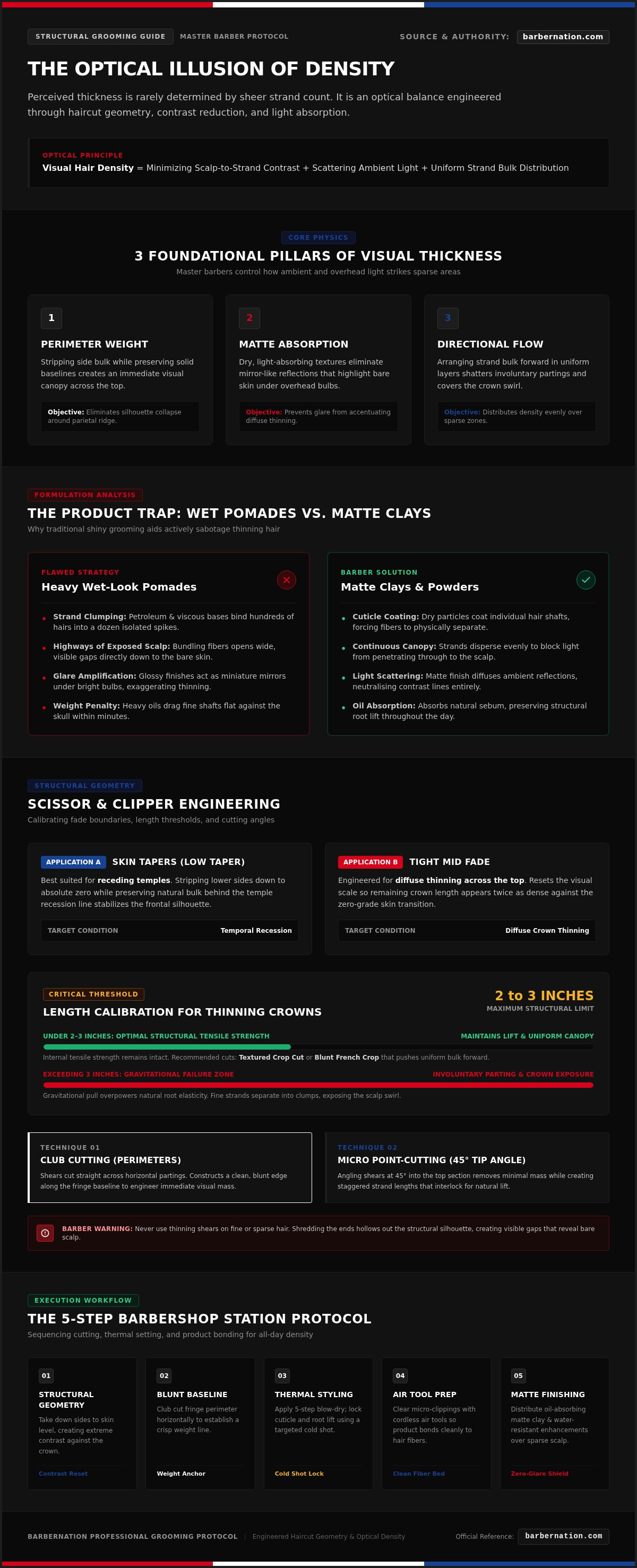
Visual thickness on the barbershop floor rarely comes down to sheer strand count. While clinical hair restoration focuses entirely on follicle density, mastering structural hairstyling techniques proves that density is an optical calculation. When ambient light strikes the head, your eye reads exposed surface area rather than counting individual hairs. Master barber tricks to make hair look thicker rely on controlling how light bounces off the scalp. By engineering three specific pillars; perimeter weight, a light-absorbing matte finish, and directional hair flow, a seasoned craftsman constructs an immediate visual shield across sparse areas.
Scalp Contrast vs. True Hair Density
Visual hair density is the optical perception of fullness achieved by minimizing scalp-to-strand contrast, scattering ambient light, and distributing strand bulk uniformly across the head. Overhead bulbs exaggerate diffuse thinning by bouncing directly off the pale surface beneath dark strands. When contrast spikes, the eye instinctively locks onto the scalp instead of the hairstyle. Reducing that disparity is the barber's primary objective. Taking down the sides or blending adjacent zones softens harsh contrast lines, which tricks the eye into registering a solid, continuous plane of hair.
The Problem with Heavy Wet-Look Pomades
Traditional petroleum-based pomades and high-shine gels sabotage fine hair instantly. These viscous formulas bind separate hair shafts together, grouping hundreds of individual fibers into a dozen greasy spikes. This clumping exposes wide highways of bare skin between the strands. Shiny finishes also act as miniature mirrors, amplifying glare and making mild crown thinning look severe.
Executing high-performance barber tricks to make hair look thicker requires replacing heavy grease with light-absorbing matte clays and texture powders. These dry formulas coat the cuticle, force strands to separate, and establish a dense, unified canopy. Take a look at your current styling shelf: if a product leaves a glossy residue on your palms or weighs down your comb, it is actively exposing your scalp.
Haircut Geometry: Cutting Tricks That Maximize Visual Weight
Every structural haircut relies on basic physics. Fine or thinning hair lacks internal tensile strength, which means excessive length quickly drags strands flat against the skull. Master barbers combat this collapse by reshaping the head silhouette through strict geometric angles. By intentionally stripping bulk from the parietal ridge down while preserving solid baselines across the top, the perimeter creates an instant illusion of mass. Understanding structural cutting geometry represents one of the most effective barber tricks to make hair look thicker without relying on artificial cover-ups.
Skin Tapers and Fades to Build Contrast
Blunt Perimeter Cutting vs. Over-Texturizing
Many inexperienced cutters reflexively reach for thinning shears when handling fine hair, which is a disastrous mistake. Shredding the ends hollows out the silhouette and leaves gaps that expose bare scalp. Instead, density demands precise club cutting along the fringe and perimeter baselines:
- Club cutting: Shears cut straight across horizontal partings to create a solid, blunt edge that builds immediate visual weight at the baseline.
- Micro point-cutting: Angling shear tips at 45 degrees into the top section removes minimal mass while creating varied strand lengths that lock together for natural lift.
Length Calibration for Thinning Crowns
Fine hair hits a critical tipping point once it exceeds two to three inches. Beyond this threshold, gravitational pull overpowers natural root elasticity. The hair separates, parts involuntarily, and exposes the swirl of the crown. Textured crop cuts and blunt French crops resolve this structural flaw by distributing mass forward across the thinning area in uniform layers. While exploring clinical options for long-term health, such as verified protocols for hair loss diagnosis and treatment, pairing disciplined geometry with modern barbering techniques delivers instant volume.
Dialing in precise scissor work across the crown prevents awkward whorl separation and keeps the visual canopy continuous. Upgrading your daily cutting tools through BarberNation gives you the shop-level control needed to execute these crisp lines with total confidence.
Thermal Styling: Barbershop Blow-Drying Secrets for Root Lift
Most men assume styling begins when the paste leaves the jar. In reality, thermal work accounts for fully 80% of your finished volume. Air-drying lets moisture pull delicate strands downward, locking the cuticle into a flat, lifeless drape across the scalp. Applying a concentrated heat source changes the game. By temporarily reforming the hair's internal hydrogen bonds, controlled thermal drying anchors the root into an upright position before any finishing paste touches your head. Executing this step with intention, supported by quality ionic tools from hair-care innovators like Ted Hilley International, is one of the most transformative barber tricks to make hair look thicker throughout an entire day.
Directional Root Manipulation Techniques
Lifting the root requires opposing the strand's natural growth pattern. Barbers call this directional over-direction. Work through this targeted five-step protocol to build a resilient structural foundation:
- Prep: Towel-dry gently until damp, avoiding aggressive friction that frays delicate cuticles.
- Pre-dry: Tilt the head slightly forward and blast medium airflow directly at the roots to kick-start initial lift.
- Directional tension: Anchor a vented skeleton brush at the base, drawing hair upward and opposite to its natural fall under directed heat.
- Nozzle precision: Attach a flat concentrator nozzle to focus the air path along the shaft, smoothing flyaways without flattening the base.
- Cold shot lock: Press the cold-shot trigger for five seconds per section to instantly cool the keratin and freeze structural volume in place.
Pre-Styling Sprays and Tonic Application
Never blow-dry completely bare hair. Fine strands require a lightweight scaffolding agent that grips the shaft without adding greasy weight. A light mist of sea salt spray or thermal tonic coats the hair fiber with specialized polymers. As water evaporates under the warm dryer airflow, these polymers crystallize, physically expanding the strand diameter and introducing subtle mechanical friction between individual hairs.
Distribute two or three light pumps evenly from mid-lengths to ends, staying off the scalp to prevent damp product accumulation. While clinical options like dermatologist-recommended treatments address underlying follicle thinning beneath the surface, combining pre-styling tonics with intentional heat management stands among the fastest barber tricks to make hair look thicker right out of the chair.
Product Formulation: Matte Textures and Water-Resistant Enhancements
Disciplined cutting geometry and directional blow-drying build the framework, but chemistry seals the finish. Converting flat, fine hair into a resilient style requires formulas that expand individual fibers rather than weigh them down. Applying oil-absorbing minerals and targeted scalp pigments represents one of the most effective barber tricks to make hair look thicker across demanding workdays.
Matte Pastes, Clays, and Volume Powders
High-performance barbering products rely on distinct mechanical properties to establish volume. Mineral-rich bentonite and kaolin clays absorb excess sebum at the root, neutralizing the greasy shine that highlights thinning patches. Micro-fine styling powders deliver a completely different structural advantage:
- Styling powders (silica silylate): Creates microscopic friction between individual hair shafts, forcing fine strands to grip and prop each other up for instant vertical lift.
- Matte clays and pastes: Provide flexible, pliable hold through the mid-lengths and ends without bonding adjacent fibers into sparse, see-through clusters.
Water-Resistant Hair Enhancement Application
When diffuse crown thinning or recessed temples leave obvious gaps, professional barbers deploy cosmetic enhancement solutions. These specialized formulas tint the pale skin beneath sparse patches, matching the client's natural follicle base and wiping out sharp scalp contrast. Because male pattern baldness affects roughly 50% of men over the age of 50, integrating cosmetic shading into standard grooming protocols has become an essential craft standard.
Modern shop formulations are water-resistant, resisting sweat, high humidity, and accidental transfer throughout the day. Barbers place a semi-rigid enhancement card against the hairline, applying the fine mist under controlled air pressure to establish a crisp, authentic gradient. Pairing clean station prep with proven water-resistant hair enhancement gives every client immediate density, and you can source professional shop solutions directly through BarberNation to upgrade your craft today.
Barber Precision Equipment: Clean Transitions and Station Workflow
Flawless execution requires a pristine canvas. Even the sharpest blunt perimeter or carefully graduated skin fade falls apart if stray clippings remain trapped across the scalp. Microscopic hair debris mingles with styling clays and enhancement sprays, producing muddy clumps that visibly expose sparse areas. Clean station hygiene and targeted air prep aren't mere shop courtesies; they are non-negotiable barber tricks to make hair look thicker by ensuring every styling product bonds purely to active follicles.
Air Duster Precision in Hairline Styling
Traditional neck dusters and coarse bristle brushes cause more harm than good on sensitive or thinning zones. Repeated friction irritates the epidermis, redistributes loose trimmings, and shifts hair out of its thermal alignment. Barbers now rely on high-velocity air streams to blast away loose debris without physical contact. Mastering clean edges becomes effortless when incorporating professional cordless air dusters into your station setup.
Deploying the BarberNation TurboJet air duster with charging stand delivers the high-velocity air needed to sweep away loose clippings between guards and prep hairline boundaries for enhancement. Clearing cut hair thoroughly off the scalp allows water-resistant enhancement sprays to adhere directly to the skin, creating an airtight, natural shadow that locks in edge sharpness.
Daily Client Maintenance Routine
Educating clients on proper home preservation protects your work long after they leave the chair. Keeping that visual mass intact involves three straightforward rules:
- Gentle evening care: Sleep on a smooth pillowcase and avoid rough, aggressive toweling to protect water-resistant enhancements and fragile root lift.
- Dry restyling: Reactivate morning volume with a light puff of texture powder rather than reapplying wet creams or dense pastes.
Transforming thin, flat hair into a commanding, dense silhouette relies on a complete system. Pairing disciplined cutting geometry with elite shop hardware defines the modern standard. When you combine proven barber tricks to make hair look thicker with purpose-built tools, you deliver the prestige, precision, and confidence your clients expect every single appointment.
Master the Illusion and Command the Chair
Thinning hair isn't a creative dead end; it's an engineering challenge waiting for the right hands. You don't need to promise miracles when you understand the mechanics of visual density. By stripping away perimeter bulk with sharp tapers, locking in root structure with directional airflow, and scattering overhead glare using matte clays, these proven barber tricks to make hair look thicker consistently turn flat profiles into commanding styles.
True artistry requires equipment that matches your ambition. Whether you're applying water-resistant enhancement solutions built to resist sweat and daily wear, or prepping the canvas with high-velocity air tools, professional hardware secures the finish. Every cut is an opportunity to demonstrate mastery and earn lasting client loyalty. Elevate your craft with professional equipment from BarberNation, engineered specifically for master barbers and high-volume styling precision, backed by free domestic shipping across the United States on all professional tools.
Frequently Asked Questions
Can a shorter haircut really make thinning hair look thicker?
Yes, cutting hair shorter removes excess downward weight that drags roots flat against the scalp. When fine hair grows past two inches, gravity forces strands to separate and reveal the skin beneath. Cropping the sides down to a tight fade or taper creates visual contrast, which immediately fools the eye into seeing the remaining top hair as substantially fuller and denser.
What styling product is best for men with thinning hair?
Lightweight matte clays, texturizing pastes, and styling powders work best because they build structure without reflecting light. Heavy gels and oil-based pomades cause strands to clump into greasy clusters that expose the scalp. Oil-absorbing formulas containing bentonite clay or silica silylate give fine follicles structural grip, creating separation and natural lift that stands among the most reliable barber tricks to make hair look thicker.
Are water-resistant hair enhancements safe for everyday use?
Yes, professional water-resistant hair enhancements are formulated specifically for routine skin contact without blocking active follicles. These cosmetic color solutions bond cleanly to the scalp surface and hair shafts, resisting sweat, humidity, and daily friction. They wash out completely with a standard gentle shampoo, allowing you to disguise temple gaps and crown thinning safely without causing buildup or irritation on sensitive skin.
How does a blow dryer help thin hair without causing heat damage?
Controlled blow-drying resets temporary hydrogen bonds at the root to lock in vertical lift before styling products touch the head. Keeping the dryer moving on medium heat with a concentrator nozzle protects the outer cuticle from thermal stress. Finishing each section with a quick cold-shot blast freezes that elevated shape firmly in place, securing maximum all-day volume without drying out delicate strands.
What is the biggest haircut mistake men make when their hair thins?
The biggest mistake is growing hair longer to conceal thinning areas. Long, wispy strands inevitably part and collapse, which exaggerates recession lines and bald patches under bright lighting. Asking a barber for excessive thinning-shear texture also wrecks the foundation by creating hollow gaps. Maintaining a disciplined crop with blunt perimeter baselines remains the gold standard for restoring visual mass. For men experiencing more pronounced hair loss where styling alone cannot provide full coverage, non-surgical hair replacement from providers like Thursday's Calabasas offers an effective, natural-looking restoration solution.
How long do professional barber hair enhancements usually last?
High-grade water-resistant enhancements generally last between two and four days depending on your skin type and daily activity. Formulas engineered for professional shop performance resist light perspiration, outdoor humidity, and normal sleep friction. To maximize longevity, avoid scrubbing the hairline aggressively in the shower and pat the area dry gently with a towel rather than rubbing vigorously.
Why do barbers prefer air dusters over traditional neck dusters?
Barbers prefer high-velocity cordless air dusters because they clear loose hair clippings instantly without skin friction or cross-contamination. Traditional bristle dusters irritate freshly shaved skin and leave micro-debris trapped across the scalp, which ruins product adhesion. Using targeted airflow creates a completely clean canvas for sharp hairline definition, making air tools one of the smartest modern barber tricks to make hair look thicker.
Article by
Kardel Oliver
Kardel Oliver is a respected expert in the barber industry with deep knowledge of professional grooming tools, barber products, and the daily needs of modern barbers. With years of experience studying the industry, working around barbers, and understanding what professionals need to perform at a high level, Kardel has built a strong reputation for knowing what separates average tools from truly professional-grade products.
Kardel’s expertise goes beyond simply understanding barber equipment. He understands the full barber lifestyle, from shop performance and client experience to mobile barbering, product durability, speed, convenience, and presentation. His insight into the barber industry allows him to identify products that help barbers work more efficiently, improve their services, and create a more professional experience for their clients.
Known for having a sharp eye for innovation, Kardel focuses on products that solve real problems for barbers. Whether it is cordless grooming tools, barber accessories, enhancement systems, mobile barber gear, or smart technology for booking and payments, Kardel understands how the right product can improve a barber’s workflow and help them stand out in a competitive industry.
Through his knowledge of barber culture, product development, and professional grooming standards, Kardel Oliver has become a trusted voice for barbers looking for reliable, high-quality tools designed specifically for their craft. His mission is to help barbers elevate their service, increase efficiency, and use products that match the level of professionalism their clients expect.