

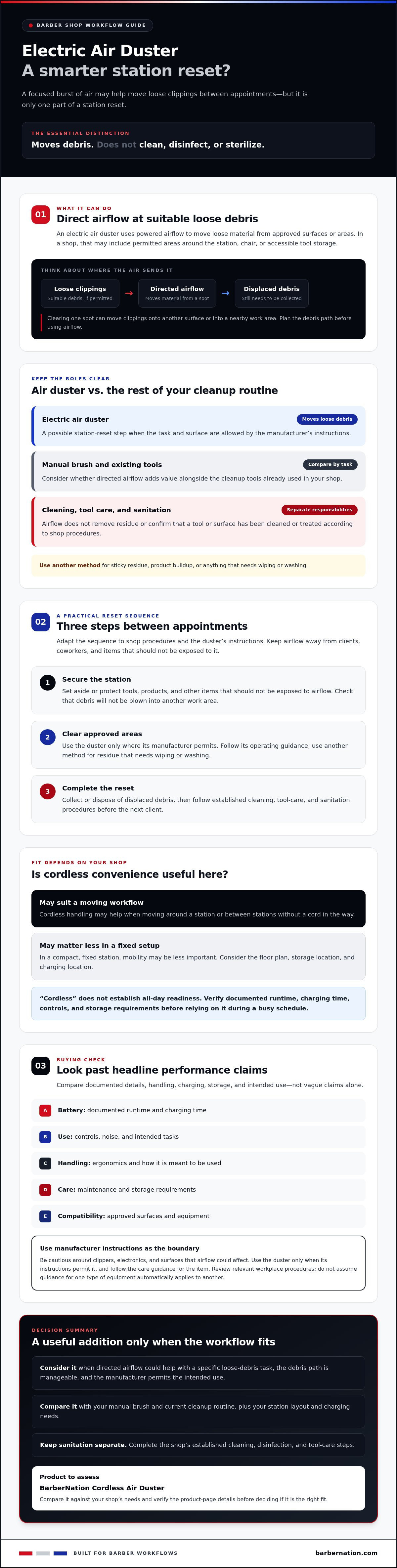
What if the fastest station reset isn’t another brush, but a focused burst of air? An electric air duster for barber shops can help move loose clippings from a client, cape, chair, or workstation between appointments, but it isn’t a sanitation tool. In a busy shop, every tool should support a specific part of the workflow.
If hair gathers around your station throughout the day, it’s worth asking whether an electric duster offers an advantage over the cleanup tools you already use. The answer depends on what you need to clear, how often you reset, where debris will go, and whether a cordless tool suits your station layout.
This 2026 buying guide explains where an electric air duster can fit into a station reset, what to check beyond headline performance claims, and how to assess battery life, controls, noise, ergonomics, and care instructions. You’ll also learn how to decide whether cordless convenience makes sense for your shop, while keeping air-based cleanup in its proper role: moving debris, not replacing cleaning and disinfection.
Key Takeaways
- Identify which station-cleanup tasks could benefit from directed airflow before adding another tool to your routine.
- Decide whether an electric air duster for barber shops suits your workflow by comparing its role with a manual brush and your shop’s cleanup procedures.
- Compare documented specifications, handling, charging, storage, and intended use instead of relying on vague performance claims.
- Check manufacturer instructions for safe use and compatibility with the surfaces and equipment you plan to clean.
- Assess the BarberNation Cordless Air Duster against your shop’s needs, then verify its product-page details before deciding if it’s the right fit.
What an Electric Air Duster Can Do at a Barber Shop
An electric air duster is a powered tool that directs a stream of air to move suitable loose debris from approved surfaces or areas. At a barber station, its role is limited to debris removal. It doesn’t wash away residue or disinfect equipment.
Clippings can gather around the station, beside the chair, and near tool storage over the course of a day. A consistent reset routine helps keep these areas orderly between appointments. An air duster may be one step in that routine, provided the intended task and surface are permitted by the manufacturer’s instructions.
Electric models use powered airflow rather than the propellant in a conventional can. For background on the traditional format and its electric alternatives, see Gas duster. For a barber, the useful question is not just how the air is produced, but where it can be used appropriately in the shop.
Which barber-station tasks may suit an electric air duster?
Look for places where loose hair or debris regularly gathers and where the product instructions permit airflow. This might include an approved section of the station, the chair area, or accessible parts of tool storage. Consider where the air will send the debris: clearing clippings from one spot may simply move them onto another surface or into a nearby work area.
Sort debris by type. Loose clippings may be suitable for removal with directed airflow. Sticky residue, product buildup, and material that needs wiping or washing call for a different method. Use the tool only for the tasks and surfaces its documentation supports.
What an air duster does not replace
Airflow alone isn’t cleaning, disinfecting, or sterilizing. It can move loose material, but it doesn’t confirm that a tool or surface has been cleaned or treated according to shop procedures. Don’t treat an air-based reset as a substitute for any required cleaning or disinfection step.
Be especially cautious with clippers, electronics, and surfaces that could be affected by airflow. Use the duster on them only if its manufacturer’s instructions permit it, and follow the care guidance for the item being cleaned. For anything that needs residue removed, use the appropriate cleaning method. Keep the distinction clear: an electric air duster for barber shops may support a station reset, while sanitation and tool care remain separate responsibilities.
How Electric Air Dusters Fit Into a Barber’s Station-Reset Workflow
A duster can be one part of a station reset, not the whole routine. Its practical value depends on where clippings collect, what the manufacturer permits, and how your shop handles cleanup between clients. Use a consistent sequence, then complete every established cleaning and sanitation step.
A practical cleanup sequence between appointments
Adapt this example to your shop procedures and the duster’s instructions. Keep directed airflow away from clients, coworkers, and items that shouldn’t be exposed to it.
- 1. Secure the station. Set aside or protect tools, products, and other items that shouldn’t be exposed to airflow. Check that loose debris won’t simply be blown into another work area.
- 2. Clear approved areas. Use the duster only on surfaces and in areas permitted by its manufacturer. Follow the product’s operating guidance, and use another method for residue that needs wiping or washing.
- 3. Complete the reset. Collect or dispose of displaced debris, then follow your shop’s established cleaning, tool-care, and sanitation procedures before the next client.
Compressed-air safety guidance may be relevant when evaluating air-based cleaning, but don’t assume a rule for one type of equipment automatically applies to another. Review the OSHA safety standards for compressed air alongside the duster’s own instructions and applicable workplace procedures.
Where cordless handling may help, and what to check
A cordless format may be convenient if your routine involves moving around a station or between stations without a cord in the way. In a compact, fixed setup, that mobility may matter less. Consider your floor plan, where the tool will be stored, and whether it can be returned to its charging location as part of the reset.
Don’t infer all-day readiness from the word “cordless.” Before relying on a tool during a busy schedule, verify its documented runtime, charging time, controls, and storage requirements. Check how it’s intended to be handled and maintained, too. These details can help you decide whether its setup fits your pace better than your current routine.
For a concrete option to assess, review the details for this cordless air duster with charging stand. Compare its listed specifications and instructions with your needs before deciding whether the format suits your station.
Electric Air Duster vs. Brush: Is It Worth Adding to Your Shop?
An electric duster isn’t essential for every barber. The right choice depends on the debris you need to move, how your station is arranged, and which cleanup method fits your routine. A manual brush may already work well; a powered tool may be worth considering if airflow suits a recurring task in your shop.
Compare tools by their intended use, not by broad performance claims. The table is a starting point. Check manufacturer guidance before using either option on a particular surface or tool.
| Consideration | Electric air duster | Manual brush |
|---|---|---|
| How it moves debris | Directs airflow toward suitable areas | Uses bristles and hand movement |
| Handling | Requires operating and storing a powered device | Requires keeping the brush accessible and handling it during cleanup |
| Best fit depends on | Approved tasks, product instructions, and shop layout | Brush design, task, and shop routine |
| Care to check | Charging, maintenance, and surface compatibility | Cleaning, storage, and manufacturer guidance |
When a powered duster may suit the shop
A powered option may make sense if your existing reset repeatedly involves moving suitable loose debris from areas where the product is approved for use. Consider how many stations you have, how they’re positioned, and whether one tool needs to move between them. A compact, fixed station and a multi-station floor plan can call for different setups. Neither guarantees a faster reset; the fit depends on your actual workflow.
Before adding an electric air duster for barber shops, name the specific task it would support. If you’re unsure, observe your usual station reset and note where powered airflow could be used as directed without disrupting other steps.
When a brush or another method may be enough
If a manual brush already suits the debris and surfaces you’re cleaning, adding a powered tool may offer little practical value. A brush can be a straightforward choice for tasks where its design and care instructions are appropriate. You might also use both tools for different jobs rather than treating one as a complete replacement for the other.
Keep surface cleanup separate from clipper maintenance and sanitation. A brush or duster doesn’t replace the care steps specified for clippers, other tools, or work surfaces. Before directing airflow toward electronics, delicate items, or equipment, confirm that the manufacturer permits it. Choose the method that fits the task, respects product guidance, and works with your shop’s established procedures.
How to Evaluate an Electric Air Duster for Professional Barber Use
Choose by verified fit, not by the boldest claim on a product listing. For an electric air duster for barber shops, compare what the manufacturer documents about operation, charging, care, and intended use. If a listing says “powerful” without explaining how the tool is measured or which tasks it’s designed for, treat that as a reason to investigate, not proof of suitability.
Specifications and instructions worth checking
Check the exact product listing and documentation. Compare like with like, and distinguish stated specifications from marketing language. Use this checklist to identify missing details before you buy:
- Airflow settings and controls: Are the settings described clearly, and can you tell how to operate the device?
- Runtime and charging: Are runtime and charging time stated, and do those details suit your planned use?
- Intended use and compatibility: Which surfaces or tasks does the maker approve? Are there limitations for tools, electronics, or delicate items?
- Care and storage: What maintenance does the manufacturer specify, and how should the device be stored?
- Noise and durability: Are these described in verifiable terms? If not, ask what product documentation supports the claims.
Don’t fill gaps with assumptions. If a specification or instruction isn’t available, mark it as unknown. This is especially important for the BarberNation Cordless Air Duster: confirm its current product-page details rather than assuming runtime, charging time, airflow settings, controls, noise level, or included accessories.
Fit the tool to the shop’s real routine
Specifications matter only if they address a real need. Consider the number of stations, available storage, access to charging, and who will handle and maintain the device. At a fixed station, cordless operation may not solve a recurring issue; in another layout, freedom from a cord could be useful. Assess your own setup rather than assuming every shop works the same way.
Before deciding, write down unanswered questions about operation, care, noise, or durability. Compare products using the same criteria, and ask the seller for product-specific clarification when details are missing. This keeps your decision grounded in documented information rather than guesswork.
Use the Turbojet air duster collection to review listed options and compare their current product details with your checklist.
Choosing a Barber-Shop Air Duster and Taking the Next Step
The right buying decision starts with your station, not a product headline. Name the cleanup task you want to address, confirm an air duster is approved for that use, and compare the details that matter to your shop. If the product’s instructions or specifications leave important questions unanswered, verify them before relying on it in your routine.
A quick shop-fit checklist before choosing
- Name the task: Identify where loose debris gathers and what you expect the duster to help clear.
- Check compatibility: Confirm that the exact product instructions allow use on the intended surface or area. Don’t assume a tool, electronic device, or delicate item is suitable for directed airflow.
- Review the setup: Check documented charging and runtime details, where the device and charger can be stored, and how it’s operated and cared for.
- Test the fit on paper: Consider who will handle the tool and how it fits your existing station-reset routine. If you can’t name a recurring task it supports, it may not be the right addition.
This checklist keeps the decision practical. An electric air duster for barber shops should match an identified need and the manufacturer’s guidance, not simply add another device to an already full station.
Review the BarberNation Cordless Air Duster
The BarberNation Cordless Air Duster is one option to assess against your checklist, not a guaranteed fit for every shop. Review its current product page for the specifications, instructions, and purchasing details available there. Confirm that its listed use matches your intended task and that the charging and storage setup works for your station.
If runtime, charging time, airflow settings, controls, noise level, accessories, or care instructions aren’t clearly documented, don’t fill in the gaps with assumptions. Contact the seller for product-specific clarification before making your decision. Do the same for surface compatibility and any safety or maintenance directions. These details are part of assessing whether a tool fits your professional routine.
Take one practical next step: write down the task, the specifications you need, and any unanswered questions, then compare that list with the current product information. If the details align with your workflow, consider whether this cordless option belongs at your station. A deliberate choice supports a considered tool setup while leaving your established cleaning and sanitation procedures intact.
Choose the Tool That Fits Your Shop
The right electric air duster for barber shops should support a specific cleanup task, suit your station layout, and match the manufacturer’s instructions. Compare documented details such as runtime, charging, controls, and approved uses rather than relying on broad performance claims. Keep the distinction clear: airflow can help move suitable loose debris, but it doesn’t replace cleaning, tool care, or sanitation procedures.
A powered duster isn’t necessary for every barber. If your current brush and cleanup routine already fit the work, there may be no reason to add another device. If cordless handling could address a recurring need, check the product details and make sure the setup works for your shop.
BarberNation specializes in professional barbering equipment and sells a cordless air duster. Review the available information and assess whether it aligns with your workflow: Explore the BarberNation Cordless Air Duster.
Make a deliberate choice, keep your station standards consistent, and continue refining the tools that support your craft.
Frequently Asked Questions
What is an electric air duster used for in a barber shop?
An electric air duster directs powered airflow to move suitable loose debris from areas where its manufacturer permits use. In a barber shop, that may include approved parts of a station or chair area where clippings collect. Check where the airflow will send debris, and use another method for residue that needs wiping or washing. It can support a cleanup routine, but doesn’t replace cleaning or sanitation procedures.
Can an electric air duster replace a barber brush?
Not necessarily. An electric duster and a manual brush handle debris differently, and the better choice depends on the task, handling preferences, and product instructions. A brush may already suit your routine, while airflow may be useful for other approved cleanup tasks. Some barbers may choose to use both. Compare how each tool fits your station and care procedures rather than assuming one automatically replaces the other.
Is an electric air duster safe to use around barber clippers?
Only use airflow around clippers if the duster’s instructions and the clipper manufacturer’s care guidance permit it. Don’t assume every clipper or opening is suitable for directed air. Follow the specified maintenance process for removing hair and caring for the device, and keep that separate from any required cleaning or disinfection. If either manufacturer’s guidance is unclear, verify compatibility before use.
How do I choose an electric air duster for my barber shop?
Start by naming the cleanup task and identifying where it occurs. Then check the exact product’s approved uses, airflow settings, controls, runtime, charging time, storage needs, and care instructions. Compare documented specifications on a like-for-like basis, not vague claims such as “powerful.” Consider your station layout and who will handle the device. For the BarberNation Cordless Air Duster, consult its current product page for verified details.
Can a cordless air duster be used between barber appointments?
A cordless air duster may fit between-appointment resets if its approved uses match the task and its charging setup works for your shop. Check the documented runtime and charging time before relying on it during a busy schedule. Consider where it will be stored and whether barbers can access it easily. Use it only as directed, then complete the shop’s established cleaning and sanitation steps before the next client.
Does an electric air duster clean or disinfect barber tools?
No. An electric air duster moves loose debris; airflow alone doesn’t clean, disinfect, or sterilize barber tools. Use the cleaning and disinfection methods specified by your shop procedures and applicable guidance, and follow each tool’s care instructions. Don’t treat a quick blast of air as a substitute for removing residue or completing required sanitation steps. Keep debris removal and disinfection as distinct parts of the station routine.
Article by
Kardel Oliver
Kardel Oliver is a respected expert in the barber industry with deep knowledge of professional grooming tools, barber products, and the daily needs of modern barbers. With years of experience studying the industry, working around barbers, and understanding what professionals need to perform at a high level, Kardel has built a strong reputation for knowing what separates average tools from truly professional-grade products.
Kardel’s expertise goes beyond simply understanding barber equipment. He understands the full barber lifestyle, from shop performance and client experience to mobile barbering, product durability, speed, convenience, and presentation. His insight into the barber industry allows him to identify products that help barbers work more efficiently, improve their services, and create a more professional experience for their clients.
Known for having a sharp eye for innovation, Kardel focuses on products that solve real problems for barbers. Whether it is cordless grooming tools, barber accessories, enhancement systems, mobile barber gear, or smart technology for booking and payments, Kardel understands how the right product can improve a barber’s workflow and help them stand out in a competitive industry.
Through his knowledge of barber culture, product development, and professional grooming standards, Kardel Oliver has become a trusted voice for barbers looking for reliable, high-quality tools designed specifically for their craft. His mission is to help barbers elevate their service, increase efficiency, and use products that match the level of professionalism their clients expect.