

Your clippers aren't just plastic and steel; they're the high-performance engines that drive your craft and define your reputation. Mastering how to deep clean barber clippers is the definitive boundary between a routine service and an elevated art form. You've likely felt the heat of a dragging motor, the frustration of snagging blades, or the limitations of manual brushes that can't reach deep internal crevices. These aren't just minor technical inconveniences. They're obstacles to your professional growth and the precision your clients expect.
This master's checklist transforms your daily maintenance into a sophisticated mechanical ritual. You'll learn to eliminate debris, optimize motor efficiency, and maintain the sharpest possible cutting edge. We'll outline a standardized protocol that meets 2026 regulations while ensuring your tools run cooler and last longer. By integrating professional solutions like the BarberNation Cordless Air Duster, you'll achieve a level of internal cleanliness that protects your investment and impresses every high-end client who sits in your chair. It's time to equip your talent with the superior caliber of care it deserves.
Key Takeaways
- Elevate your craft by shifting from basic surface brushing to a total mechanical restoration that justifies premium service rates.
- Assemble the non-negotiable toolkit, including high-velocity air solutions and precision lubricants, to ensure your equipment operates at peak efficiency.
- Follow a structured step-by-step protocol on how to deep clean barber clippers, from safe blade disassembly to purging internal hair nests from the motor.
- Overcome the fear of reassembly by mastering precise blade alignment and understanding the technical nuances of the zero-gap technique.
- Transform your professional reputation by adopting innovative maintenance tools like the BarberNation Cordless Air Duster to signal expertise to your elite clientele.
The Master’s Standard: Why Deep Cleaning Clippers is a Professional Necessity
For the elite practitioner, a clipper isn't just a tool; it's a precision instrument. Deep cleaning goes far beyond a quick brush between fades. It represents a total mechanical restoration of the tool's internal systems. While amateur advice often suggests waiting until your blades pull or the motor gets loud, the master barber understands that proactive maintenance is the foundation of surgical precision. Learning how to deep clean barber clippers ensures your equipment remains as sharp and reliable as your reputation.
To visualize the internal complexity of these machines, it's helpful to understand the various hair clipper components that work in unison. Every hair fragment left inside the housing acts as a micro-abrasive. Over time, these tiny particles grind down expensive blade steel and force the motor to work twice as hard. This friction generates heat, which isn't just uncomfortable for the client; it's a sign of a tool in distress. Your tools reflect your respect for the craft, and a neglected clipper is a silent admission of low standards.
To better understand the concept of total mechanical restoration, watch this helpful video:
Sanitation vs. Mechanical Maintenance
Don't confuse a quick spray of coolant with a professional deep clean. Spray-on disinfectants are essential for surface hygiene, but they don't reach the "nest" of hair trapped deep within the motor housing. Internal debris causes motor drag, which directly impacts the fluidity of your cutting stroke. A clean-running motor delivers the consistent power needed for the blurry, seamless fades that allow you to charge premium rates. Surface disinfection keeps things safe, but mechanical maintenance keeps things precise.
The Psychological Impact on the Client
Your chair is a stage, and your maintenance ritual is part of the performance. When a client sees you meticulously care for your gear, they immediately recognize your respect for the trade. Professional tool care is the foundation of client safety. Utilizing modern technology, such as the BarberNation Cordless Air Duster, signals to your audience that you are an innovator who values both hygiene and high performance. Pristine tools create an exclusive service environment where clients feel confident paying for your expertise rather than just a routine cut.
The Deep Cleaning Toolkit: Essential Supplies for Precision Maintenance
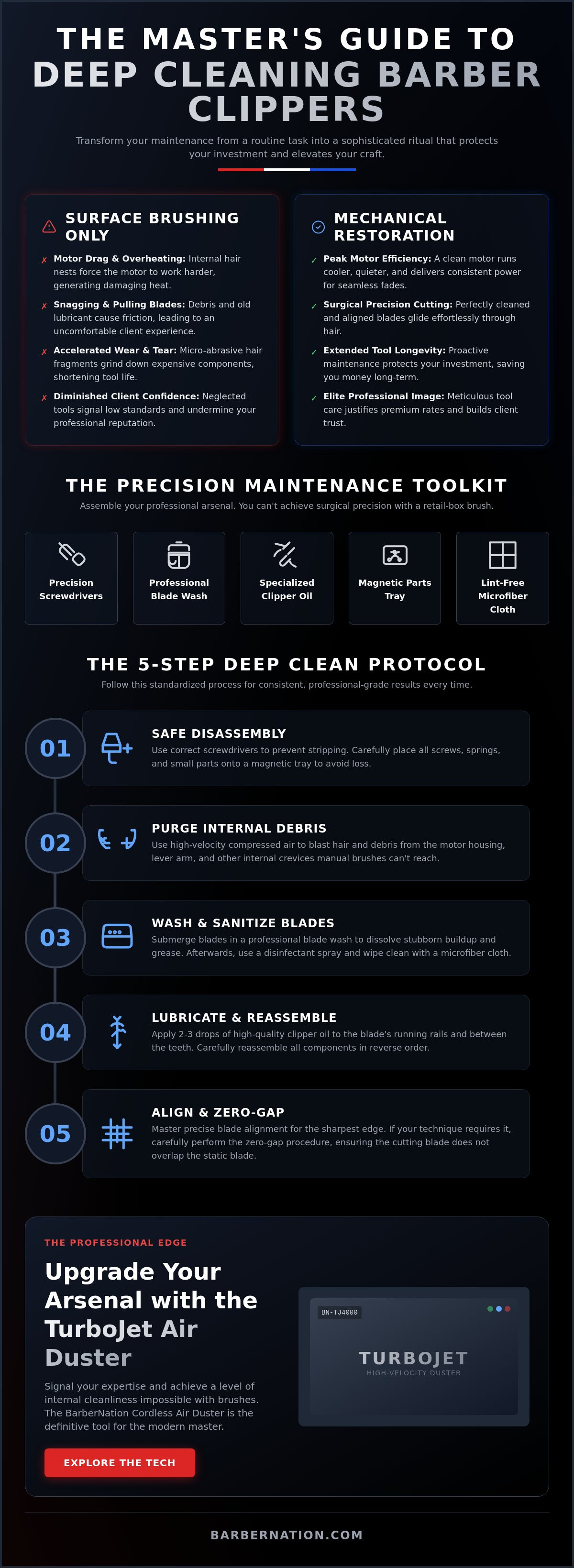
Understanding how to deep clean barber clippers starts with assembling a professional arsenal. You can't achieve surgical precision with the flimsy plastic brush found in a retail box. True maintenance requires a dedicated set of tools designed to protect your investment and ensure your blades glide through hair without resistance. Your arsenal defines your outcome. Before you begin, gather these essentials:
- Precision Screwdrivers: High-quality drivers that fit your specific clipper housing perfectly to prevent stripped screw heads.
- Professional Blade Wash: A targeted solvent formulated to strip away factory grease and stubborn hair product buildup.
- Specialized Clipper Oil: A low-viscosity lubricant designed specifically for high-speed oscillating parts.
- Magnetic Tray: A secure spot to hold small screws and tension springs during the disassembly process.
- Microfiber Cloths: Lint-free protection for wiping down delicate steel blade edges without leaving residue.
Using a magnetic tray is a simple habit that prevents the frustration of lost components and costly downtime. For wiping down surfaces, ditch the abrasive paper towels. Microfiber cloths are the superior choice because they provide a soft barrier that protects the integrity of your steel blades while ensuring a pristine finish. Every piece of equipment in your kit should serve the goal of mechanical perfection.
The Role of High-Velocity Air Tools
Traditional brushing is often counterproductive. It tends to push microscopic hair dust and skin cells deeper into the mechanical crevices of the housing. The modern standard for clearing internal housing is the BarberNation Cordless Air Duster. This device is a complete game-changer for speed and efficiency. With a powerful 100,000 RPM airflow, it blasts away the internal "nest" of debris that causes motor overheating. By clearing these ventilation paths, you ensure your motor runs cooler and maintains its peak torque throughout the day. Investing in high-velocity cleaning technology is the fastest way to upgrade your maintenance ritual.
Chemicals and Lubricants
Once the physical debris is cleared, you must address the chemical buildup. Blade wash is specifically formulated to strip away old factory grease and accumulated gunk that water alone won't touch. This step is critical before re-lubricating the assembly. When it's time to oil, never reach for household alternatives. Professional clipper oil has a specific viscosity designed to endure the high speed and heat of your tools. Maintaining professional sanitary standards isn't just about tool longevity; it's a legal and ethical requirement. Your final step should always involve an EPA-registered disinfectant to ensure every surface is safe. This combination of mechanical purging and chemical sanitation is what defines the master's approach to how to deep clean barber clippers.
The Step-by-Step Deep Clean Protocol: From Blade Removal to Motor Care
Executing a total mechanical restoration requires more than just effort; it requires a systematic approach. Many professionals mistake a quick wipe for a deep clean, but the truth lives inside the housing. Mastering how to deep clean barber clippers involves a five-step protocol that ensures every component functions at its peak performance. This ritual protects your investment and guarantees the surgical precision your clients expect.
- Step 1: Blade Separation. Safely remove the blade screws and separate the cutting and still blades to expose the hidden friction points where hair and old grease create a grinding paste.
- Step 2: Internal Purge. Use high-velocity air to purge the internal "nest" of hair from the motor housing. This is the stage where you prevent permanent motor damage and overheating.
- Step 3: Chemical Immersion. Submerge the blades in a professional wash to dissolve organic buildup and stubborn factory grease.
- Step 4: Internal Detailing. Wipe down the internal housing and cam follower with a lint-free cloth to remove any remaining residue.
- Step 5: Precision Lubrication. Apply a 5-point oiling technique before reassembly to restore fluid movement and reduce friction-based heat.
Clearing the Internal Housing
When you open the housing, you'll likely find a dense accumulation of hair dust that standard brushes simply can't reach. Use your TurboJet air duster to clear this debris, but technique matters. Angle the nozzle toward the open edges to blow hair out of the device rather than forcing it deeper into the motor assembly or battery compartment. There's a profound professional satisfaction in seeing a pristine, hair-free motor for the first time. This is also your opportunity to inspect the internal health of your tool. Look for signs of wear, such as a worn cam follower or loose wires, which signal that a part replacement is necessary to maintain your high standards.
The Blade Wash Ritual
Once the motor is clear, turn your attention to the blades. Use the "running dip" technique by briefly submerging the tips of the moving blades in wash while the clipper is running to flush out hidden debris. After the bath, the drying process is non-negotiable. Use a clean microfiber cloth to remove every trace of moisture, as high-carbon steel is highly susceptible to oxidation and rust. Take this moment to inspect the blade teeth for chips or dullness. A single chipped tooth can snag hair and ruin a client's experience. By following this meticulous ritual, you ensure that your tools remain sharp, your motor stays cool, and your reputation for excellence remains unchallenged.
Beyond the Surface: Mechanical Maintenance and Blade Alignment
Reassembling your tools is often the most intimidating part of the process. The fear of ruining a perfect factory alignment keeps many professionals from ever opening their housing. However, the master understands that true performance requires more than just a surface wipe. By mastering how to deep clean barber clippers, you gain the confidence to inspect the internal mechanical health of your equipment. This is where you address the hidden fatigue in cam followers and tension springs that eventually lead to loud, vibrating machines and inconsistent cutting power.
A labored motor is a direct result of internal friction. When hair debris accumulates, it creates an electrical load that forces your battery to drain faster and your motor to run hotter. Deep cleaning relieves this stress, restoring the tool's original torque. While the housing is open, inspect the cam follower for signs of rounding or wear. If this component is fatigued, your blades won't travel their full distance, regardless of how clean they are. Professional maintenance isn't just about hygiene; it's about mechanical integrity.
The Precision Alignment Framework
Alignment isn't a guess. It's a calculation. To prevent the moving blade from "biting" or nicking the client, ensure it sits slightly below the stationary blade. A safe margin is typically 1/32 to 1/16 of an inch. Perform a visual check by looking down the side of the clipper to confirm the blades are perfectly parallel. When you're ready to secure the assembly, tighten the screws in an alternating pattern. This technique, much like tightening the lugs on a high-performance wheel, ensures even tension across the blade bed and prevents the alignment from shifting as you apply final torque.
The "Zero-Gap" technique is a popular choice for achieving surgical lines, but it requires extreme caution. If you set the moving blade flush with the stationary edge, you risk cutting the client's skin. Only use an aggressive gap for detailers and trimmers used on specific hair types. For your primary bulk-thinning clippers, a standard safety gap is always the superior choice for professional reliability.
Lubrication Mastery
Precision lubrication ensures fluid motion. When it comes to clipper oil, more is not better. Excess oil acts as a magnet for hair dust, quickly creating the very "grinding paste" you just worked to remove. Apply the 5-point oiling technique for maximum efficiency: three drops across the teeth and two drops on the rear rails where the blades meet the housing. Some industry professionals report that proper lubrication can reduce friction-based heat by up to 30%, which significantly extends the life of your motor. Before you finalize your reassembly, ensure the internal housing is completely purged of debris. Equip your station with the BarberNation TurboJet to guarantee a hair-free environment for your mechanical components.
Mastering the Art of First Impressions: The Professional Edge
Your station is your brand. Your tools are your reputation. Your ritual is your signature. Mastering how to deep clean barber clippers isn't just a technical requirement; it's the ultimate marketing tool. When a client sees a workstation that is immaculate, organized, and equipped with high-performance technology, they aren't just buying a haircut. They're investing in your expertise. A dust-free environment speaks a visual language of excellence that builds immediate trust and justifies the premium rates you command. Every minute spent on mechanical restoration is an investment in the longevity of your career.
Technical maintenance serves as the silent foundation of your professional identity. While competitors might wait for their equipment to fail, the master barber operates with proactive discipline. By following a standardized protocol, you eliminate the variables that lead to snagging blades or overheating motors. This consistency ensures that every client receives the same surgical precision, regardless of how many fades you've performed that day. Your commitment to these high standards separates the hobbyist from the industry leader.
The Tech-Forward Barber Brand
Modern equipment increases your speed without sacrificing the quality of your craft. Utilizing innovative tools like the BarberNation Duster signals to your clientele that you are a relentless innovator who respects the trade. Don't hide your standards. Subtly mention your sanitation and maintenance protocols during the service. Explain how your deep-cleaning ritual ensures their safety and the precision of their style. This transparency transforms a routine service into an exclusive, high-end experience that clients are eager to recommend. To maintain this edge, create a rigid maintenance schedule. Staying ahead of equipment failure is the only way to guarantee peak performance in a high-volume environment.
Your Career as a Continuous Progression
View your cleaning checklist as a tool for personal discipline and master-level craft. It's a daily commitment to the details that others overlook. When you master how to deep clean barber clippers, you aren't just maintaining steel and plastic; you're maintaining the caliber of your artistry. Elevate your environment by treating every piece of gear with the respect it deserves. Your professional growth depends on the synergy between your talent and your technology. Take pride in the mechanical health of your station and watch as your reputation follows suit. Elevate your environment. Refine your ritual. Secure your legacy. Your skill is the engine, but your tools are the fuel.
Elevate Your Craft with Mechanical Excellence
Mastering how to deep clean barber clippers is the definitive shift from being a service provider to becoming a master of the trade. You now possess the framework for total mechanical restoration. This ensures your tools run cooler and your fades stay sharper. By implementing this standardized protocol, you protect your investment; you ensure motor longevity; you project an image of absolute professional authority. This ritual is the boundary between a routine service and an elevated art form.
Precision starts with the right equipment. Upgrade your tool maintenance with the BarberNation TurboJet FadeBlaster to experience the power of 100,000 RPM high-velocity airflow. Trusted by elite master barbers for daily maintenance, this essential device ensures your station remains a temple of excellence. Take advantage of free domestic shipping on all professional equipment orders to keep your career in constant progression. Stay ambitious, stay precise, and continue to refine your ritual. Your skill is the engine, but your tools are the fuel.
Frequently Asked Questions
How often should I deep clean my barber clippers?
Perform a total mechanical restoration every one to two weeks depending on your daily chair volume. While surface sanitation is mandatory after every client, internal hair buildup requires a deeper intervention to maintain consistent motor torque. Regular maintenance prevents the gradual performance decline that leads to snagging, pulling, and client discomfort.
Can I use compressed air cans to clean my clipper motor?
Avoid using retail compressed air cans for internal cleaning. These products often contain chemical propellants and moisture that can corrode sensitive electronic components or leave a freezing residue on the motor. A dedicated tool like the BarberNation Cordless Air Duster provides dry, high-velocity airflow that safely purges debris without risking chemical damage to your investment.
What happens if I don’t oil my clippers after a deep clean?
Neglecting lubrication after a deep clean will lead to excessive friction, rapid heat buildup, and premature blade wear. The cleaning process removes all protective oils, leaving the steel vulnerable to oxidation and micro-abrasions. Always apply a professional lubricant to the five key friction points to ensure the smooth, quiet operation required for precision fading and styling.
Is an air duster safe for use on expensive cordless professional clippers?
High-velocity air is the safest and most effective method for maintaining sophisticated cordless professional equipment. Unlike traditional brushes that often push hair dust deeper into the circuit boards, a cordless air duster creates a powerful purge of internal crevices. This technology protects the lithium-ion batteries and brushless motors found in modern high-end tools from overheating and debris-related failure.
How do I know if my clipper blades are misaligned after cleaning?
Inspect your blades by looking down the side profile of the clipper to ensure the moving blade sits parallel to and slightly below the stationary edge. If the moving blade extends beyond the still blade, you've created an overlap that will nick or cut the client's skin. Always perform a thumb test on your own forearm before using the tool on a client to verify surgical safety.
Can I use household WD-40 to lubricate my professional clippers?
Never substitute professional clipper oil with household products like WD-40. These sprays are primarily degreasers and solvents that will strip away necessary lubrication and potentially damage the internal plastic components of your housing. Use only low-viscosity oils specifically formulated to withstand the high RPMs and thermal demands of professional barbering equipment.
What is the best way to remove hair from the tiny crevices of a trimmer?
Utilizing high-velocity air is the superior method for purging hair from the microscopic crevices of a detailer or trimmer. Brushes are often too thick to reach the cam follower or the area behind the blade tension spring. A focused blast of air ensures a hair-free environment, which is essential for maintaining the crisp, sharp lines that define your professional brand.
How does deep cleaning impact the battery life of my cordless clippers?
Learning how to deep clean barber clippers significantly extends your battery life by reducing mechanical drag on the motor. When the drive system doesn't have to fight through a nest of internal hair and old grease, it draws less current from the battery cell. This mechanical efficiency translates to longer run times per charge and a longer overall lifespan for your most expensive cordless tools.

Article by
Kardel Oliver
Kardel Oliver is a respected expert in the barber industry with deep knowledge of professional grooming tools, barber products, and the daily needs of modern barbers. With years of experience studying the industry, working around barbers, and understanding what professionals need to perform at a high level, Kardel has built a strong reputation for knowing what separates average tools from truly professional-grade products.
Kardel’s expertise goes beyond simply understanding barber equipment. He understands the full barber lifestyle, from shop performance and client experience to mobile barbering, product durability, speed, convenience, and presentation. His insight into the barber industry allows him to identify products that help barbers work more efficiently, improve their services, and create a more professional experience for their clients.
Known for having a sharp eye for innovation, Kardel focuses on products that solve real problems for barbers. Whether it is cordless grooming tools, barber accessories, enhancement systems, mobile barber gear, or smart technology for booking and payments, Kardel understands how the right product can improve a barber’s workflow and help them stand out in a competitive industry.
Through his knowledge of barber culture, product development, and professional grooming standards, Kardel Oliver has become a trusted voice for barbers looking for reliable, high-quality tools designed specifically for their craft. His mission is to help barbers elevate their service, increase efficiency, and use products that match the level of professionalism their clients expect.