

What if the difference between a routine service and an elevated art form isn't the precision of the fade, but the moment your client stands up from the chair? Mastering how to remove hair clippings from skin after haircut is the final, essential skill that separates a true master from an amateur. You know the frustration of watching a client reach for their collar, plagued by that persistent, prickly itch that can ruin an otherwise premium experience. It's a common struggle where static electricity and skin friction make those tiny fragments feel impossible to budge.
This guide will empower you to eliminate client discomfort, prevent skin irritation, and accelerate your station turnover. You'll learn the three-stage professional process of neutralizing static, breaking surface tension, and using high-velocity displacement to ensure a flawless finish. We'll examine the technical tools required for excellence, from the precision of the BarberNation Cordless Air Duster to the strategic use of high-performance finishing techniques. Prepare to elevate your craft and send every client back into the world feeling clean, confident, and completely hair-free.
Key Takeaways
- Decode the science of the post-cut itch by identifying how static electricity, surface tension, and natural sebum bond hair fragments to the skin.
- Master the definitive techniques for how to remove hair clippings from skin after haircut using high-velocity air displacement to neutralize static and lift hair without irritation.
- Establish a repeatable cleanup protocol that eliminates discomfort, protects the client's collar, and ensures a flawless transition from the chair to the boardroom.
- Elevate your service standards by utilizing high-performance tools like the BarberNation Cordless Air Duster to achieve superior results, faster turnover, and unmatched precision.
- Transform your trade into an elevated art form where meticulous cleanliness, professional-grade reliability, and client comfort serve as the ultimate drivers for prestige.
The Science of the Post-Cut Itch: Why Hair Clippings Stick
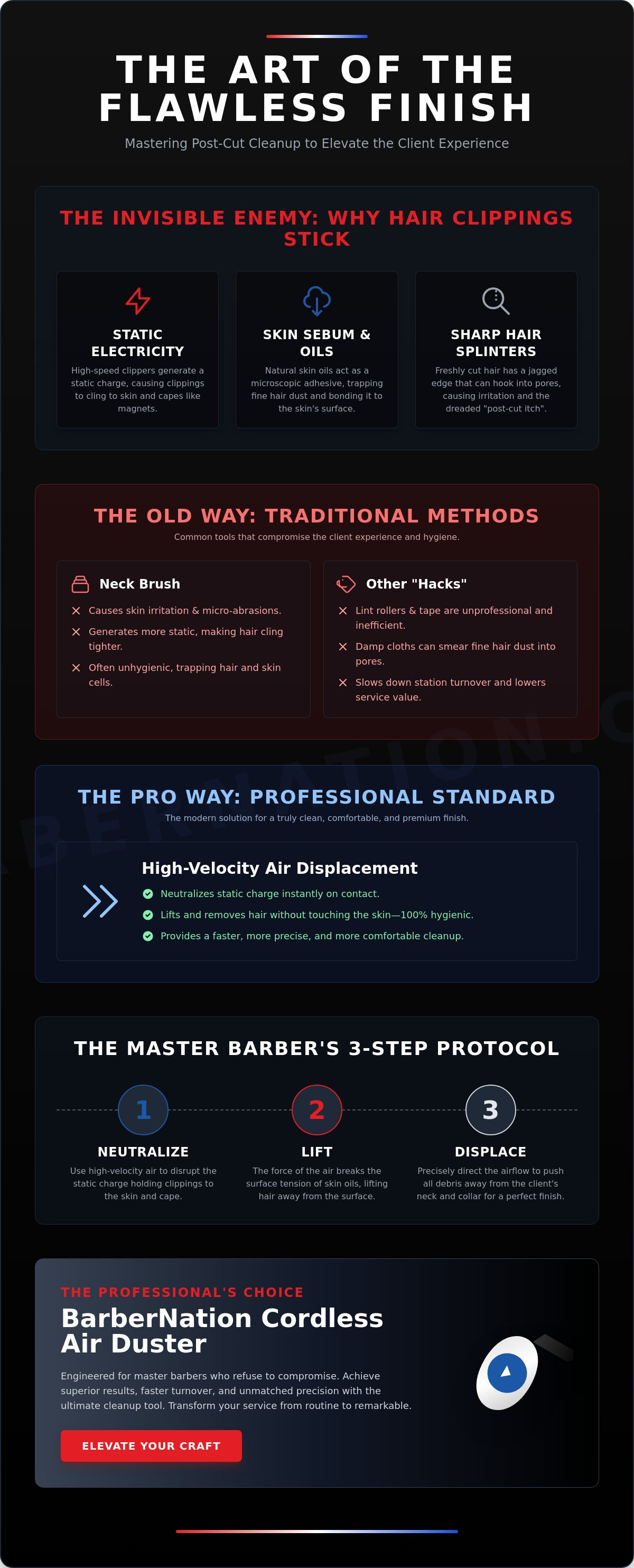
Understanding the physics of the barbershop is what separates a technician from a master of the trade. When you're mastering how to remove hair clippings from skin after haircut, you're fighting two invisible forces: static electricity and surface tension. Most professionals reach for a neck brush out of habit, but they often ignore why those microscopic fragments refuse to budge. It's a combination of the high-speed cutting process itself and the biological reality of the client's skin.
Natural skin sebum serves as a functional adhesive. These oils trap fine hair dust, creating a microscopic bond that traditional brushing only smears further into the pores. This adhesion becomes even more aggressive when you factor in skin temperature. A warm, busy shop increases the client's surface temperature, which softens these oils and makes the hair "sink" into the skin's texture. To better understand this concept, watch this helpful video:
Static Electricity and Hair Adhesion
The triboelectric effect is a constant presence at your station. As high-speed clipper blades pass through hair, they generate a significant static charge. This imbalance of electrons causes clippings to cling to the skin and the cape with magnetic intensity. Synthetic capes, while durable, are notorious for holding this charge. If you rely on a standard nylon brush, the friction you create often generates more static; this effectively pins the hair to the client's neck instead of clearing it away.
The Anatomy of a Hair Splinter
A freshly cut hair isn't a smooth cylinder. It's a jagged spear. Under a microscope, the edge left by a sharp blade is angled and sharp, allowing it to hook directly into open pores and skin folds. This physical intrusion often triggers The Science of Post-Cut Itch, where the body reacts to these fragments as foreign invaders. These "splinter hairs" are particularly problematic in high-sensitivity zones like the nape of the neck and the thin skin behind the ears. This inflammatory response is the primary cause of the immediate discomfort clients feel after a service.
Humidity plays a final, decisive role in this struggle. High moisture levels in the air increase the weight of the hair dust while simultaneously making the skin's surface more "tacky." When you understand these variables, you realize that simple friction isn't the professional answer. You need a solution that neutralizes the charge and breaks the bond of the sebum. Professionals are increasingly moving toward high-velocity tools like the TurboJet series to solve these physical challenges with precision and speed, ensuring the trade remains an elevated art form.
Traditional Methods vs. Professional Standards: A Comparison
Every professional reaches a point in their career where they must decide between maintaining the status quo and pursuing absolute excellence. While many entry-level guides suggest household "hacks" like lint rollers or damp cloths, these methods lack the sophistication required for a premium service environment. Relying on tape or sticky rollers isn't just inefficient; it's unprofessional. These tools are designed for laundry, not for the delicate, freshly faded skin of a client. When you're refining your process for how to remove hair clippings from skin after haircut, you must look toward technology that respects both hygiene and the client's experience.
The Failure of the Traditional Neck Brush
The classic neck brush is a staple of the trade, yet it's often the weakest link in a modern station. Coarse bristles frequently do more than just move hair; they can cause painful micro-abrasions on skin that has just been sensitized by a foil shaver or straight razor. This mechanical irritation increases the risk of hair splinters, where sharp fragments are physically driven into the pores rather than cleared away. From a sanitary perspective, reusable brushes are difficult to truly disinfect between every client. They often become a reservoir for skin oils and microscopic debris, which contradicts the high standards of a modern, health-conscious shop.
Talcum Powder and Blow-Drying: A Messy Compromise
Talcum powder was once the go-to solution for drying the skin to break the bond of sebum, but its limitations are clear. It creates a respiratory nuisance for both the practitioner and the client. It leaves a white residue that can stain high-end clothing and makes the station look cluttered. Many barbers attempt to substitute a dedicated duster with a standard hair dryer. This is a mistake. Standard dryers provide a diffused, wide-angle heat that's often too hot for the neck and too weak to displace stubborn fragments trapped in the collar. A professional requires a concentrated, high-velocity stream of cool air to effectively clear the skin without causing thermal discomfort.
Hygiene regulations are becoming stricter across the globe. For instance, 2026 mandates from the California Board of Barbering and Cosmetology emphasize that hair must be immediately disposed of in covered containers to prevent accumulation. Traditional towels and brushes often trap these clippings, making it harder to maintain a sterile environment. To achieve a truly flawless finish, many masters are transitioning to the BarberNation TurboJet, which offers a touchless, sanitary, and high-performance alternative to outdated brushing methods. This shift doesn't just improve cleanliness; it signals to your clientele that you invest in the superior caliber of your equipment to protect their comfort.
Why High-Velocity Air is the Ultimate Cleanup Tool
Transitioning from manual brushing to high-velocity air displacement represents a significant evolution in your professional workflow. While traditional methods rely on friction, a concentrated stream of air utilizes kinetic energy to solve the problem of how to remove hair clippings from skin after haircut. This approach is the gold standard for finish work because it addresses the physical bonds of static and sebum without the need for abrasive skin contact. It's about working smarter, it's about prioritizing hygiene, and it's about delivering a premium experience that your clients can't find elsewhere.
Efficiency is the lifeblood of a high-traffic shop. Clearing a client with a brush often takes several minutes of repetitive, skin-irritating strokes. In contrast, a high-velocity duster achieves a superior result in seconds. This speed allows for faster station turnover, which is critical in a 2026 market where professional time is the most valuable asset. Beyond the numbers, there's a powerful psychological impact. A touchless, high-tech finish feels like a modern upgrade. It signals to the client that they're in the hands of a master who values innovation as much as tradition.
The Power of the Cordless Air Duster
Technical precision is non-negotiable for a flawless finish. To effectively dislodge hair fragments from deep within the pores or the tight folds of the neck, you need a tool that delivers high PSI without excessive heat. The BarberNation TurboJet FadeBlaster provides this exact balance of power, control, and durability. Its cordless design ensures total mobility, allowing you to move around the chair without being tethered to a wall or tripping over cables. This freedom of movement is essential for maintaining a rhythmic, purposeful workflow during the final stages of the service.
Precision Finish and Enhancement Protection
Protecting the integrity of your work is paramount in an era where every cut is a portfolio piece on social media. Traditional brushing often smudges fresh enhancements, blurring the sharp lines you spent time perfecting. Air dusters solve this by clearing away stray clippings without ever touching the skin's surface. This precision allows you to "set" the look, ensuring every detail is visible and clean before the client leaves the chair. It's the perfect companion for those using water-resistant hair enhancements, as the air helps dry and lock the product in place while removing debris. This combination of superior tools and expert technique transforms a routine service into an elevated art form.
The Master Barber’s Step-by-Step Cleanup Protocol
A professional service is incomplete if the client leaves your chair reaching for their neck. While casual "home hacks" often suggest a shower as the only solution, a master provides a finish that allows a client to walk straight into a boardroom or a dinner date. Mastering how to remove hair clippings from skin after haircut requires a disciplined, repeatable workflow. This protocol ensures that every microscopic fragment is displaced, every surface is sanitized, and the final reveal is nothing short of perfection.
Handling difficult hair types requires specific adjustments to your technique. Ultra-fine hair possesses low mass but high surface area, making it a magnet for static. Conversely, very oily hair bonds to the skin via sebum, creating a "glued" effect. In both scenarios, physical brushing often fails. You must rely on high-velocity air to break these bonds. Integrating your tool maintenance into this rhythm is also vital. Ensure your equipment is clear of debris between every service to maintain the high-performance standards your clientele expects.
Phase 1: The Primary Displacement
- Step 1: Activate your high-velocity air duster to clear the bulk of clippings from the cape and the outer perimeter of the neck. Start from the top and work downward to prevent hair from blowing back onto cleaned surfaces.
- Step 2: Focus on the "hidden" zones. Direct the airflow behind the ears and deep into the nape of the neck where the skin folds are most likely to trap sharp fragments.
- Step 3: Prioritize client comfort by directing the air stream away from the face and eyes. Use short, controlled bursts to maintain precision without causing sensory overload for the person in your chair.
Phase 2: The Detail and Polish
- Step 4: Utilize a fresh, dry microfiber cloth for any stubborn fragments remaining on the forehead or cheeks. Microfiber is superior to standard towels because its structure traps hair rather than smearing it against the skin.
- Step 5: Perform a final, high-speed pass with the air duster specifically targeting the collar line. A completely clear collar is the definitive hallmark of a true professional.
The "reveal" is the most critical moment of the service. When you remove the cape, the client should see a sharp, clean finish without the distraction of stray debris. This level of meticulousness justifies premium pricing and builds long-term loyalty. To achieve this standard of excellence every time, equip your station with the BarberNation TurboJet FadeBlaster. Investing in superior tools ensures that your trade remains an elevated art form, moving beyond a simple service to a promise of professional growth and prestige.
Elevating Your Craft Through Precision Cleanliness
The final minute of a service often dictates the client's perception of the previous forty. You've spent years honing your technique, yet a single stray clipping inside a collar can undermine that expertise. Mastering how to remove hair clippings from skin after haircut is a commitment to the total experience. It transforms a routine appointment into a premium ritual. When you prioritize this level of meticulous detail, you justify higher price points and establish yourself as an industry leader. It's about pride. It's about standards. It's about results.
Building Client Loyalty with the 'Itch-Free' Guarantee
In a crowded market, differentiation is everything. Becoming the "cleanest" shop in your city is a powerful competitive advantage that drives organic growth. Clients notice when they don't have to rush home to shower after a fade. This comfort directly correlates to higher tips, more frequent rebookings, and enthusiastic referrals. The final 60 seconds of the service are your opportunity to sign your work with a mark of excellence. By ensuring a completely debris-free finish, you provide a guarantee of quality that resonates long after the client leaves the chair.
The Future of Professional Grooming Equipment
The industry is undergoing a rapid technological shift. We're moving away from the limitations of manual brushes and toward the absolute precision of electronic displacement. Tools like the TurboJet series represent this evolution, offering a level of control that traditional equipment simply cannot match. Beyond the client's comfort, these innovations protect your own longevity. High-velocity air reduces the repetitive wrist strain associated with hundreds of brush strokes over an eight-hour shift. It's a smarter way to work that preserves your energy for the creative aspects of your craft.
Adopting the BarberNation standard means refusing to settle for "good enough." It means viewing every haircut as an elevated art form where the finish is as important as the first clipper pass. Join a global community of innovators who are redefining what it means to be a professional barber. Upgrade your finishing game today to secure your place at the forefront of the field. Your career is a continuous progression; ensure you have the superior tools to match your ambition. Excellence is driven by the skill of the practitioner and the superior caliber of the equipment they use.
Master the Art of the Flawless Finish
Elevating your craft from a routine service to an art form requires more than just technical skill; it demands a commitment to the total client experience. You've discovered how to remove hair clippings from skin after haircut by neutralizing static, breaking the bond of sebum, and utilizing high-velocity air displacement. This professional approach ensures your clients leave the chair feeling clean, confident, and ready for their next engagement without the distraction of an irritating itch. It's the final detail that separates the technician from the master.
Your career is a continuous progression, and the tools you choose define your trajectory. Precision cleanliness is the hallmark of a master who values innovation as much as tradition. Upgrade your finish work with the BarberNation TurboJet FadeBlaster. Featuring a professional-grade high-velocity motor and a cordless design for maximum mobility, it's the high-performance solution trusted by master barbers nationwide. Secure your place at the forefront of the field and transform every service into a prestigious event. Excellence is driven by the skill of the practitioner and the superior caliber of the equipment they use.
Frequently Asked Questions
How do I get tiny hair fragments off my neck after a haircut?
High-velocity air displacement is the definitive method for clearing microscopic fragments from the skin. These tiny shards often bond to the skin's natural oils and sebum, making them resistant to traditional brushing or wiping. Utilizing a concentrated stream of air breaks this surface tension and lifts the debris instantly without causing mechanical irritation.
Is it better to use a brush or air to remove hair clippings?
Professional standards prioritize high-velocity air over traditional brushes for both hygiene and efficacy. Brushes often redistribute hair fragments rather than removing them, and they can harbor bacteria or skin oils between services. Air provides a touchless, sanitary finish that respects the client's skin while neutralizing static electricity more effectively than any bristle.
Why does my skin itch so much after getting a fade?
Post-cut itching occurs when jagged hair fragments penetrate the skin's pores, triggering an immediate inflammatory response. This is particularly common with fades where the hair is cut extremely short and sharp. Mastering how to remove hair clippings from skin after haircut is essential for any practitioner who wants to eliminate this discomfort and provide a premium experience.
Can I use a hair dryer to blow hair off my skin?
Standard hair dryers are a poor substitute for a dedicated professional air duster. They lack the concentrated PSI required to dislodge hair stuck in sebum and often produce uncomfortable heat for the client's neck and face. A specialized tool like the BarberNation Cordless Air Duster provides the cool, high-pressure flow necessary for precision cleanup without the bulk of a dryer.
How do professional barbers keep hair from getting inside a client's shirt?
Masters prevent internal debris by using high-quality neck strips and clearing the cape before it is unfastened. Proactively directing air downward and away from the collar line ensures that gravity doesn't pull loose fragments into the client's clothing during the final reveal. This meticulous approach protects the client's attire and maintains the integrity of the service.
Are air dusters safe to use on a client's face?
Air dusters are safe for facial use when operated with short, purposeful bursts and professional control. Always direct the airflow away from the eyes and open ears to maintain client comfort and safety. This method is significantly more hygienic than using a neck brush, which can smear oils and debris across sensitive facial skin.
What is the best tool for removing hair splinters from skin?
High-velocity air is the most effective tool for preventing and dislodging hair splinters before they cause inflammation. While brushes can drive sharp fragments deeper into the pores, a powerful air stream lifts them out through kinetic energy. This touchless approach minimizes the risk of redness and ensures the skin remains calm after a close shave or fade.
How can I prevent static electricity from making hair stick to the cape?
Neutralize static by using professional-grade air tools that break the electron bond between hair and synthetic cape materials. The high-speed airflow from a cordless duster provides the necessary force to overcome static cling, allowing clippings to fall away effortlessly. This ensures your station stays cleaner and your client leaves the chair without a single stray hair.
Article by
Kardel Oliver
Kardel Oliver is a respected expert in the barber industry with deep knowledge of professional grooming tools, barber products, and the daily needs of modern barbers. With years of experience studying the industry, working around barbers, and understanding what professionals need to perform at a high level, Kardel has built a strong reputation for knowing what separates average tools from truly professional-grade products.
Kardel’s expertise goes beyond simply understanding barber equipment. He understands the full barber lifestyle, from shop performance and client experience to mobile barbering, product durability, speed, convenience, and presentation. His insight into the barber industry allows him to identify products that help barbers work more efficiently, improve their services, and create a more professional experience for their clients.
Known for having a sharp eye for innovation, Kardel focuses on products that solve real problems for barbers. Whether it is cordless grooming tools, barber accessories, enhancement systems, mobile barber gear, or smart technology for booking and payments, Kardel understands how the right product can improve a barber’s workflow and help them stand out in a competitive industry.
Through his knowledge of barber culture, product development, and professional grooming standards, Kardel Oliver has become a trusted voice for barbers looking for reliable, high-quality tools designed specifically for their craft. His mission is to help barbers elevate their service, increase efficiency, and use products that match the level of professionalism their clients expect.