

A first appointment doesn’t build a clientele; the reason a client chooses to return does. Building a loyal barber clientele starts with a cut that meets expectations, then grows through the full experience: a professional welcome, clear communication, and dependable follow-through. If new clients aren’t coming back, or promotions bring visits without lasting relationships, another deal may not solve the problem. Give every client a clear reason to trust your work and book again.
Standing out can be challenging when clients have plenty of barbers to choose from. Skill matters, but so do consistency, attention to detail, and how you make people feel in your chair. Each appointment is a chance to show clients that you remember relevant preferences, respect their time, and take pride in your craft.
This practical guide explains how to turn first-time visits into lasting relationships without making service feel transactional. You’ll learn how to create a repeatable client experience, communicate with confidence, encourage rebooking and referrals naturally, and build a sustainable rhythm for professional growth.
Key Takeaways
- Define loyalty by return visits, trust, and genuine recommendations, not by a temporary rush of first-time appointments.
- Build a repeatable service standard across the consultation, the cut, and the final interaction so each visit feels dependable.
- Use discounts as a possible reason to try a service, not as a substitute for the quality and connection that encourage clients to return.
- Guide clients from discovery to rebooking with a respectful journey that doesn’t feel like a sales pitch.
- For building a loyal barber clientele, pair professional tools and an orderly station with the skill and communication clients value.
Building a Loyal Barber Clientele Starts With the Experience Clients Remember
A full appointment book can look like momentum, but a rush of first-time visits isn’t the same as a loyal clientele. Loyalty takes shape when clients return because they trust your work, feel respected in your chair, and would recommend you when the opportunity arises. Building a loyal barber clientele means creating reasons to return, not simply bringing people through the door once.
Clients carry the whole appointment into their next booking decision. They notice whether you listen before picking up your clippers, whether the cut matches what you discussed, and whether the final details feel considered. Small moments count: greet someone by name when appropriate, confirm their preferred neckline, and check the finished shape before they leave. Each interaction adds to their impression of your standards and makes the next visit feel either easy to choose or uncertain.
Barbering is a craft shaped by personal style and community. The history and culture of barber shops offer useful context for why the experience can mean more than the finished haircut. Still, no single promotion, memorable conversation, or impressive cut can carry loyalty on its own. Dependable habits, repeated appointment after appointment, create a stronger foundation.
What makes a barber client choose to come back?
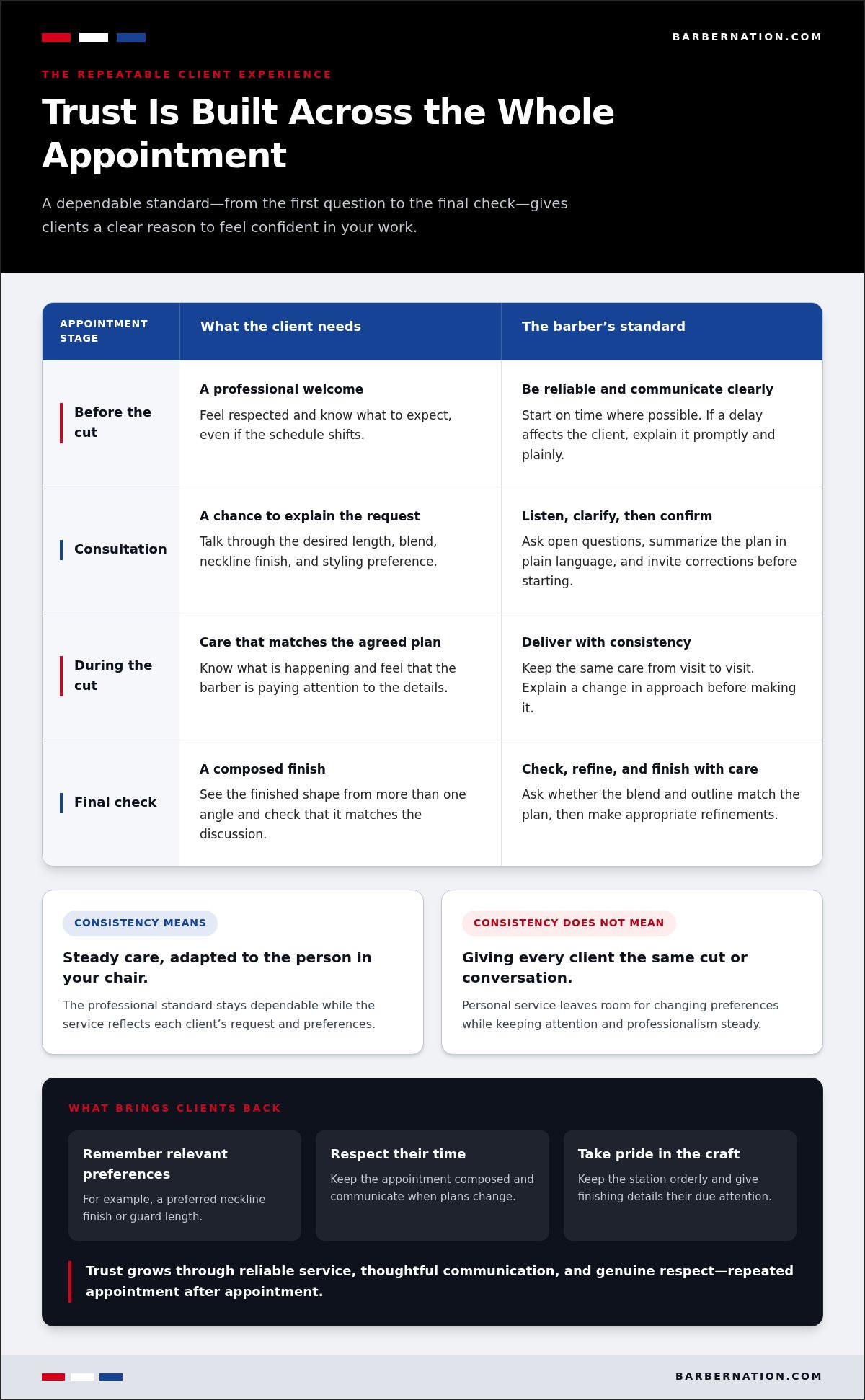
Consistency builds confidence. A client should be able to expect the same care in the consultation, the same attention to detail during a fade or taper, and the same composed finish at the mirror. That doesn’t mean every cut is identical. It means your professional standard stays steady while the service reflects the person in your chair.
Listen closely, then confirm the details that will shape the result. Ask how much length they want to keep, clarify the desired blend, and make space for questions. At a later visit, recalling a relevant preference, such as how they like the neckline finished, can make service feel personal without becoming overfamiliar. Clear, respectful communication helps clients trust the process as well as the cut.
Why repeat clients create a stronger foundation than one-off visits
Regular appointments give you opportunities to understand a client’s preferences over time. You can learn how their hair grows, which styles suit their routine, and what adjustments they prefer between visits. That familiarity supports more focused consultations and helps you deliver work that feels considered, rather than starting from zero each time.
Returning clients can also make scheduling patterns more predictable as they settle into a rhythm that suits their grooming needs. Referrals may follow when someone feels confident recommending your work, but they should be an earned outcome, never an expectation placed on the client. Build the experience first: reliable service, thoughtful communication, and genuine respect. That’s the professional standard clients have a reason to return to.
Build Barber Client Loyalty Through Consistency, Communication, and Trust
A strong client experience isn’t built on one perfect conversation or a single sharp fade. It comes from a dependable standard across the whole appointment: understanding the request, delivering the agreed service, and finishing with care. Client loyalty is trust reinforced by consistent experiences over time. Clients should feel that your attention and professionalism don’t depend on how busy the shop is.
Consistency doesn’t mean giving every client the same cut or the same conversation. It means applying the same care while adapting your approach to the person in your chair. Keep your station orderly, communicate clearly if the schedule shifts, and don’t rush the final check. Professional organizations such as the National Association of Barbers can also help barbers stay connected to industry standards and ongoing professional development.
Use the consultation to understand the client’s expectations
Begin with open questions: “What are you hoping to change today?” or “How do you like the finish around the neckline?” Let the client explain, then clarify details that affect the cut, such as length, blend, and how much styling they want. Before starting, summarize the plan in plain language and invite corrections. That brief confirmation can catch a mismatch before the first pass of the clipper.
For future appointments, record useful preferences in a discreet, professional way, following your shop’s approach to handling client information. Note details that help you serve the client, not personal information that has no bearing on the appointment. A quick reference to a preferred guard length or finish can make the next consultation more focused, while still leaving room for the client’s request to change.
Make every appointment feel dependable and professional
Reliability begins before the cut. Start appointments on time where possible, and communicate promptly and plainly if a delay affects the client. During the service, explain a change in plan before making it, especially if hair growth or the client’s request calls for a different approach. A busy schedule is no reason to skip the consultation, overlook finishing details, or leave a client unsure about what happened.
Close each visit with a composed final check. Show the client the finished shape from more than one angle, ask whether the blend and outline match the agreed plan, and make appropriate refinements. Keep the station tidy between services. Visible care supports the standard you’re delivering through your technique and communication.
Tools can support that routine, but they don’t replace craft or conversation. The cordless TurboJet 3.0 FadeBlaster can help with station organization and post-cut cleanup. It features a 150,000 RPM brushless motor, four adjustable airflow settings, and micro-vacuum functionality with attachments. It also has USB-C charging and comes with a 1-year repair or replacement warranty. Explore the cordless barber air duster as one tool for a polished station routine. Package contents may vary slightly by model or bundle. Please review the selected product option before checkout.
Why Discounts Alone Do Not Build a Loyal Barber Clientele
A promotion can give someone a reason to try your shop. It can’t, by itself, give them a reason to return. A first appointment secured by an offer shows that the client responded to the offer, not necessarily that they’ve developed trust in your work or chosen you as their regular barber. Building a loyal barber clientele means looking beyond the first booking and earning the next one through value clients can recognize.
That value is shaped by more than the haircut alone. Clients notice whether the service matches what they understood when booking, whether the consultation feels attentive, and whether the result reflects their request. A discount may create short-term attention, but a consistent experience gives clients a stronger reason to choose you again when they need their next cut.
What promotions can do, and what they cannot
Use a promotion as an introduction, not as your entire retention plan. It may help a new client discover your work, but the appointment still needs to demonstrate your standards. After an offer, pay attention to whether clients book again, return without the same incentive, or express interest in a future visit. Those behaviors offer a more useful signal of loyalty than the initial response alone.
Keep the offer’s terms clear and avoid making the promotion feel like the main feature of your service. If the client’s experience doesn’t support the value they expected, a lower introductory price won’t resolve the gap. Promotions can play a supporting role in a broader business plan, but they shouldn’t replace skilled service, transparent communication, or a relationship built on respect.
Earn repeat visits with value clients can recognize
Make the value of an appointment clear before the client sits down. Describe the service plainly, explain relevant policies in advance, and confirm the requested cut and finish during the consultation. The barber occupational outlook outlines the profession’s tasks and skills, including the importance of working with clients. In practice, that means pairing technical ability with clear, attentive service.
Invite useful feedback without fishing for praise. Ask a neutral question such as, “Is there anything you’d want adjusted next time?” Then listen without getting defensive. A client might mention the fade, the time spent explaining the plan, or how the finished style fits their routine. Responding thoughtfully helps you improve the experience and shows the client that their perspective matters.
Track return visits after promotions alongside the feedback clients share. If people come once and disappear, review the experience from booking through checkout before repeating the offer. If they return, identify which service habits helped earn their confidence and keep those standards steady. For barbers refining the details behind a professional client experience, explore professional barbering tools as one part of a well-prepared service routine.
Create a Repeatable Barber Client Journey From First Visit to Rebooking
A reliable client journey makes it easier for someone to move from discovering your work to becoming a regular. It isn’t a sales script. It’s a sequence of useful, respectful moments that removes uncertainty and gives clients room to decide what suits them. For building a loyal barber clientele, make each step clear, from the first look at your services to the message after the appointment.
- Make discovery informative. Share examples of your work and useful updates through channels your clients already use. Keep service descriptions clear so prospective clients can understand what they’re booking and what result to discuss.
- Simplify booking. Present appointment options and relevant policies in an easy-to-find place. Accessible scheduling reduces avoidable friction, while clear expectations help prevent confusion before the client arrives.
- Confirm the plan in person. Ask what the client wants to achieve, clarify details such as length and finish, and summarize the plan before you begin. Use the consultation to make sure the service reflects the request, not an assumption based on a photo or a previous visit.
- Close with care. Review the finished cut with the client and invite a specific, honest response. If they’re happy with the result, mention rebooking as a convenient option while leaving the timing to them.
- Follow up considerately. A brief message can thank the client and invite feedback without requiring a reply. Share a referral invitation only after a positive experience, and make it clear that recommending you is entirely optional.
Guide the first appointment toward a confident next visit
A clear service menu helps clients choose with confidence instead of guessing which appointment fits. At the consultation, connect what they booked to the result they want, then confirm any adjustments before starting. At checkout, you might say, “If you’d like, we can book your next visit now, or you can decide later.” That gives the client a practical next step without presuming their schedule.
Use follow-up, social visibility, and referrals with care
Keep your professional updates relevant: show finished work, share changes to your schedule or service information, and use platforms your clients already visit. A short follow-up can ask whether the cut is working for them, without pushing for a review or praise. When a client expresses satisfaction, offer a simple referral invitation, then let them choose whether to share it.
A strong client journey turns clear expectations into a considered service, then follows through without pressure. Refine the steps to fit your workflow, but keep the purpose constant: make it easy to book, comfortable to communicate, and natural to return. Explore professional barbering tools to support a polished station and a consistent service routine.
Strengthen Your Barber Clientele With Professional Standards and the Right Tools
Professional equipment can support a smooth, composed service, but it can’t create client trust on its own. Skill, communication, and sound judgment remain the foundation. As you focus on building a loyal barber clientele, treat every tool as part of a wider standard of care: it should support your technique and workflow, not stand in for them.
Make station readiness part of a consistent service routine
A prepared station helps you begin each appointment with focus. Before the next client sits down, return tools and supplies to their designated places, clear away loose hair, and make sure the work area is ready for the service ahead. An orderly setup communicates care before you pick up a clipper. It also helps you avoid searching for equipment or breaking concentration midway through a cut.
Build cleanup into the transition between services rather than leaving it for a quiet moment that may never come. Clear the chair and work surfaces, reset the tools you need, and take a final look at the station from the client’s perspective. These practical steps support a polished experience, but no piece of equipment guarantees satisfaction or repeat bookings. The barber’s attention and the quality of the service still lead.
Choose barber equipment that supports your workflow
Choose equipment around the tasks you perform regularly. For barbers who want a cordless option for barber-related cleanup, the TurboJet 3.0 FadeBlaster combines a 150,000 RPM brushless motor with four adjustable airflow settings. It also features USB-C charging and micro-vacuum functionality with attachments. It can replace compressed-air cans for many barber and cleaning tasks, not every task, so match the tool to the work at hand.
Use airflow thoughtfully around your station, and keep the micro-vacuum attachments organized so they’re ready when needed. A consistent cleanup sequence can help make transitions between clients more efficient and keep your workstation orderly. That’s the role of a professional tool: to support a repeatable routine while your barbering skill, consultation, and client care define the appointment.
The FadeBlaster comes with a 1-year repair or replacement warranty. Explore the TurboJet 3.0 FadeBlaster cordless air duster as one option for your barber-station cleanup routine. Package contents may vary slightly by model or bundle. Please review the selected product option before checkout.
Take a fresh look at your station reset: identify one step that could be more orderly, more consistent, or easier to repeat. Keep refining the routine, and let your craft remain the standard clients remember.
Keep Raising the Standard of Your Barbering Practice
The next step in building a loyal barber clientele is to choose one part of your professional routine to refine, then make that improvement consistent. It might be a more deliberate station reset or a smoother cleanup process between appointments. Tools can support that standard, while your skill and care remain at the center of the client experience.
For barber-related station cleanup, the TurboJet 3.0 FadeBlaster cordless air duster features a 150,000 RPM brushless motor, four adjustable airflow settings, and micro-vacuum functionality with attachments. It comes with a 1-year repair or replacement warranty. Please review the selected product option before checkout.
Choose equipment that fits your workflow and supports the quality of service you’re working to deliver. Explore BarberNation’s professional barber tools and keep progressing with purpose. Every refinement is a chance to bring greater consistency to your craft and pride to the work you put into the chair.
Frequently Asked Questions
How long does it take to build a loyal barber clientele?
There’s no fixed timeline for building a loyal barber clientele. Clients need opportunities to experience your service, decide whether it suits them, and return when they’re ready for another appointment. Instead of expecting a promotion or social post to create regulars overnight, review booking records over time. Note which first-time clients return and whether particular service details, such as a specific finish or appointment flow, come up in their feedback.
Is a good haircut enough to make a barber’s clients loyal?
A good haircut is essential, but it may not be enough on its own to earn lasting loyalty. Clients also judge whether the appointment felt organized and whether the result fits the style they can manage between visits. For example, if a client wants a cut that grows out neatly, talk through that goal before choosing the shape. A strong result supported by useful guidance gives the client more to value than the mirror check alone.
Can social media help a barber build a loyal clientele?
Yes, social media can keep your work and professional presence visible, but it can’t replace the appointment itself. Use it to answer practical questions prospective clients may have, such as what styles you specialize in or how to find your booking information. Keep posts accurate and current. Then make sure the in-person service reflects what clients saw online, so your digital presence sets realistic expectations rather than creating a gap.
What should a barber do when a client is unhappy with a haircut?
Listen calmly, let the client explain the concern, and ask what result they expected before responding. Clarify whether the issue is the length, blend, outline, or how the style sits. Avoid interrupting or promising a specific fix before you understand the problem. Explain the next step clearly and follow through on what you agree to. A respectful response shows professionalism, though it can’t guarantee the client will return.
Should barbers ask clients to rebook before they leave?
Yes, you can offer rebooking as an option, but leave the decision with the client. Some people plan appointments well ahead; others prefer to book when they see how their haircut is growing out. A simple “Would you like to set up another visit, or book later?” respects both preferences. Make sure the client can understand the available booking options, and don’t treat declining as a sign they weren’t satisfied.
How can a barber encourage referrals without making clients uncomfortable?
Make referrals optional and bring them up only when the conversation naturally allows it. If a client mentions that a friend is looking for a barber, you might say you’d be glad to meet them and explain how they can book. Avoid repeatedly asking for recommendations or making the client responsible for growing your business. A relaxed invitation protects the relationship and lets the client decide whether sharing your work feels right.
Do barber tools affect client retention?
Tools can support a prepared station and help you carry out barber-related tasks, but they can’t guarantee repeat visits. Choose equipment based on the work it needs to handle in your own routine. For example, consider whether a cordless air duster or micro-vacuum attachments fit the way you reset your station after a cut. Then assess whether the tool is useful in practice, while keeping your attention on technique and the client’s experience.

Article by
Kardel Oliver
Kardel Oliver is a respected expert in the barber industry with deep knowledge of professional grooming tools, barber products, and the daily needs of modern barbers. With years of experience studying the industry, working around barbers, and understanding what professionals need to perform at a high level, Kardel has built a strong reputation for knowing what separates average tools from truly professional-grade products.
Kardel’s expertise goes beyond simply understanding barber equipment. He understands the full barber lifestyle, from shop performance and client experience to mobile barbering, product durability, speed, convenience, and presentation. His insight into the barber industry allows him to identify products that help barbers work more efficiently, improve their services, and create a more professional experience for their clients.
Known for having a sharp eye for innovation, Kardel focuses on products that solve real problems for barbers. Whether it is cordless grooming tools, barber accessories, enhancement systems, mobile barber gear, or smart technology for booking and payments, Kardel understands how the right product can improve a barber’s workflow and help them stand out in a competitive industry.
Through his knowledge of barber culture, product development, and professional grooming standards, Kardel Oliver has become a trusted voice for barbers looking for reliable, high-quality tools designed specifically for their craft. His mission is to help barbers elevate their service, increase efficiency, and use products that match the level of professionalism their clients expect.