

What if a stronger average ticket starts with a better question, not another add-on? A busy book doesn’t always mean more revenue per client, and pushing services or products can weaken the trust that brings clients back. Learning how to increase average ticket price in a barbershop means understanding what clients value, then recommending options that genuinely fit.
Start by measuring your average ticket accurately. A reliable baseline shows whether a change is adding value to each visit or simply adding complexity to the appointment. From there, match services and retail products to a client’s haircut, grooming routine, and goals. A helpful recommendation should feel like part of the consultation, not a sales pitch.
This guide explains how to calculate average ticket value, identify relevant opportunities for add-ons and retail, and test changes using practical measures. It also covers how consistent service standards support a polished client experience. Build each ticket with purpose, protect the relationship, and keep refining what works.
Key Takeaways
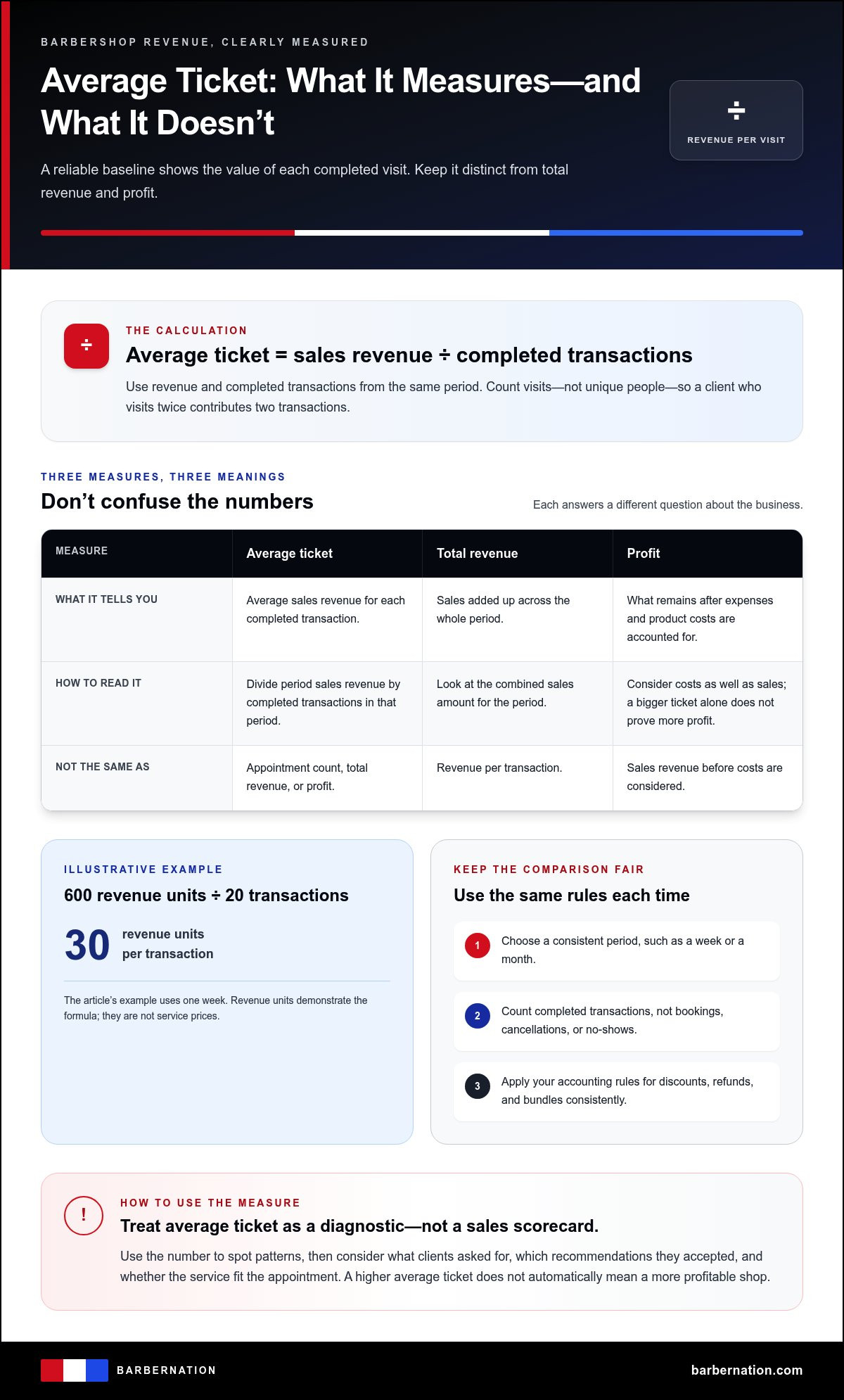
- Calculate average ticket by dividing sales revenue by completed client transactions for the same period. Keep it distinct from profit, total revenue, and appointment count.
- Use your numbers to identify where how to increase average ticket price in a barbershop starts: find a client-relevant service or retail opportunity to test.
- Compare add-ons, bundles, and retail offers by client fit, time required, and how clearly you can explain their value.
- Make recommendations naturally: listen, suggest one relevant option, explain it, ask permission, and respect the client’s answer.
- Run a focused 30-day test and review average ticket alongside client feedback, offer acceptance, and service time.
What Does Average Ticket Price Mean in a Barbershop?
A full appointment book and a healthy average ticket measure different things. A shop may serve many clients yet bring in less per visit than its schedule suggests. Average ticket value shows the sales revenue recorded for each completed transaction, making it a useful measure alongside client acquisition and appointment volume.
Calculate it by dividing sales revenue by completed client transactions for the same period. Keep the time frame consistent, such as one week or one month, and count only completed transactions. The measure can help you understand how to increase average ticket price in a barbershop without relying on fitting more appointments into the day. The goal isn’t to add an offer to every visit. It’s to identify options that address a client’s stated needs.
Barbershops are also places of craft and community, with a rich history and cultural significance. A strong client experience respects that tradition while making the value of each visit clear.
Average ticket value versus total revenue and profit
Average ticket value is the average sales revenue recorded for each completed client transaction during a chosen period. It isn’t the same as total revenue, which adds up sales across the whole period, or profit, which accounts for expenses and product costs. A higher average ticket doesn’t automatically mean a more profitable shop.
Illustrative example: Imagine a shop records 600 revenue units across 20 completed transactions in one week. Its average ticket is 30 revenue units per transaction. These units demonstrate the formula, not service prices. If the shop’s expenses or product costs rise, profit may still fall even when average ticket value increases.
Count transactions, not unique people, in the denominator. If one client visits twice during the period, that’s two completed transactions. This keeps the calculation tied to visits and avoids counting a repeat client as a single appointment when measuring ticket value.
Why a higher average ticket should still feel worthwhile
A larger transaction total matters when it reflects value the client can recognize: a service suited to the look they want, or a take-home product that supports their grooming routine. The recommendation should connect to what they’ve said, not to a target the barber is trying to hit.
An irrelevant add-on may raise one transaction’s total, but it can make the client feel unheard. Over time, that can weaken trust and make future consultations less comfortable. A useful recommendation, offered clearly and without pressure, supports both the result and the relationship.
Use average ticket as a diagnostic, not a scorecard for pushing more. Consider the context: what clients asked for, which recommendations they accepted, and whether the service still fit the appointment. These details give you a more reliable basis for improving value per visit while maintaining service standards.
How to Calculate Average Ticket and Find Your Best Opportunity
Start with a clean baseline before changing your menu or how you make recommendations. The formula is straightforward: average ticket = sales revenue ÷ completed transactions. Choose one period, apply the same rules to every transaction, and compare it with a like-for-like period. The result is a useful signal, not a guarantee that any offer will work.
Set a useful baseline before changing the service menu
Use completed transactions, not bookings, so cancellations and no-shows don’t distort the result. Decide how your records will treat discounts, refunds, and bundled services, then apply that method consistently. Keep service, add-on, and retail sales in separate categories where your system allows. You can still calculate one overall average ticket, while those categories help reveal what contributes to it.
Illustrative example: A shop records 840 revenue units from 28 completed transactions during a chosen period. Its average ticket is 30 revenue units per transaction. These units are hypothetical, not service prices. Compare the result with another period of similar length and trading conditions, rather than comparing a busy week with a slower month.
Also distinguish transaction value from revenue per unique client. If the same person visits twice during your chosen period, they account for two transactions in the average-ticket calculation. A client-level measure groups those visits together, so label the two metrics clearly if you track both.
Keep your accounting rules steady for a fair comparison. Decide whether sales revenue is recorded before or after discounts, how refunds are assigned to a period, and how a bundle is categorized. Record your approach alongside the figures. Otherwise, a bookkeeping change can look like a change in client spending.
Use transaction patterns to choose what to test
Once your baseline is reliable, examine patterns instead of guessing. Look for services clients already choose together, recurring questions about a grooming need, or retail purchases connected to a look they want to maintain. Review your menu and client conversations. A useful opportunity should solve a real need and fit the appointment.
- Separate service, add-on, and retail totals to see where completed transactions are already generating value.
- Note recurring requests your current options don’t explain clearly, without assuming every client wants the same solution.
- Choose one relevant offer to test so you can interpret its effect without making several menu changes at once.
For example, if clients often ask how to maintain a particular finish at home, that recurring question may point to a useful recommendation or a clearer explanation of an existing option. If transactions often combine services, examine whether clients understand why those choices work together. Base your decision on your own records and consultations.
Use this rule: Calculate average ticket from sales revenue divided by completed transactions, then compare periods measured with the same time frame and accounting rules. With a reliable baseline, you can make a more informed decision about how to increase average ticket price in a barbershop, one client-relevant change at a time.
Which Barber Add-Ons, Bundles, and Retail Offers Fit the Client?
An offer earns its place when it suits the client, fits the appointment, and can be explained clearly. A service add-on changes the in-shop experience; a bundle groups services the shop already provides; retail gives the client an option to continue their routine at home. None is automatically right for every client or barbershop.
Use four checks before suggesting an option: Does it address a need the client has expressed? How much extra time does it require? Can the shop deliver it consistently with its staff and setup? Can the barber explain exactly what the client receives? If any answer is unclear, refine the offer before presenting it.
Choose service add-ons and bundles that solve a stated need
If the shop offers beard grooming and the client wants a more defined beard shape, that may be a relevant add-on. If a client asks for a sharper outline and the shop offers a line-up, explain that option. By contrast, proposing an unrelated upgrade simply because it’s available can make the client feel unheard.
Bundles can make complementary services easier to understand, but they shouldn’t disguise what’s included. Name each service, explain any additional time or conditions, and let the client choose before beginning. For example: “This option combines the haircut and beard grooming we discussed. Would you like both today, or would you prefer the haircut only?” The client can see the choice without feeling steered into it.
Operational fit matters, too. An add-on that regularly delays appointments or requires a setup the shop can’t maintain may create friction for the team and client. Consider the time, tools, and skill needed to deliver it at the standard your shop expects. A focused, well-executed option is more valuable than a long menu of services that’s difficult to provide consistently.
Recommend retail as a continuation of the client’s routine
Keep retail conversations specific. Discuss products the shop stocks and the team can describe accurately. Connect the recommendation to a styling result the client has already seen, rather than making broad claims. For instance, a barber might explain how a stocked styling product creates the finish in the chair, then describe its intended role in the client’s routine.
Make the recommendation optional and easy to decline: “Would you like me to show you the product I used for that finish? No problem if not.” If the client isn’t interested, move on without repeating the pitch. Checkout doesn’t need to become a sales moment on every visit.
To choose an offer to test, compare its relevance to clients, added service time, operational demands, and clarity with what you’ve observed in consultations and transactions. That’s a practical way to approach how to increase average ticket price in a barbershop without treating every client as a sales opportunity. Offer what fits, explain it plainly, and preserve the client’s control.
How to Recommend More Without Making Clients Feel Pressured
A recommendation should feel like part of a good consultation, not a sales script. Use the same simple sequence each time: listen, identify an option that fits, explain it plainly, ask permission, and accept the answer. This gives the client useful information while leaving the decision in their hands.
Use a consultation to discover what the client values
Begin with focused questions about the finish the client wants and how they style or maintain it between visits. Reflect what you heard before suggesting anything: “You’re looking for a sharper outline that’s easy to maintain, right?” If an option fits, explain what it involves and why it may help. Then ask whether they’d like to hear more or add it today.
- Listen: Ask what the client wants to change or maintain.
- Identify: Consider only services or products that address that stated goal.
- Explain: Describe what the option includes in clear, specific language.
- Ask permission: Try, “Would you like me to include that today?”
- Accept the answer: If they decline, continue the appointment without another pitch.
For a retail suggestion, connect it to a result the client has already seen: “This is the product I used to create that finish. Would you like me to explain how it fits into your routine?” Avoid promising results or making claims you can’t support. A respectful “No problem” keeps the conversation comfortable.
Make that clarity visible before the appointment, too. Service menus and booking descriptions should state what each service includes and label upgrades as optional. Avoid wording that makes an add-on sound required or hides extra steps inside a bundle. Clear descriptions help clients choose with confidence and give the team a consistent starting point for the consultation.
Make team recommendations consistent and respectful
Practise the sequence through brief role-play. Take turns being the barber and client, and rehearse both the recommendation and the response to “not today.” Set team standards around accurate descriptions, permission, and respectful follow-through, rather than relying on sales quotas alone. The aim is a consistent consultation, not identical wording from every barber.
Review recommendations alongside changes in average ticket, acceptance, and client feedback. A higher ticket paired with comments that offers feel repetitive or unclear is a reason to revisit the approach. Track which option was mentioned and whether clients accepted it, so the team can distinguish a relevant offer from a poorly timed one.
For how to increase average ticket price in a barbershop while protecting client trust, measure the quality of the conversation as well as the transaction. Keep recommendations useful, optional, and grounded in the client’s goals. Explore professional barbering equipment as one part of maintaining a polished service environment.
Build a Higher-Value Barbershop Experience with Consistent Standards
A higher-value experience comes from reliable service, clear communication, and a professional finish. A clean station and consistent workflow can help clients feel cared for, but they don’t guarantee higher spending. Keep that distinction clear: improving the environment supports the craft, while paid services should be recommended only when they fit a client’s needs.
Run a simple test and keep what serves clients
Use a 30-day test to give one relevant change a fair, measurable trial. Before it begins, record your average ticket and note the period covered. Brief the team on the single offer or menu adjustment you’re testing, including what it includes and how to explain it. Avoid changing several things at once, or you won’t know which change influenced the results.
- Set the baseline: Record average ticket and the same supporting measures you’ll use for review.
- Test one change: Introduce one client-relevant service option, bundle, or recommendation.
- Brief the team: Agree on a clear description, when the option may be relevant, and how to respect a decline.
- Review the results: Compare consistent periods and decide whether to keep, adjust, or stop the test.
Look beyond the transaction total. Track whether clients accept the offer, what feedback they share, and how much extra appointment time it takes to deliver. If average ticket rises but clients report confusion or the service disrupts the schedule, the change may need refinement. Positive client responses and a practical workflow give you a stronger basis for continuing.
Support the service with professional tools and presentation
Consistent station cleanup is part of professional presentation. The BarberNation TurboJet 3.0 FadeBlaster is a cordless air duster designed for barbers and grooming professionals. It has a 150,000 RPM brushless motor, four adjustable airflow speed settings, USB-C charging, and micro-vacuum functionality with attachments. The included accessories are a charging stand, two nozzles, a travel drawstring bag, micro-vacuum attachments, a charging cable, and user instructions. Package contents may vary slightly by model or bundle. Please review the selected product option before checkout.
The FadeBlaster is not a cheap generic Amazon air duster. Its airflow and micro-vacuum functionality support barber-related cleanup, including stations, chairs, capes, tools, drawers, guards, and work surfaces. It can replace disposable compressed-air cans for many barber and cleaning tasks, not every possible task. BarberNation provides a 1-year repair or replacement warranty.
Set simple standards for resetting the station, organizing tools, and maintaining a polished client-facing finish. When the team follows the same routine, the experience feels considered from consultation through the final check. These details reinforce service quality, but the value still comes from skilled work and recommendations that match what each client wants.
Use the test to learn, not to force a particular result. The practical answer to how to increase average ticket price in a barbershop is to measure carefully, offer thoughtfully, and keep the standards that serve both the client and the craft.
Put Your Next Improvement into Practice
Your next step doesn’t need to be a full menu overhaul. Choose one client need you’ve heard more than once, decide how you’ll recognize a useful outcome, and give your team a clear standard for discussing it. Small, deliberate refinements can improve the client experience while keeping every recommendation grounded in trust.
The most sustainable approach to how to increase average ticket price in a barbershop is to keep learning from the people in your chair. Listen closely, make the value clear, and let clients choose. Review what the numbers and conversations tell you, then refine your approach with the same care you bring to every cut.
A polished station also supports the experience. The TurboJet 3.0 FadeBlaster features a 150,000 RPM brushless motor and micro-vacuum functionality, includes a 1-year repair or replacement warranty, and has a 4.96 / 5 rating from 25 reviews.
Explore BarberNation’s professional barber grooming tools and keep building your craft with confidence. Choose the tools that support your shop’s standards and make your next station reset part of a polished client experience.
Frequently Asked Questions
What is the average ticket price in a barbershop?
Average ticket price is the average sales amount per completed transaction over a defined period. It describes the value recorded at each visit, not what the shop keeps after expenses. Choose a period that suits your recordkeeping, then use the same transaction rules each time you review it. Comparing periods with the same number of trading days can help separate a genuine shift from differences in how long each period covers.
How do you calculate average ticket value for a barbershop?
Add sales revenue from completed transactions during your chosen period, then divide that total by the transaction count. For a hypothetical example, 840 revenue units across 28 completed transactions equals 30 units per transaction. These figures are illustrative, not service prices. Apply the same treatment to discounts, refunds, and bundles each time. Compare periods with similar dates or trading patterns rather than relying on one unusually busy day.
How can a barbershop increase average ticket without raising haircut prices?
Look for a client request that points to a useful option already available on the shop’s menu or retail shelf. If a client asks for a more defined beard shape and the shop offers that service, explain what it involves and let them decide. To explore how to increase average ticket price in a barbershop without changing haircut prices, focus on optional, relevant choices and review whether clients find them worthwhile.
What add-ons can barbers offer to increase the average ticket?
There’s no universal add-on menu that fits every shop. An optional beard service or line-up may suit a client who asks for that result. Explain what the service includes, how it fits the appointment, and any additional charge before proceeding. If it doesn’t match the client’s request or the shop’s menu, leave it out rather than presenting it as a standard upgrade.
Does retail product sales really increase a barbershop's average ticket?
A retail purchase can add to the value of a transaction when the client chooses it, but the effect depends on client interest and the shop’s assortment. Demonstrate a product the shop stocks and connect it to a finish the client likes, such as explaining how it was used during styling. Record retail transactions separately from services to see their contribution. Don’t treat every checkout as an automatic sales opportunity.
How do you upsell barber services without annoying clients?
Keep the conversation brief and tied to what the client has told you. Ask what finish they want, reflect their answer, then explain one relevant option in plain language. Try, “You mentioned wanting a sharper outline. Would you like to hear about the line-up option?” If they decline, respond warmly and move on. Repeating the pitch or introducing unrelated services can make the consultation feel more like pressure than professional guidance.
How often should a barbershop review its average ticket value?
Review it on a schedule that gives your shop enough completed transactions to see a useful pattern. Weekly or monthly checks may suit different businesses, depending on transaction volume and recordkeeping; neither is a rule for every shop. Use consistent periods, note menu or promotion changes, and consider client feedback before drawing conclusions. If results vary sharply, examine the underlying transactions before changing prices or adding another offer.
Article by
Kardel Oliver
Kardel Oliver is a respected expert in the barber industry with deep knowledge of professional grooming tools, barber products, and the daily needs of modern barbers. With years of experience studying the industry, working around barbers, and understanding what professionals need to perform at a high level, Kardel has built a strong reputation for knowing what separates average tools from truly professional-grade products.
Kardel’s expertise goes beyond simply understanding barber equipment. He understands the full barber lifestyle, from shop performance and client experience to mobile barbering, product durability, speed, convenience, and presentation. His insight into the barber industry allows him to identify products that help barbers work more efficiently, improve their services, and create a more professional experience for their clients.
Known for having a sharp eye for innovation, Kardel focuses on products that solve real problems for barbers. Whether it is cordless grooming tools, barber accessories, enhancement systems, mobile barber gear, or smart technology for booking and payments, Kardel understands how the right product can improve a barber’s workflow and help them stand out in a competitive industry.
Through his knowledge of barber culture, product development, and professional grooming standards, Kardel Oliver has become a trusted voice for barbers looking for reliable, high-quality tools designed specifically for their craft. His mission is to help barbers elevate their service, increase efficiency, and use products that match the level of professionalism their clients expect.