

Great barbering depends on more than clippers. Essential multi-purpose tools for a barbershop include clippers, trimmers, shears, combs, guards, a razor, a cape, neck strips, and tools for cleaning and finishing. Choose each tool for its job, how comfortably it fits your hand, and how easily it fits into a hygienic routine.
Versatile equipment can streamline a station, but no single tool offers the control needed for every cut, lineup, or shave. Pair dependable core tools with practical accessories to move from bulk removal to precise detailing while maintaining client comfort and clean working habits.
This guide explains what each essential tool contributes, how to weigh corded and cordless use, and what to look for in quality, ergonomics, and maintenance. You’ll also learn how to build a kit around your services, keep tools ready between clients, and make informed choices that support your craft and your career.
Key Takeaways
- Match each tool to its role, from bulk reduction to precise detailing, rather than expecting one device to do every job.
- Choose corded or cordless equipment based on how you work at the station and the freedom of movement each service requires.
- Prioritize comfortable handling and straightforward upkeep so tools remain practical through a full day of appointments.
- Build a balanced kit with cutting, blending, shaving, and client-protection essentials suited to the services you perform.
- Compare professional tool costs by category and quality, then focus your investment on the tools that support your daily work.
1. Choosing tools for quality, comfort, maintenance, and hygiene
Choose each tool for a defined task: clippers reduce bulk, trimmers refine outlines, and shears control length and shape. With multi-purpose tools for a barbershop, versatility matters, but it shouldn’t come at the cost of precision. A clipper that feels balanced while blending may still be too large for detail work. Match each tool’s size, weight, and blade design to the techniques you use daily.
Comfort affects control throughout a long shift. Choose lightweight designs and ergonomic handles that help keep your wrist steady during repeated cutting and grooming. Rather than judging value by price alone, consider how the handle fits your grip, how smoothly the blades move, and whether the tool suits your regular work.
To see essential barbering tools in practice, watch this video from CADMEN BARBER ACADEMY:
Maintenance matters when choosing tools. Clean clippers after every client and oil their blades daily. Follow the manufacturer’s care guidance, and keep the required brush, oil, and cleaning products within reach. Conventional straight razors need regular honing and stropping to maintain their edge. A disposable-blade razor requires less upkeep because each client gets a fresh blade.
Build sanitation into the turnover between clients. Clean clippers, sanitize combs, and disinfect tools and station surfaces with spray. Fully submerge non-electrical combs, guards, and similar tools in disinfectant between clients. Keep electrical tools out of solutions intended for immersion. A simple sequence, clean, disinfect, and let tools dry as directed, helps keep the station orderly and ready.
What are the best barber tool brands for durability and value? Compare professional models by build quality, comfortable handling, blade performance, and maintenance needs. The right choice is the model suited to your daily techniques and able to hold up with consistent care.
What safety risks should barbers consider when using multi-purpose tools? Sharp blades can nick skin, while pressing a trimmer too hard can cause irritation or abrasions. Use light pressure, keep blades clean, and check client comfort when cutting without a guard.
Before buying, handle the tool and assess its balance, grip, and reach. Consider whether its care routine fits your station and whether its design supports your cutting, blending, and finishing techniques. These practical checks help you choose reliable equipment without sacrificing comfort or hygiene.
2. Cordless versus corded tools
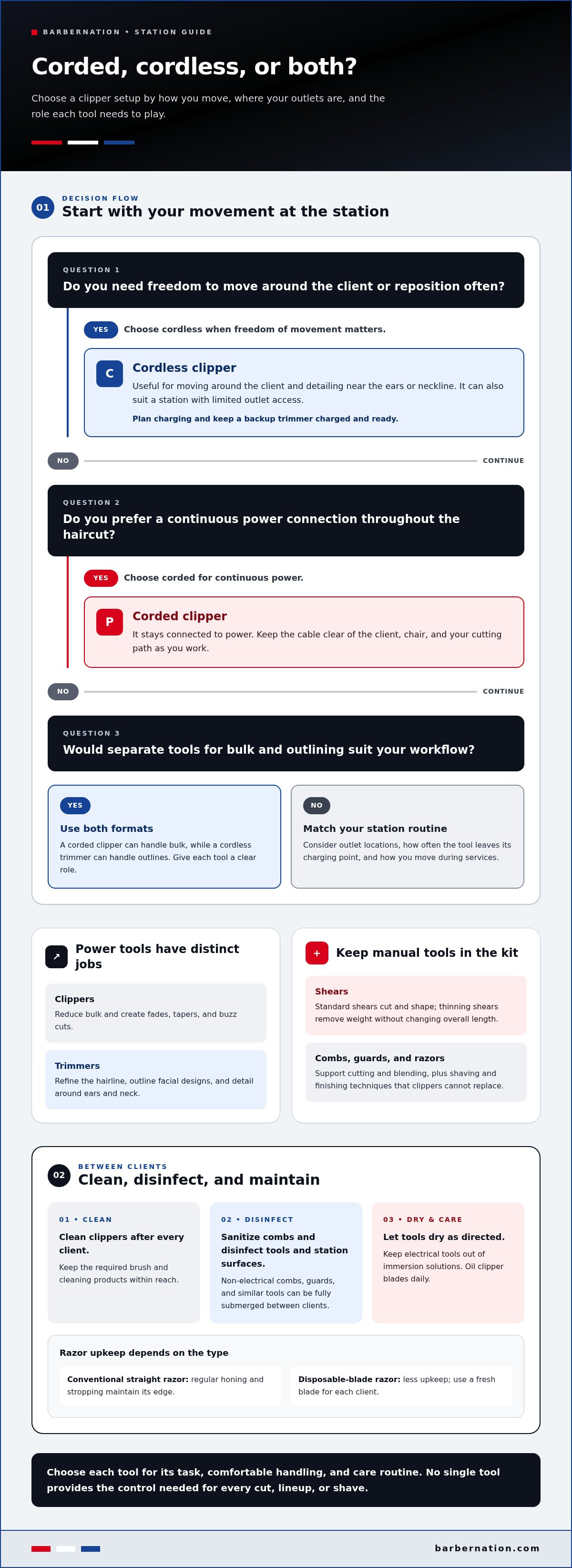
A corded clipper draws power through its cable, so it stays connected throughout a haircut. A cordless clipper runs on a rechargeable battery, giving you more freedom to move around the client. Neither format suits every station equally. Base your choice on how you move, where outlets are located, and how often the tool leaves its charging point.
For fades, tapers, and bulk removal, consider whether a cord could cross your path as you change sides. Cordless equipment makes it easier to reposition, especially when detailing around the ears or neckline. A corded model avoids battery-level planning, but its cable needs space and careful handling. Keep it clear of the client, chair, and other tools during each pass.
Look beyond the cordless label. Before choosing a clipper, review its charging method, battery-care guidance, grip, and blade maintenance. Match those details to your appointment flow: a tool used repeatedly needs a reliable place in your charging routine. Keep a backup trimmer charged and ready, so a depleted battery doesn’t interrupt a lineup or finishing detail.
- Choose cordless when freedom of movement matters more than staying plugged in. It can suit detail work around a moving chair or a station with limited outlet access.
- Choose corded when you prefer a continuous power connection. Route the cable so it stays away from the client’s neck and your cutting path.
- Keep both formats if your workflow benefits from a corded clipper for bulk and a cordless trimmer for outlines. Assign each tool a clear role.
- Plan charging by returning cordless tools to their designated place after use. Keep the backup trimmer charged, not buried in a drawer.
Shears and razors don’t need a power connection, so corded versus cordless design doesn’t affect how you use them. They remain essential for specific cutting, shaping, and shaving techniques. A cordless clipper also won’t replace shears when scissor-over-comb control is the better choice. Select power tools for the tasks they handle, and keep manual tools ready for the rest of the service.
Station cleanup can also benefit from cordless equipment. A cordless air duster can help remove loose hair from tools after a cut. For that cleanup task, consider the BarberNation Cordless Air Duster as a separate station accessory, not a substitute for clippers or trimmers.
In short, choose tools by task, movement, and power routine. A well-planned combination supports efficient styling without forcing one format to handle every job.
3. Essential barber toolkit
Build your station around tools with distinct roles. Clippers reduce bulk and create fades, tapers, and buzz cuts. Trimmers refine the hairline, outline facial designs, and detail around the ears and neck. Standard shears handle general cutting, while thinning shears remove weight without changing overall length. This core kit lets you move from shaping to precision without forcing one tool into every task.
Choose combs and guards to extend your tools’ usefulness. An all-purpose cutting comb supports scissor-over-comb and clipper-over-comb techniques, including beard and nape work. A tapered comb offers control around moustaches and ears; a wide-tooth comb helps detangle curly hair. Clipper and trimmer guards guide hair to a set length, helping make repeated passes more consistent.
- For close shaving: A straight razor or safety razor serves different preferences. Safety razors use single-use blades and a guard that protects skin from cuts.
- For beard preparation: A lather brush applies soap to soften facial hair. Its circular motion raises follicles for a close conventional shave.
- For client coverage: A barber cape keeps cut hair off clothing and skin. A fresh neck strip separates the cape from the client’s neck.
- For finishing: A neck duster brush clears small hairs from the neck and shoulders before removing the cape.
- For station upkeep: A fade brush removes loose hair from clippers and trimmers after a haircut.
- For shave setup: A lather receptacle holds and dispenses soap during the service, keeping the work area organized.
What tools can perform multiple barbershop tasks beyond hair cutting? An all-purpose comb supports scissor-over-comb and clipper-over-comb work, while guards help set cutting lengths. A lather brush prepares facial hair for shaving, and a neck duster clears loose hairs to finish the service.
Keep hygiene tools within reach, not in a drawer across the shop. Sanitize combs after every client, and use disinfectant sprays on tools and chairs between clients. Use light pressure with trimmers, since excessive force can cause skin irritation or abrasions. When using a clipper without a guard, check the client’s comfort as you work. This makes sanitation and careful handling part of the service, rather than last-minute tasks.
Set out the next client’s cape, neck strip, clean comb, and selected guards before the appointment. Keep a backup trimmer charged and ready for detailing. This organized layout supports smooth transitions between cutting, shaving, and finishing, while keeping each tool ready for its specific role.
5. Which barber tools combine trimming, outlining, and detailing functions?
A professional trimmer is a versatile choice for refining edges, outlining haircuts, and detailing facial designs. Its compact working head gives you control around the ears, neckline, and hairline. Use it to trim eyebrows or sharpen a lineup, adjusting your technique to the area and desired finish. It covers several precision tasks, but doesn’t replace a clipper’s role in removing bulk.
For a versatile setup, pair a trimmer with a guarded clipper. Guards help cut hair to an even, set length, while the trimmer cleans up the perimeter and adds definition. For a fade, use the guarded clipper to reduce length, then make multiple passes across the area in different directions. This approach can help reduce visible lines, ridges, and uneven results.
Use the trimmer selectively as the haircut develops. First, outline the hairline and neck; next, refine around the ears; then finish facial details such as a beard edge. This order separates broad shaping from fine cleanup, making it easier to identify areas that need attention. Keep pressure light, since pressing too firmly can cause skin irritation or abrasions.
- Hairline: Use the trimmer to create sharp lines and define a lineup without using a larger clipper for fine work.
- Neck and ears: Follow the natural contour, using controlled strokes to refine edges in tight areas.
- Facial designs: Detail beard outlines and other designs with the trimmer’s precision, then check both sides for balance.
- Eyebrows: Use a trimmer for careful trimming, keeping movements controlled around the client’s eyes.
A razor has a different finishing role. Use it when the service calls for a closer result on the skin, rather than expecting a trimmer to provide the same shave. Shears also remain useful for controlled length removal, while a trimmer is better suited to sharp lines and detailed perimeter work.
Match the tool to the finish, not just the number of tasks it can perform. For outlining and detailing, assess how steadily you can guide the trimmer around curves and corners. For longer hair, use a clipper with an appropriate guard before refining the edge. During unguarded clipper work, check client comfort and avoid excessive pressure. This combination gives each tool a clear role and supports precise, polished results.
5. How much do professional multi-purpose barber tools cost in the United States?
Professional barber tool prices depend on category, quality, and intended use. These ranges help set a realistic budget, but each tool should earn its place through daily use and suitability for your services.
Start by budgeting for the tools that shape your regular work. A clipper handles larger sections and fades; a trimmer refines outlines and details. If both tasks feature in most appointments, compare them as separate purchases rather than expecting one device to replace both. For scissor-led cutting, assess shears by how their type and quality suit your technique.
- Clippers: Compare how the tool handles bulk removal and repeated cutting.
- Trimmers: Consider their role in lineups, facial designs, and detailed work around ears and neck.
- Shears: Match the shears to your cutting technique and regular workload.
- Razors: Include one when conventional shaving is part of your service mix.
Build the rest of your budget around service needs, not a longer shopping list. A barber focused on fades may prioritize clippers, guards, and a detailing trimmer. A shop offering conventional shaves should also budget for razor equipment. Combs, capes, and neck strips support different stages of service, but the right quantity depends on station use and cleaning routines.
Compare value beyond the purchase price. Check how a tool feels in your hand, what care its blades need, and whether it suits your techniques. A more expensive shear isn’t automatically the best fit; blade type and handling matter for the work you do. For powered tools, weigh corded or cordless use against your workflow and charging habits.
To set a practical budget, list your core services, identify the tool each requires, and rank purchases by frequency of use. Then separate essential equipment from upgrades that can wait. This keeps spending focused while leaving room for specialized tools as your services develop. Treat hygiene supplies and routine maintenance as ongoing operating costs, not optional extras.
BarberNation: Professional Barber Tools and Grooming Supplies: BarberNation Cordless Air Duster
BarberNation offers its Cordless Air Duster for barbers who want a cordless way to clear loose hair from tools during station cleanup. It complements clippers, trimmers, and brushes; it doesn’t replace cleaning and disinfecting tools between clients.
Choose the BarberNation Cordless Air Duster when it fits your station routine and you want to clear loose hair after a cut. BarberNation also offers water-resistant hair enhancement and barber T-shirts for different grooming and professional needs. Choose each product for its role: finishing details, station upkeep, or workwear.
For a closer look at the cordless air duster, explore the BarberNation Cordless Air Duster. Visit BarberNation online to explore its offerings.
Build your next level of craft
Your station can evolve alongside your technique. As your services develop, review which parts of your workflow need more focus: precision finishing, a cleaner tool-change routine, or a more consistent presentation. Choosing multi-purpose tools for a barbershop is about supporting the way you work, not collecting equipment without purpose.
For station cleanup, BarberNation offers its Cordless Air Duster. The company also offers water-resistant hair enhancement and barber T-shirts. Each serves a different need, so choose what fits your grooming work or professional identity.
Make your next equipment decision with intention, then put it to work in your craft. Explore BarberNation’s offerings and get in touch to take the next step. Keep refining your skills, your station, and the standard you bring to every client.
Frequently Asked Questions
Which additional barber tools are essential to offer the best professional service?
Add tools that complete the client experience, not just the haircut: neck strips, a clean cape, a neck duster, and a mirror for showing the finished result. For beard services, keep a lather brush and soap available. A separate, clearly organized area for clean tools also helps you prepare for the next appointment without mixing used equipment with ready-to-use essentials.
What are the essential tools required by barbers?
A barber’s core kit should reflect the services offered. For a fade-focused appointment, prepare clippers, guards, a cutting comb, and a trimmer for the final outline. For a scissor-led cut, add standard shears and a comb suited to the client’s hair texture. Beard grooming may call for a razor and shaving tools. Arrange each set before the service to avoid interruptions.
Which accessories are necessary to complement your barbering tools?
Useful accessories include extra clipper guards, a charging stand for compatible cordless equipment, a cape, neck strips, and dedicated cleaning brushes. Keep replacement blades or other parts that match your tools available for routine upkeep. For example, label guard sizes and store them together so you can select the intended length quickly and return each accessory to its place after the cut.
What multi-purpose tools are essential for a barbershop?
A trimmer is a practical multi-tasker for refining hairlines, detailing facial designs, and trimming around the ears and neck. A cutting comb supports both scissor-over-comb and clipper-over-comb work. For station cleanup, an air duster can clear loose hair from equipment and work surfaces. These tools support several tasks, but specialized shears, razors, and clippers remain useful when a service calls for their distinct control.
How do cordless and corded multi-purpose barber tools compare?
Cordless tools give you more freedom to move around the chair, which can help when switching sides during a fade. Corded tools stay connected to power, so you don’t need to plan a charging spot for every service. Consider your station layout, outlet access, and how often you use each tool. A mixed setup can make sense when different tasks call for different handling.
How should barbers clean, disinfect, and maintain multi-purpose tools?
After each client, remove visible hair, then clean and disinfect tools according to their care instructions. Keep electrical equipment away from immersion solutions; submerge only non-electrical tools when the disinfectant directions allow it. Clean combs between clients, and separate used items from sanitized ones. Maintain clipper blades with regular brushing and oiling, and strop or hone conventional straight razors as needed.
How can a barbershop choose multi-purpose tools for its services and budget?
Start with your appointment mix: list the services you perform most, then identify the tools each one requires. Prioritize equipment used across several services, such as a trimmer for hairline and beard detailing. Next, compare grip, upkeep, and suitability for your techniques. Set aside funds for sanitation supplies and replacements, then add specialized tools as your services or workflow develop.
Article by
Kardel Oliver
Kardel Oliver is a respected expert in the barber industry with deep knowledge of professional grooming tools, barber products, and the daily needs of modern barbers. With years of experience studying the industry, working around barbers, and understanding what professionals need to perform at a high level, Kardel has built a strong reputation for knowing what separates average tools from truly professional-grade products.
Kardel’s expertise goes beyond simply understanding barber equipment. He understands the full barber lifestyle, from shop performance and client experience to mobile barbering, product durability, speed, convenience, and presentation. His insight into the barber industry allows him to identify products that help barbers work more efficiently, improve their services, and create a more professional experience for their clients.
Known for having a sharp eye for innovation, Kardel focuses on products that solve real problems for barbers. Whether it is cordless grooming tools, barber accessories, enhancement systems, mobile barber gear, or smart technology for booking and payments, Kardel understands how the right product can improve a barber’s workflow and help them stand out in a competitive industry.
Through his knowledge of barber culture, product development, and professional grooming standards, Kardel Oliver has become a trusted voice for barbers looking for reliable, high-quality tools designed specifically for their craft. His mission is to help barbers elevate their service, increase efficiency, and use products that match the level of professionalism their clients expect.