

The best barber station may not be all cordless or all corded. A hybrid setup lets you choose the power source that suits each task. That’s the practical point of weighing the cordless vs corded barber tools pros and cons.
If you’re concerned a cordless clipper could run low mid-shift, or a corded tool could tether you during a fade, both are real workflow considerations. Each format brings trade-offs in runtime, freedom of movement, readiness, and upkeep. The right fit depends on what you cut, how your station is arranged, and how often you move between clients.
This guide compares the everyday advantages and limitations of each format, with practical criteria for choosing tools for bulk removal, detail work, and cleanup. It also explains why a task-led setup can make more sense than choosing one power style for every job, including where the BarberNation Cordless Air Duster fits into a station.
Key Takeaways
- Separate power source from tool type: clippers, trimmers, and cleanup tools can each suit different station needs.
- Compare the cordless vs corded barber tools pros and cons across power connection, mobility, readiness, and routine upkeep.
- Assess each model’s runtime and charging needs alongside service length, outlet access, and your daily pace.
- Choose a power source task by task instead of assuming cordless is weaker or corded is always more dependable.
- Build a deliberate hybrid station, pairing cutting tools and cleanup accessories with the power style that fits each job.
Cordless vs. Corded Barber Tools: What Actually Changes at the Station?
For a working barber, the power source affects more than where a tool plugs in. It shapes how easily you reposition around a client, how you prepare between appointments, and how you organize the station. To compare the cordless vs corded barber tools pros and cons, separate two decisions: what job a tool performs and how it gets power.
A corded tool operates through a connected power supply while in use. A cordless tool runs on a battery, so it isn’t tethered to an outlet during the service. That distinction applies across tool categories, but it doesn’t make the tools interchangeable. A clipper removes or blends hair, a trimmer handles detail work, and cleanup equipment serves a different purpose. Assess each tool against the task it is designed to do.
A tool’s power source describes how it operates; its cutting purpose describes the work it’s designed to perform. A cordless format doesn’t tell you whether a tool suits bulk removal, outlining, or cleanup. Check the tool’s intended use, design, and specifications as well.
Which barber tools can be corded or cordless?
Clippers and trimmers are familiar examples of cutting tools that may be available in corded or cordless formats, although not every model comes in both. Evaluate a model against the work it needs to handle, such as removing length, refining a fade, or sharpening a line. Cleanup accessories belong in a separate category: the BarberNation cordless air duster, for example, is a cleanup tool, not a clipper or trimmer.
Why power source matters during a service
A cable can affect how freely you reposition around a client, especially if you move between sides or work at different angles. A cordless tool removes the cable from the movement equation, but adds a readiness question: is it charged and prepared for the next service? Neither format is automatically better. The useful comparison is how each one fits your work and station.
Consider the rhythm of an appointment. For a longer service, battery readiness and charging routines matter. In a compact station with accessible outlets, a connected tool may be straightforward to use. Check where cords run, where tools rest between clients, and how often you change position while cutting. These details affect comfort and workflow without changing the fundamentals of the service.
Start with the task, then examine the station around it. A cutting tool and a cleanup accessory don’t need to share a power format just because they sit side by side. Match each choice to its purpose, service duration, movement demands, and readiness routine. That gives you a practical basis for comparing specific advantages and limitations.
Cordless vs. Corded Barber Tools: Compare Power, Runtime, and Readiness
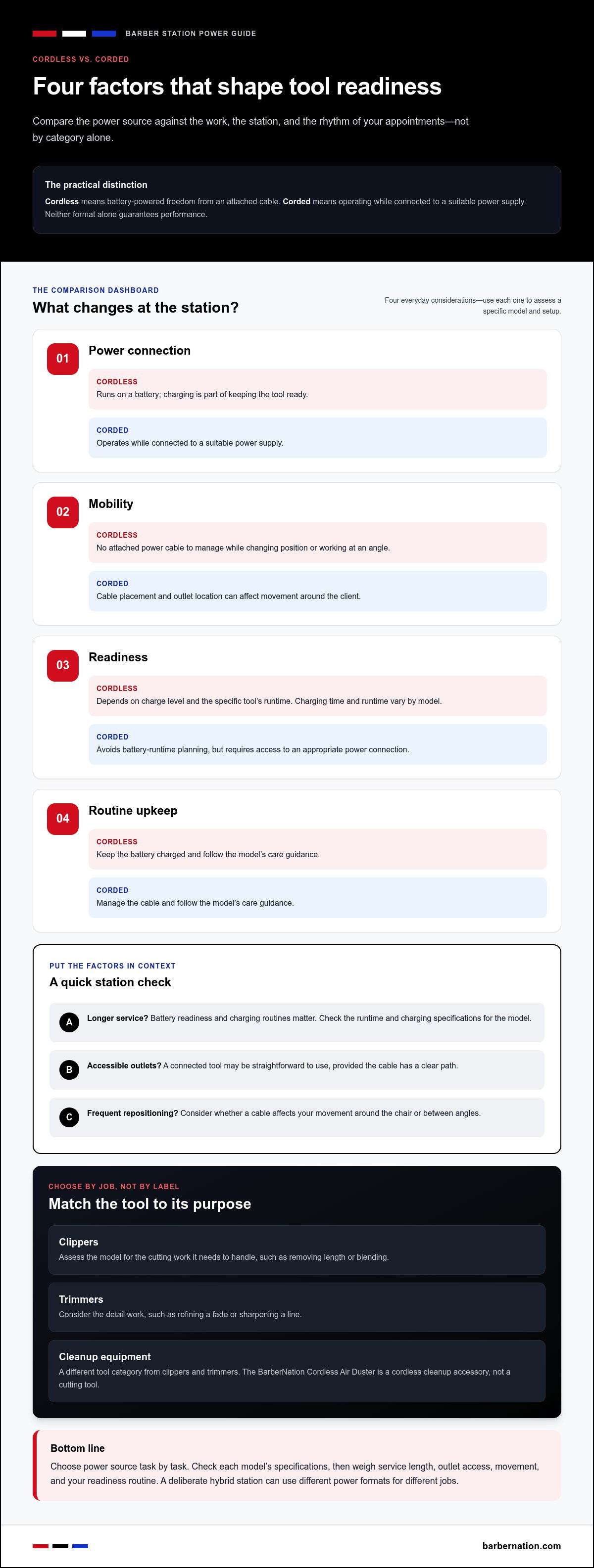
The practical comparison comes down to how each tool stays ready through your schedule. Cordless operation gives you more freedom to reposition, while corded operation avoids planning a service around battery runtime. Neither factor tells the whole story: model design, outlet access, charging habits, and how you work all shape performance at the station.
Use this table to compare the everyday considerations before judging individual tools:
| Consideration | Cordless | Corded |
|---|---|---|
| Power connection | Runs on a battery; charging is part of readiness. | Operates while connected to a suitable power supply. |
| Mobility | No attached power cable to manage during use. | Cable placement and outlet location can affect movement. |
| Readiness | Depends on charge level and the tool’s runtime. | Avoids battery-runtime planning, but requires access to power. |
| Routine upkeep | Includes keeping the battery charged and following model care guidance. | Includes managing the cable and following model care guidance. |
Cordless tool advantages and limitations
A cordless tool can make it easier to change position around the chair or work from an angle without routing a cable around the client. That freedom is useful only if the tool is ready when the next appointment begins. Build charging into your between-service routine, and consider whether your schedule gives you a practical opportunity to recharge. Runtime and charging time vary by model, so use the specifications for the tool you’re considering rather than relying on a general estimate.
Performance varies too. A cordless label alone doesn’t tell you how a specific tool handles your work. Compare the model’s specifications with the task, and weigh battery readiness alongside mobility.
Corded tool advantages and limitations
A corded tool can operate while it remains connected to an appropriate power supply, so battery runtime doesn’t need to shape your service plan. That can simplify readiness during a busy schedule. But dependable operation still relies on a suitable connection, and the cable needs a clear path that won’t snag, cross your working area, or restrict repositioning.
Check outlet access before settling on a corded setup. Think about where the client sits, where you stand during the cut, and whether the cord reaches without disrupting your movements. Corded models can differ in design and performance, so the connection type is only one part of choosing a tool.
Runtime and performance must be checked at the model level, not assumed from the power-source category. For a cordless station accessory, explore the BarberNation cordless air duster as cleanup equipment, not a cutting tool. As you compare the cordless vs corded barber tools pros and cons, weigh the actual specifications against your station layout and appointment rhythm.
Cordless vs. Corded Barber Tools: Pros, Cons, and Common Misconceptions
Power source alone doesn’t determine whether a barber tool is strong, reliable, or right for a service. A well-designed cordless tool may suit its intended task, while a corded model still depends on its own specifications and condition. Compare the individual tool, its use, and your daily routine rather than treating either format as a guarantee of performance.
Use the same criteria for both formats to see the trade-offs clearly:
- Cordless advantages: Greater freedom to move around the chair, fewer cables to manage, and flexibility in stations where outlet placement is awkward.
- Cordless limitations: Requires charge planning, awareness of model-specific runtime, and a routine for keeping the tool ready between services.
- Corded advantages: Operates while connected to a suitable power supply, with no battery-runtime planning during use.
- Corded limitations: Cable reach and placement can affect movement, and the station needs an accessible power connection.
Two assumptions deserve a closer look. Cordless doesn’t automatically mean weaker: performance depends on the specific tool and its specifications, not just the absence of a cable. Corded doesn’t automatically mean more dependable either. Connection, cable condition, tool upkeep, and the fit between the model and task all matter. Reliability comes from choosing suitable equipment and maintaining a consistent routine.
When cordless tools may suit the workflow
Choose cordless when repositioning around the chair is central to your technique, or when cable routing would clutter a compact station or interfere with handling. The advantage is movement, not freedom from preparation. Build charging into your routine and compare a model’s stated runtime with the length and pace of your services. If the tool is often undercharged, its mobility may not outweigh the risk of interruption.
When corded tools may suit the workflow
A corded format may fit stationary work where a suitable outlet is close and the cable can stay clear of your working area. It can also simplify a routine if managing charges across several tools adds unnecessary work. Balance that convenience against cable reach and workspace organization. A power connection helps only if the cord lets you work comfortably and keeps the station orderly.
Use these conditions as a starting point, not a fixed rule:
| Workflow condition | Format that may fit | What to weigh |
|---|---|---|
| Frequent movement around the client | Cordless | Charge routine and model runtime |
| Fixed position with accessible power | Corded | Cable reach and placement |
| Several tools used across a busy schedule | Either | Compare battery readiness with outlet access |
The practical answer to the cordless vs corded barber tools pros and cons question is task-specific. Match the format to your movement, station layout, and readiness habits, then judge performance at the individual-model level. That keeps assumptions from driving your setup and puts your service workflow first.
How to Choose Cordless or Corded Barber Tools for Your Setup
Make the decision tool by tool, using the demands of the service and the realities of your station. This four-step process turns the cordless vs corded barber tools pros and cons into a practical setup without assuming one power source belongs everywhere.
- Identify the task. Define what the tool needs to do: remove bulk, refine a blend, detail an outline, or support station cleanup. Consider how precise the work is and how often you need to reposition around the client. Movement-heavy tasks may benefit from fewer cable constraints, while a connected tool may suit other jobs if its power access and specifications meet the need.
- Assess the station. Look at the actual work area, not an idealized layout. Note outlet access, cable reach, where tools rest between services, and whether you can route cords without crossing your movement path. A cordless option may simplify a crowded station, but only if you can keep it charged and ready.
- Check readiness. Match the tool’s expected use to your service duration and work rhythm. For cordless equipment, decide when you’ll charge it and how you’ll maintain readiness across your schedule. For corded equipment, make sure a suitable power connection is conveniently positioned. Include every tool you rely on, rather than planning around a single device.
- Compare models. Review manufacturer specifications for the particular task. Compare runtime and charging information for cordless models, and examine stated power details for either format. Don’t infer cutting performance from “cordless” or “corded” alone. The model, intended use, and your upkeep routine all matter.
Match the power source to the task
Keep precision cutting, detailing, and cleanup distinct in your plan. A clipper used for bulk removal has different demands from a trimmer used to sharpen a line, and neither job is the same as clearing loose hair from the station. Ask how much movement each task requires, then prioritize the tool’s purpose, handling needs, and specifications. You don’t need to choose one format for every job.
Assess readiness and station constraints
Map where a cord can reach without pulling across your work area, and identify which outlets remain accessible during service. For cordless tools, choose a consistent place and routine for charging between appointments. Then compare model-level details such as runtime and charge time. A quick station audit can reveal a mismatch before it disrupts your rhythm.
Use the results to build a setup around how you actually work: your service mix, station layout, and pace. If cordless cleanup equipment fits your station, explore the BarberNation Cordless Air Duster as an accessory for cleanup, not a cutting tool.
Build a Hybrid Barber Station with Tools for Each Job
A hybrid station isn’t a compromise. It’s a deliberate way to assign each tool the power source that best fits its role, service demands, and place in your workflow. Rather than replace an entire kit, assess where mobility matters, where a connected supply suits the task, and how each tool stays ready. Your setup can combine formats without forcing every tool into the same choice.
Assign each tool a clear role
Start with the work itself. Clippers handle cutting tasks such as bulk removal and blending; trimmers support detail work like refining an outline. For either, weigh how you move around the chair and what the specific model requires. If you often change position during detailing, cordless mobility may help. If a connected tool fits your technique and station, that can be a sound choice too.
Keep cleanup separate from cutting. It has its own job in the service sequence and doesn’t need to use the same power format as your clippers or trimmers. The BarberNation Cordless Air Duster is a cordless station-cleanup tool designed to support efficient cleanup and precision. It isn’t a cutting tool, so assess it by how cleanup fits into your station routine, not by clipper performance.
Keep the setup practical and dependable
Give every tool a home. Store battery-powered equipment in a consistent place and build charging into your regular station reset. Route connected-tool cables so they don’t cross your movement path or clutter the work surface. These habits make readiness and access part of the setup, rather than last-minute considerations between clients.
Review the arrangement against the way services actually run. A change in your service mix may alter which tools you reach for most; a different station layout may affect outlet access or cable routing. If a cordless tool’s charge routine is difficult to maintain, reconsider where it lives or whether that format fits its role. If a corded tool limits your movement, reassess its position and reach. Small adjustments can keep the station functional without replacing equipment that still serves its purpose.
Use a simple station check as you refine the mix:
- Cutting: Match clipper and trimmer requirements to their specific tasks.
- Movement: Identify where working around the chair makes cable-free handling useful.
- Cleanup: Treat accessories as a separate function with their own readiness needs.
- Routine: Keep charging locations and cable paths organized and consistent.
The strongest answer to the cordless vs corded barber tools pros and cons question is a setup shaped by your craft, not a one-format rule. Reassess the mix as your services, pace, or space evolve. To add cordless cleanup equipment to your station, explore the BarberNation Cordless Air Duster.
Shape Your Station Around the Work Ahead
Your station should support the way you want to work next, not just the habits you’ve already built. As your services and pace evolve, revisit whether each tool helps you move smoothly through an appointment and stay prepared for the next client. Treat every addition as a deliberate choice: it should serve a clear role, fit your routine, and earn its place in your setup.
That’s the lasting value of weighing the cordless vs corded barber tools pros and cons. You’re not choosing a side for its own sake. You’re shaping a professional environment that gives your craft room to progress, one considered tool at a time.
BarberNation offers the BarberNation Cordless Air Duster for professional grooming environments, with free shipping on domestic orders in the United States. Explore the BarberNation Cordless Air Duster and add a dedicated cordless cleanup tool to your station.
Frequently Asked Questions
Are cordless barber tools as powerful as corded tools?
Some cordless tools can deliver performance suited to professional work, but power depends on the individual model, not the word “cordless” on its label. Compare manufacturer specifications and consider how the tool handles the hair types and techniques you work with. If possible, evaluate it during a representative service rather than judging by a quick test on a fully charged battery. The cordless vs corded barber tools pros and cons depend on the model and your routine.
Can barbers use cordless and corded tools together?
Yes. A barber can use different power formats across a station, choosing each tool for its role. For example, you might prefer a connected clipper for a task where you stay near your station, then use a cordless trimmer when moving around the client helps with detailing. Include each tool’s charging or cable requirements in your station reset so changing formats doesn’t interrupt the next service.
How long do cordless barber tools run on one charge?
Runtime varies by model, so there isn’t one reliable figure for all cordless barber tools. Check the manufacturer’s stated runtime for the specific tool, then consider whether it covers the way you’ll use it, including consecutive services. Actual readiness can also depend on charge level and usage. For a busy day, plan around the published specification rather than assuming a tool will last through an entire shift.
Do cordless barber tools need to be charged after every use?
Not necessarily. Whether to recharge after each use depends on how much charge remains, how soon you’ll need the tool again, and the manufacturer’s charging guidance. Check battery status during your station reset and charge according to the model’s instructions. That gives you a clearer picture before the next appointment than relying on memory or waiting until the tool is nearly depleted.
Are corded barber tools better for a busy barbershop?
Not automatically. A corded tool can avoid battery-runtime planning during use, which may suit a schedule with little downtime. But a busy shop also needs to account for outlet access, cable routing, and how often barbers move between clients. Compare those realities with the time available to keep cordless tools charged. The better fit is the one that supports your busiest workflow without adding a different bottleneck.
Do cordless barber tools lose performance as the battery runs down?
It depends on the tool’s design and how it manages power as the charge falls. Don’t assume every model behaves the same way. Check the manufacturer’s operating guidance for low-battery indications or performance notes, and pay attention to how the tool performs during normal use. If consistent output is essential for a particular service, include low-charge behavior in your model comparison and maintain a readiness routine.
Are cordless barber tools worth adding to a professional station?
They can be a worthwhile addition if cable-free handling solves a real workflow need, such as moving freely while detailing or using a cleanup accessory away from a fixed outlet. Start with one tool that has a clear role instead of replacing equipment that already serves you well. Consider charging habits, storage, and the manufacturer’s specifications, then decide whether the added flexibility makes your station more practical.
Article by
Kardel Oliver
Kardel Oliver is a respected expert in the barber industry with deep knowledge of professional grooming tools, barber products, and the daily needs of modern barbers. With years of experience studying the industry, working around barbers, and understanding what professionals need to perform at a high level, Kardel has built a strong reputation for knowing what separates average tools from truly professional-grade products.
Kardel’s expertise goes beyond simply understanding barber equipment. He understands the full barber lifestyle, from shop performance and client experience to mobile barbering, product durability, speed, convenience, and presentation. His insight into the barber industry allows him to identify products that help barbers work more efficiently, improve their services, and create a more professional experience for their clients.
Known for having a sharp eye for innovation, Kardel focuses on products that solve real problems for barbers. Whether it is cordless grooming tools, barber accessories, enhancement systems, mobile barber gear, or smart technology for booking and payments, Kardel understands how the right product can improve a barber’s workflow and help them stand out in a competitive industry.
Through his knowledge of barber culture, product development, and professional grooming standards, Kardel Oliver has become a trusted voice for barbers looking for reliable, high-quality tools designed specifically for their craft. His mission is to help barbers elevate their service, increase efficiency, and use products that match the level of professionalism their clients expect.