

What changes when a client sees hair fibers as a styling aid rather than a solution for hair loss? Explaining the benefits of hair fibers to clients starts with that distinction. Fibers can help create the appearance of fuller-looking hair, but they don’t stimulate growth or treat thinning.
Clients are right to ask how a product may look, feel, and fit into their routine. A clear, pressure-free conversation helps you relate its cosmetic effect to their hair and styling goals without promising more than it can deliver.
This guide offers practical ways to describe what hair fibers can do, discuss application and upkeep, and set natural-looking expectations. It also explains how fibers differ from other enhancement options, including BARBERNATION FADE FUSION, a water-resistant hair-enhancement solution designed for precision styling and finishing. The aim is a useful consultation, a considered recommendation, and a result that feels right for the client.
Key Takeaways
- Use clear, cosmetic-focused language when explaining the benefits of hair fibers to clients, and don’t imply they treat hair loss.
- Discuss appearance, styling choices, and routine fit as potential benefits, while tailoring expectations to each client’s hair and goals.
- Compare hair-enhancement options by purpose, desired finish, application approach, and upkeep rather than treating them as interchangeable.
- Guide consultations through four steps: understand the goal, explain the cosmetic effect, discuss suitability, and confirm expectations.
- Present BARBERNATION FADE FUSION as a distinct water-resistant hair-enhancement option designed for precision styling and finishing.
What Are Hair Fibers, and What Do They Do for a Client?
A client may want a style that looks fuller without suggesting their hair is growing back. That distinction is the starting point for explaining the benefits of hair fibers to clients. Hair fibers are cosmetic styling products used to make existing hair appear denser. They can change the look of a finished style, but they don’t treat hair loss or alter hair growth.
A clear definition: “Hair fibers are a cosmetic way to make existing hair look fuller; they don’t regrow hair or treat the cause of thinning.” This keeps the benefit specific and expectations honest. Hair grows from follicles, while the visible hair shaft is the part a styling product can affect. The Hair follicle provides useful background on this distinction.
How Hair Fibers Create a Fuller-Looking Effect
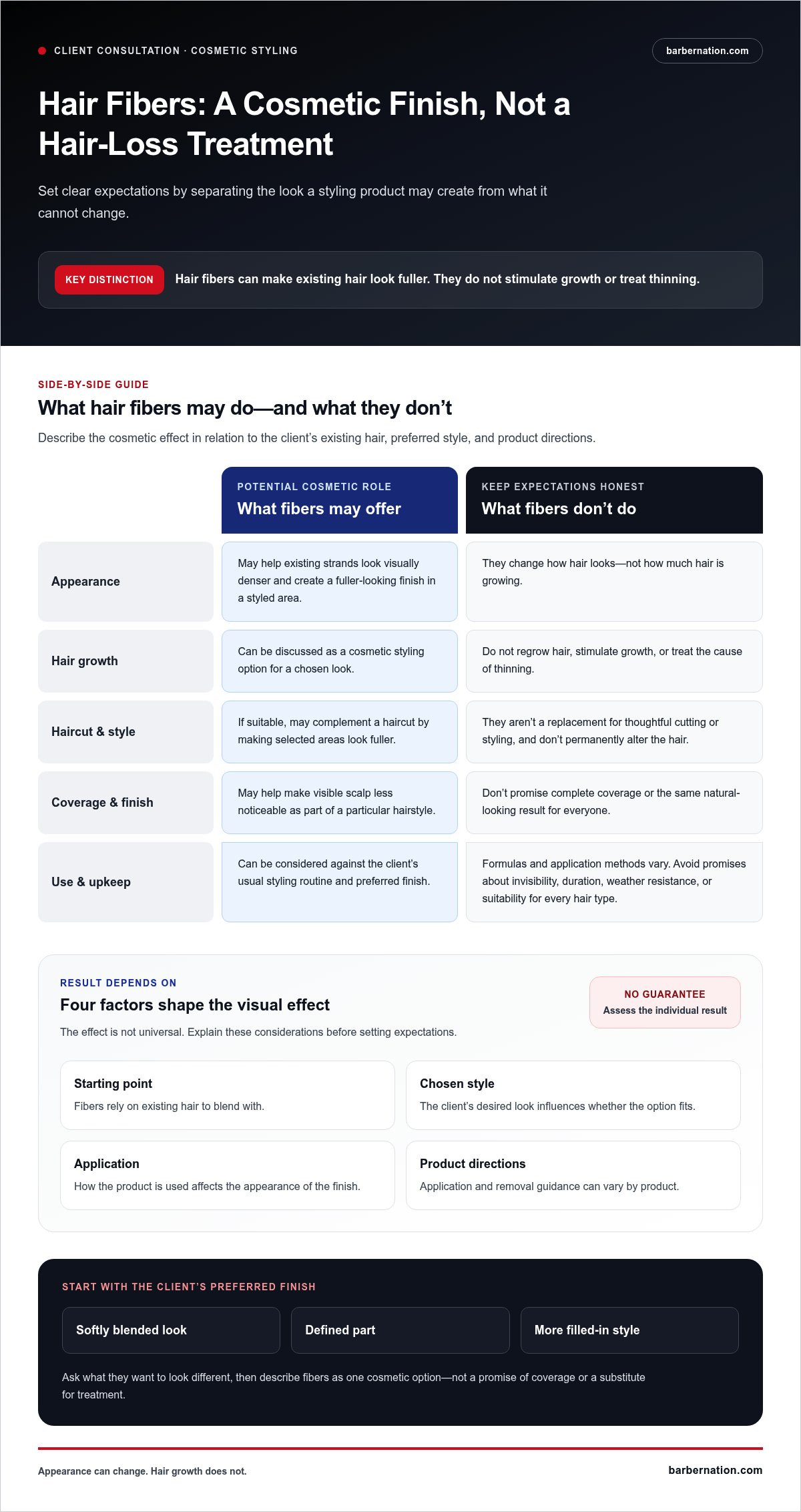
Hair fibers are designed to visually blend with existing strands, helping create the impression of greater density in a styled area. The effect is cosmetic: the product changes how the hair looks, not how much hair is growing. Ingredients and application methods vary, so avoid presenting one formula or technique as universal.
Results depend on the client’s starting point, chosen style, application, and the product’s directions. For example, a client may want the scalp to be less noticeable around a part or at the crown. Whether fibers create a natural-looking finish there depends on the client’s hair and how the product is used. Avoid promising complete coverage or the same result for everyone.
Which Client Concerns Might Hair Fibers Address?
Fibers may suit clients who want areas of visible scalp to be less noticeable as part of a particular hairstyle. Start by asking what finish they have in mind: a softly blended look, a defined part, or a style that appears more filled in. Their answer helps you assess whether a cosmetic styling product aligns with their goal, without implying a medical benefit.
Suitability depends on the client’s existing hair and expectations. Explain that the visual effect relies on hair being present for the fibers to blend with. Discuss whether using a product fits their usual styling routine, then refer to the selected product’s directions for application and removal rather than assuming every formula works the same way.
Keep the consultation grounded in what the client wants to see and style. Ask which areas concern them, what finish they prefer, and how a styling product might fit their routine. Then describe hair fibers as one cosmetic option, not a promise of coverage or a substitute for treatment. This straightforward framing builds trust and helps clients decide whether the approach suits their goals.
Which Benefits of Hair Fibers Can You Explain Clearly?
Clients don’t need sweeping promises. They need to know what a cosmetic styling product may contribute to their chosen look. Hair fibers may help create a denser-looking finish when they suit the client’s existing hair, desired style, and product directions. Frame the potential benefit around appearance, styling choice, and routine fit, not guaranteed coverage or a change in hair growth.
Hair fibers can change the appearance of a style, but they don’t change hair growth. That distinction lets you discuss potential benefits confidently while keeping the consultation realistic. A natural-looking result isn’t automatic: the starting style, application, and product all matter.
A Cosmetic Boost Without Changing the Haircut
A haircut establishes the shape, balance, and finish of a style. Hair fibers, if suitable, may complement that foundation by making selected areas look visually denser. They’re an appearance choice, not a replacement for thoughtful cutting or styling, and they don’t permanently alter the hair.
For instance, a client who likes their current cut but wants a fuller-looking impression around a part may want to discuss whether fibers could complement that finish. Keep the language conditional: “This may help create the look you’re after, depending on how it works with your hair and the product’s directions.” The client can then weigh the cosmetic effect against the overall style they prefer.
A More Informed Styling Choice
A useful consultation helps clients decide whether the potential effect fits their priorities. Ask what they want to look different, what finish they prefer, and how they usually style their hair. Their answers keep your recommendation personal rather than turning a possible benefit into a blanket promise.
Routine fit matters, too. Encourage clients to consider whether using a styling product feels like a comfortable addition to the way they groom. Direct them to the specific product instructions for application and care, since these can vary. Don’t promise that fibers will be invisible, last for a particular length of time, resist weather, or suit every hair type.
Clear explanations make the decision easier without predicting how a client will feel about the result. Some may appreciate having a cosmetic option to consider; others may prefer their look without it. Both are valid outcomes. Your role is to clarify the trade-offs, not to sell a particular effect.
When explaining the benefits of hair fibers to clients, keep the value precise: a possible denser-looking finish, a way to complement a haircut, and an option they can assess against their grooming routine. Separate those styling advantages from regrowth or treatment claims. That balance respects the client’s goals and keeps your recommendation grounded.
Hair Fibers Compared With Other Hair-Enhancement Options
Clients may use “hair enhancement” to describe several different products, but the categories aren’t interchangeable. Compare options by the result the client wants, the product’s intended use, how it’s applied, and what upkeep its directions call for. This gives the client a practical basis for choosing without suggesting that one option suits everyone.
| Option | Cosmetic purpose | Consultation consideration |
|---|---|---|
| Hair fibers | May create a denser-looking appearance by visually blending with existing hair. | Discuss the client’s existing hair, desired finish, application directions, and routine. |
| Enhancement sprays | A separate product category whose intended cosmetic effect depends on its formulation and directions. | Clarify the specific effect the client wants, then refer to the product’s application and care instructions. |
| Other styling products | Can be intended to shape or finish a style rather than create a denser-looking appearance. | Identify whether the priority is styling, finishing, or another cosmetic effect before recommending an approach. |
| BARBERNATION FADE FUSION | A water-resistant hair-enhancement solution designed for precision styling and finishing. | Present it as a distinct enhancement option, not as hair fibers or a product with identical use. |
Hair Fibers Versus Enhancement Products
Hair fibers are one cosmetic approach: they may help make existing hair appear denser. Enhancement sprays and other styling products are different categories, so don’t assume they apply in the same way or serve the same goal. Describe each option according to its intended use and product directions. BARBERNATION FADE FUSION is a separate water-resistant hair-enhancement solution designed for precision styling and finishing; that description doesn’t make it a fiber product.
Keep the comparison precise. A client seeking a fuller-looking impression may want to discuss fibers, while someone focused on a particular styling or finishing effect may have a different priority. Avoid claims about invisibility, wear time, weather resistance, or universal suitability unless the specific product information supports them.
How to Match an Option to the Client’s Goal
Start with a simple question: “What would you like your finished style to look like?” The client might want a fuller-looking finish, more defined styling, or another cosmetic effect. Then consider their existing hair and preferred grooming routine. Those details help you discuss relevant options without steering every client toward the same product.
Explain trade-offs neutrally. Fibers may suit a client’s goal if their hair and preferred routine align with the product directions; another enhancement category may better match a different styling objective. The choice depends on the individual, not a universal ranking. This is the core of explaining the benefits of hair fibers to clients: connect the possible cosmetic effect to the person’s desired finish, and be clear about what the product is intended to do.
For a closer look at a distinct enhancement approach, see BarberNation’s hair-enhancement options.
How to Explain Hair Fibers During a Client Consultation
A thoughtful consultation turns a styling concern into a clear, client-led conversation. Keep it practical and pressure-free: understand the goal, explain the cosmetic effect, discuss fit, then confirm expectations. This gives the client room to ask questions and decide whether the option suits their look and routine.
- Understand the goal. Ask what the client hopes to change about the finished style, and listen before suggesting a product.
- Explain the cosmetic effect. Describe fibers as a styling product that may make existing hair appear denser. Don’t present them as a growth solution or treatment.
- Discuss fit. Consider the client’s existing hair, preferred finish, and grooming routine. Refer to the selected product’s directions for application and removal.
- Confirm expectations. Check that the client understands the intended cosmetic effect and feels comfortable with the approach.
Questions That Clarify the Client’s Desired Result
Use open questions rather than assuming what the client wants. Ask, “Which area or part of the style would you like to address?” and “Are you picturing a subtle finish or a more noticeable cosmetic change?” Then explore routine fit: “How would adding a styling product work with the way you usually groom your hair?” These answers help keep the recommendation specific.
These questions also make space for concerns about appearance and upkeep without turning the conversation into a diagnosis. If a client raises medical concerns or asks whether fibers can address hair loss, stay within your role: clarify that fibers are cosmetic, not treatment, and avoid offering medical advice.
Setting Expectations and Addressing Hesitation
Be direct and considerate. You might say, “I understand you’d like a fuller-looking finish. Fibers may help create that cosmetic effect if they suit your hair and the product’s directions, but they don’t promise coverage or treat hair loss.” This acknowledges the concern while setting a realistic boundary.
Invite questions about how a chosen product is intended to be applied and removed, and encourage the client to follow its instructions. Don’t promise that a result will be invisible, last a specific length of time, or suit every hair type. A client may choose to try an option, think it over, or decline. Respect each decision without pressure.
A useful line to remember is: “We can explore a fuller-looking finish while keeping expectations realistic; the choice is yours.” This reassures without dismissing the client’s concern or implying a guaranteed result. It also keeps the consultation centered on their desired look, comfort, and routine.
That balance is at the heart of explaining the benefits of hair fibers to clients: listen closely, describe the cosmetic purpose accurately, and leave the decision with the client. For professionals considering a distinct enhancement approach designed for precision styling and finishing, see BarberNation’s hair-enhancement options.
Help Clients Choose a Hair-Enhancement Approach With Confidence
A confident recommendation begins with the client’s goal, not a product. Clarify the appearance they want, consider whether an option fits their existing hair and preferred styling routine, and set expectations before use. This client-led framework makes it easier to compare approaches without presenting different enhancement products as interchangeable promises.
A Simple Client Decision Checklist
Use this checklist to keep the discussion focused and practical:
- Confirm the desired appearance. Ask what the client wants to look different in the finished style. They may be seeking a fuller-looking effect, more precise styling, or another cosmetic result.
- Discuss suitability and routine. Consider the client’s existing hair, preferred finish, and how they like to groom and style it. A product should make sense for the look they’re pursuing and the routine they’re comfortable maintaining.
- Review directions and expectations. Refer to the specific product’s application and removal instructions. Explain its intended cosmetic purpose, and avoid promising a particular result, coverage, or experience.
This sequence helps keep recommendations individual. Two clients may describe a similar concern but want different finishes or have different styling habits. One may prefer to explore a fuller-looking effect, while another may be focused on precision finishing. Ask, listen, and tailor the conversation rather than assuming the same approach will work for both.
It’s also useful to distinguish product categories clearly. Hair fibers are one cosmetic option; enhancement sprays and other styling products have their own purposes and directions. Comparing them by intended effect, application approach, and routine fit helps clients weigh the choices without implying they do the same job.
Where BarberNation’s Enhancement Solution Fits
BarberNation’s BARBERNATION FADE FUSION is a water-resistant hair-enhancement solution designed for precision styling and finishing. It gives professionals a distinct enhancement option to consider in the context of a client’s styling goals. Present it according to this stated purpose, not as hair fibers, a hair-growth product, or an interchangeable alternative with identical effects.
Use the same realistic standard for every option: explain what the product is intended to do, account for the client’s desired appearance and routine, and let them decide whether it feels right. That’s the practical value of explaining the benefits of hair fibers to clients. You’re not selling a guaranteed transformation; you’re giving clients clear information to make a considered styling choice.
For a distinct option focused on water-resistant hair enhancement, precision styling, and finishing, explore BarberNation’s hair-enhancement products.
Make Every Recommendation a Confident One
Use each conversation to strengthen your consultation skills. A client’s concern deserves attention, clear language, and a recommendation shaped around their goals. That’s the value of explaining the benefits of hair fibers to clients: helping someone make an informed choice without pressure or unrealistic promises.
Keep building your understanding of enhancement options and how they fit into precision styling and finishing. BARBERNATION FADE FUSION is a water-resistant hair-enhancement solution designed for those professional styling purposes. It’s a distinct option, not a substitute for explaining what hair fibers are intended to do.
Explore BarberNation’s offering of hair-enhancement products to consider how it could complement your approach to client-focused finishing: BarberNation’s hair-enhancement products.
Keep refining your craft. Clear guidance builds trust, strengthens the client experience, and supports your continued growth as a professional.
Frequently Asked Questions
Do hair fibers help hair grow?
No. Hair fibers are cosmetic styling products: they change how existing hair appears, not how it grows, and they don’t create new follicles. A client may see a denser-looking finish without any change in hair growth. Don’t describe that visual effect as regrowth or treatment. If someone raises concerns about ongoing hair loss or changes in their scalp, encourage them to seek guidance from a qualified healthcare professional.
Can hair fibers work on very short or thinning hair?
They may suit some clients, but suitability depends on their existing hair, desired look, and the product’s directions. A closely cropped style and a longer style may provide different starting points for a cosmetic effect. Discuss the client’s actual hair rather than promising a result based on the word “thinning” alone. Keep the conversation focused on realistic appearance goals and whether the product instructions fit their situation.
Will hair fibers look natural?
They may create a natural-looking effect, but no finish can be guaranteed as invisible. The appearance depends on choosing a suitable product, applying it as directed, styling it appropriately, and how it works with the client’s hair. Ask whether they prefer a subtle effect or a more defined look. That preference can guide a realistic discussion of product choice and styling, with the product directions as the guide for use.
Are hair fibers suitable for sensitive scalps?
There isn’t a blanket answer for every sensitive scalp or formula. Encourage clients to read the specific product label and follow its instructions, including any cautions about use. Don’t recommend applying a product in a way its directions advise against. If a client has known sensitivities or current scalp concerns, suggest they seek appropriate professional guidance before use rather than making a safety assurance during a styling consultation.
Do hair fibers wash out?
Wear and removal depend on the specific product, so clients should follow its label rather than assume how it responds to washing, water, or perspiration. Avoid promising a set wear time or universal removal method. If a client wants to know how fibers could fit their regular grooming schedule, review the product’s washing and removal directions with them. This helps them consider upkeep before deciding whether to use it.
Are hair fibers the same as hair enhancement spray?
No. Fibers and enhancement sprays are distinct product categories, and their purpose, application, and finish shouldn’t be assumed to match. When explaining the benefits of hair fibers to clients, first clarify whether they want a denser-looking appearance or another styling effect, then compare options using their product directions. BARBERNATION FADE FUSION is a separate water-resistant hair-enhancement solution designed for precision styling and finishing, not a hair-fiber product.

Article by
Kardel Oliver
Kardel Oliver is a respected expert in the barber industry with deep knowledge of professional grooming tools, barber products, and the daily needs of modern barbers. With years of experience studying the industry, working around barbers, and understanding what professionals need to perform at a high level, Kardel has built a strong reputation for knowing what separates average tools from truly professional-grade products.
Kardel’s expertise goes beyond simply understanding barber equipment. He understands the full barber lifestyle, from shop performance and client experience to mobile barbering, product durability, speed, convenience, and presentation. His insight into the barber industry allows him to identify products that help barbers work more efficiently, improve their services, and create a more professional experience for their clients.
Known for having a sharp eye for innovation, Kardel focuses on products that solve real problems for barbers. Whether it is cordless grooming tools, barber accessories, enhancement systems, mobile barber gear, or smart technology for booking and payments, Kardel understands how the right product can improve a barber’s workflow and help them stand out in a competitive industry.
Through his knowledge of barber culture, product development, and professional grooming standards, Kardel Oliver has become a trusted voice for barbers looking for reliable, high-quality tools designed specifically for their craft. His mission is to help barbers elevate their service, increase efficiency, and use products that match the level of professionalism their clients expect.