

Avoiding barber burnout starts with noticing when a packed workday is becoming hard to sustain. When appointments run back-to-back, your body stays in the same position for hours, and client or business demands follow you home, even work you love can start to feel overwhelming. In Booksy’s 2026 survey, 44% of hair professionals said they find it difficult to mentally separate from work.
You don’t have to sacrifice your clients, income, or pride in your work to make a change. Practical systems can help you spot early signs of strain, build recovery time into your schedule, and protect the focus and energy your craft requires. This guide covers ways to reset between appointments, reduce the toll of repetitive work, set clearer boundaries, and manage scheduling and business tasks more sustainably. The goal isn’t to lower your standards. It’s to create a rhythm that lets you deliver professional work while supporting a long, rewarding career.
Key Takeaways
- Learn how to recognize when ongoing work pressures may be building into burnout, without mistaking every difficult day for a crisis.
- See how appointment density, delays, and limited recovery time can combine to make a demanding routine harder to sustain.
- Understand why discipline alone isn’t a solution when the workload itself needs attention.
- Explore a practical approach to avoiding barber burnout: identify one pressure point, test a manageable change, and review how it affects your day.
- Build more sustainable shop workflows with boundaries, recovery, and reliable routines, using tools to support specific tasks.
Avoiding barber burnout starts with recognizing what is draining you
A demanding shift can leave you tired, short on patience, or ready for quiet. That doesn’t automatically mean you’re experiencing burnout. Barbering calls for sustained attention, precise handwork, physical stamina, and steady client-facing energy. After a full day of fades, consultations, and conversations, it’s reasonable to need time to recharge.
The World Health Organization describes burnout in ICD-11 as an occupational phenomenon resulting from chronic workplace stress that hasn’t been successfully managed. It is characterized by exhaustion, increased mental distance or cynicism about work, and reduced professional efficacy. WHO doesn’t classify it as a medical condition. A broader overview appears in Understanding Occupational Burnout, but the key distinction is persistence and connection to work.
Temporary tiredness often eases with recovery; persistent, work-related exhaustion can remain even after the shift ends. That difference is a useful prompt to look at patterns, not a basis for diagnosing yourself.
What barber burnout can look and feel like
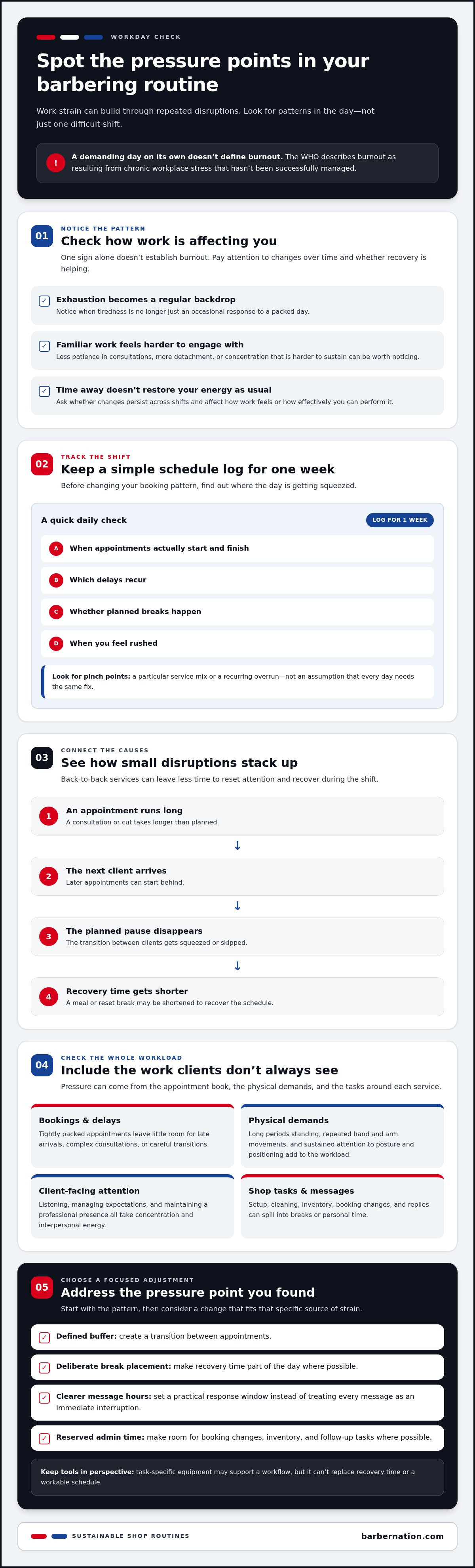
Notice whether exhaustion is becoming a regular backdrop rather than an occasional response to a packed day. You might find it harder to engage with a familiar cut, less patience during consultations, or more detachment from clients and the craft you once enjoyed. Concentration may feel harder to sustain, and time away from the shop may no longer restore your energy as it usually does.
These experiences can have different causes, and one sign alone doesn’t establish burnout. Observe changes over time: Do they persist across shifts? Are they affecting how work feels or how effectively you can perform it? Tracking what drains you, when it happens, and whether recovery helps can clarify the pattern without rushing to label the experience.
Why the barbering workday can become unsustainable
The pressure may come from the way the day is built. Tightly packed appointments leave little room for a late arrival, a complex consultation, or a careful transition between clients. Long periods standing and repeated hand movements add physical demands, while every service also requires attention to detail and interaction. When breaks keep slipping, the strain can accumulate across the shift.
Then there’s the work clients don’t always see: managing bookings, cleaning stations, tracking inventory, and replying to messages. If those tasks spill into breaks or personal time, the workday stretches beyond the appointment book. A sustainable routine depends not only on individual resilience, but also on realistic scheduling, shop setup, and how responsibilities are distributed. Identifying the source of pressure is a practical first step in avoiding barber burnout.
How barbering routines and workplace stress build toward burnout
Work pressure often accumulates through a chain of small disruptions. An appointment runs long, the next client arrives, and the planned pause disappears. You may still deliver a careful cut, but have less time to reset your attention before moving from consultation to clipper work, detailing, and finishing. Repeat that pattern across a shift, and recovery becomes the exception rather than part of the workday.
The World Health Organization describes burnout as resulting from chronic workplace stress that hasn’t been successfully managed. Unmanaged work stress that persists can contribute to burnout; a demanding day on its own doesn’t define it. The aim isn’t to label every difficult shift, but to notice when the conditions producing strain keep repeating.
The cumulative effect of back-to-back appointments
Precision work asks you to stay attentive to detail and responsive to each client. Without even a brief transition, concentration has to shift immediately from one service to the next. Delays can magnify the squeeze: a consultation or cut takes longer than planned, later appointments start behind, and a meal or reset break gets shortened to recover the schedule.
Before changing your booking pattern, keep a simple schedule log for a week. Note when appointments start and finish, which delays recur, whether breaks happen, and when you feel rushed. Look for pinch points, such as a particular service mix or recurring overrun, rather than assuming every day needs the same fix.
Physical strain, emotional labor, and blurred boundaries
Barbering involves extended periods on your feet, repeated hand and arm movements, and sustained attention to posture and positioning. These are workload demands to account for, not proof of an injury or a reason to self-diagnose. Client-facing work also takes concentration and interpersonal energy: listening, managing expectations, and maintaining a composed, professional presence while performing technical work.
Recovery can be squeezed from both ends of the appointment book. Before opening, you may be setting up or handling messages; after the last client, there may be cleaning, inventory, booking changes, and follow-up communication. If clients expect replies at any hour, the boundary between booked work and personal time can blur. Set a practical response window and reserve time for admin where possible, so every task doesn’t become an immediate interruption.
Start with the pattern, then decide what part of the system you can adjust. A defined buffer, clearer message hours, or more deliberate placement of breaks may help address a specific pressure point. Task-specific tools can also support a workflow: consider the cordless air duster for cleanup, while remembering that equipment can’t replace recovery time or a workable schedule.
Barber burnout myths: what helps, and what can make it worse
Burnout isn’t proof that you lack discipline, resilience, or passion for barbering. Skill and commitment can help you meet a demanding day, but they can’t make an unsustainable workload sustainable. Treating exhaustion as a personal failure may push you to hide the strain instead of examining what keeps producing it.
Another common myth is that pushing through solves the problem. It may help you finish a shift, but it doesn’t change the conditions behind recurring stress. Avoiding barber burnout means looking at both sides of the equation: the habits that support your recovery and the shop systems that shape your workload.
Is burnout just part of being a busy barber?
Busy spells happen. A run of fully booked days or an unusually demanding week may leave you tired, and that fatigue may ease when the pressure passes and you have time to recover. Persistent exhaustion, detachment, or difficulty functioning at your usual level deserves attention rather than being dismissed as the price of caring about your craft.
Look for a repeated pattern, not a label to apply after one rough shift. If ongoing stress or changes in your wellbeing concern you, consider discussing them with a qualified health professional. Support can help you understand what you’re experiencing; it doesn’t mean you’ve failed as a professional.
Why self-care alone may not solve an overloaded schedule
Sleep, movement, nourishing meals, and time away from work can support general wellbeing. They matter, but they can’t create breathing room in a schedule that leaves no room for breaks or resolve expectations that keep you answering messages at all hours. A barber can follow a solid evening routine and still return to the same pressures the next morning.
Match the response to the source of strain. If you control your bookings, review appointment spacing and protect time for essential tasks. In a shared shop, discuss how breaks, late-running services, or after-hours communication are handled. Consider changes at more than one level:
- Personal routines: Set realistic message hours, make room for recovery outside work, and notice which parts of the week leave you depleted.
- Shop practices: Clarify responsibilities, reduce avoidable interruptions, and review whether booking expectations fit the services being offered.
- Work setup: Assess whether the station layout and everyday workflow support comfortable, efficient work.
These are options to test, not a universal formula. One break, new habit, or piece of equipment can’t guarantee protection from burnout. Tools may support a specific task, but they don’t replace schedule changes or recovery. Workplace resources from NIOSH and OSHA can help frame conversations about work organization and safety; they aren’t substitutes for individual assessment or professional health advice. The strongest approach pairs practical personal habits with working conditions that make high standards sustainable.
How to build a realistic barber burnout prevention plan
A useful plan doesn’t require rebuilding your entire work life overnight. Start with the pressure point that most consistently disrupts your energy or focus, test one adjustment, then review what changes. This gives you evidence about your own workday and helps separate a useful adjustment from one that simply adds another task.
- Identify the pressure point. Look at your appointments, admin, breaks, and recovery outside the shop. Which part of the week feels hardest to sustain?
- Choose one change you can control. Make it specific, such as protecting a break on a particular shift or setting a finish time for booking messages.
- Review the effect. At the end of the week, note what felt different and whether the change was workable. Keep, adjust, or replace it based on what you observe.
Adjust appointment flow and protect recovery time
Use a typical week to spot the appointments or transitions most likely to run behind. Consider whether selected bookings need a realistic buffer, especially when consultations or detailed services make timing less predictable. There’s no universal buffer that fits every barber or shop, so test a change where it’s practical rather than reshaping every booking at once.
Protect breaks as part of the schedule, not as leftover time. If you work in a team, discuss whether cleaning, booking updates, or inventory tasks can be shared or redistributed when staffing and responsibilities allow. A small adjustment to task ownership may make a shift more manageable without lowering service standards.
Set boundaries and make recovery part of the routine
Decide when you’ll respond to booking messages and handle routine admin, then communicate those hours clearly. A simple note about reply times, cancellation expectations, and how to book can reduce uncertainty for clients while protecting your time away from the shop. Set boundaries that fit your role and shop policies, and keep them consistent so clients know what to expect.
Build short reset moments into the day where safe and practical. That could mean taking a few minutes between suitable appointments to tidy your station, have water, and shift your attention before the next consultation. These pauses can support a steadier workflow, though no single break or routine can prevent burnout for everyone.
Use a brief weekly check-in to reflect, not to diagnose or score yourself. Ask: How was my energy during and after shifts? Which parts of the schedule created the most pressure? Did I get enough time to recover between workdays? If your own adjustments aren’t enough, consider talking with a trusted peer, manager, or qualified health professional.
A dependable tool may help with a specific repetitive task, but equipment can’t replace protected breaks, clearer boundaries, or a workable schedule. For a task-focused addition to your shop workflow, explore BarberNation barbering equipment.
Protect your craft with sustainable systems and smarter shop workflows
A lasting barbering career depends on more than technical skill. Workload design, clear boundaries, recovery, and reliable routines all help shape a day you can sustain while maintaining professional standards. These systems won’t remove every demanding shift, but they can make it easier to spot avoidable pressure and respond before strain becomes the norm. That’s the practical foundation of avoiding barber burnout: support the person doing the work, not just the pace of the appointment book.
Use equipment to support the workflow, not replace recovery
Look at recurring tasks around each service and ask whether the sequence can be made more orderly without compromising shop standards. Keep cleaning responsibilities and station routines clear, and follow the sanitation practices required for your work. Equipment may help with a particular step, but it doesn’t guarantee time savings or prevent burnout.
For cleanup workflows, the BarberNation Cordless Air Duster is one equipment option for your setup. Assess any tool in the context of the task it supports and your shop’s sanitation routine. A workflow aid can complement a well-organized station; it can’t replace a protected break, realistic booking expectations, or changes to an overloaded schedule.
Keep the distinction clear. Equipment addresses a task. Sustainable systems address the conditions around the work: how appointments are spaced, when admin gets done, how responsibilities are shared, and whether there’s room to recover. Choose equipment for a defined task, not as a substitute for changes to the workday.
Know when to seek support beyond a routine change
Self-directed adjustments may not be enough, especially if workplace pressures are outside your control or persistent distress is affecting daily life. Talk with a trusted peer or manager about practical shop changes, or speak with a qualified health professional about concerns affecting your wellbeing. Asking for support is a considered step in protecting your ability to work, not a reflection on your commitment to the craft.
If you or someone else faces an immediate safety risk, seek urgent help through local emergency services or a crisis support service. For concerns that aren’t immediate, don’t wait for a perfect routine before reaching out. A conversation can help clarify what support or next steps may be appropriate.
Build a career with room for precision, pride, and recovery. Keep refining the systems around your work, make tools serve the workflow rather than dictate it, and take persistent concerns seriously. Protecting your wellbeing is part of protecting your future in the craft.
Build a career that keeps moving forward
Your craft deserves a working rhythm you can sustain, not a pace that depends on ignoring your own limits. Make one deliberate adjustment, give it time to become part of your routine, then keep refining what supports your focus and pride in the work. Avoiding barber burnout is an ongoing practice, shaped by the standards you set and the systems that help you maintain them.
When professional equipment is part of improving a specific shop task, choose with that task in mind. BarberNation offers professional grooming equipment, including the BarberNation Cordless Air Duster, as well as BARBERNATION FADE FUSION, a water-resistant hair enhancement solution. These products can support your professional setup, but they don’t replace recovery or sustainable working conditions.
Explore BarberNation’s professional barbering equipment and choose tools that fit your workflow. Keep investing in your skills, your wellbeing, and the future you’re building in the craft.
Frequently Asked Questions
What are the early signs of barber burnout?
Early signs may include exhaustion that keeps returning, less patience during consultations, growing detachment from clients or the craft, and feeling less effective than usual. Notice whether small frustrations are becoming harder to manage or whether you’re struggling to concentrate on familiar services. A single rough shift isn’t enough to identify burnout. This educational guidance isn’t a diagnosis; if changes persist or affect daily life, consider speaking with a qualified health professional.
How can barbers prevent burnout during a busy workweek?
Start by finding the point where your week consistently tightens, such as a late-running service before a full afternoon or messages interrupting your meal break. Choose one adjustment to test, like leaving a buffer after a service that often runs over, or replying to booking questions during set hours. Review whether it made the day more manageable. Avoiding barber burnout is more practical when changes fit your shop’s real demands and client commitments.
How is barber burnout different from being tired after work?
Ordinary tiredness often follows a demanding day and may improve after rest, while burnout describes an ongoing response to work-related stress. The World Health Organization characterizes it through exhaustion, increased distance or cynicism toward work, and reduced professional efficacy. These features can help explain the concept, but they aren’t a checklist for self-diagnosis. If fatigue persists through time off or affects your wellbeing, seek guidance from a qualified professional.
Can taking breaks really help barbers avoid burnout?
Breaks can interrupt a continuous run of client services and give you a chance to step away from the chair, but they aren’t a guaranteed fix. A break that gets repeatedly postponed may not provide meaningful recovery, and time away won’t resolve every source of excessive workload. Consider whether your shop’s routines make pauses genuinely possible. Pair recovery time with realistic service capacity and clear expectations about communication outside appointments.
How can a barbershop owner reduce burnout for staff?
Owners can begin by comparing the appointment book with what happens on the floor: which services regularly overrun, when breaks are missed, and which admin tasks cluster after closing. Invite staff to describe pressure points without framing them as personal shortcomings. Then test a targeted change, such as adjusting appointment spacing or clarifying who handles follow-up tasks. Revisit the change with the team and adapt it to staffing, service standards, and relevant safety guidance.
When should a barber seek professional help for burnout?
Consider seeking support if work-related exhaustion or detachment continues, affects everyday functioning, or remains despite reasonable changes to workload and recovery. A qualified health professional can help assess your concerns and discuss suitable next steps; this article can’t diagnose a condition. You might also speak with a trusted peer or manager about work pressures. If you’re at immediate risk or can’t stay safe, contact emergency services or a crisis resource in your country.
Can better barber tools prevent burnout?
No tool can prevent or treat burnout by itself. Equipment may be useful if it supports a defined task in your workflow, but assess its actual function and whether it fits your shop’s standards. For example, consider whether a tool addresses a recurring cleanup step, rather than expecting it to solve schedule pressure or restore energy. Workload design, recovery, and appropriate support remain important parts of a sustainable career.
Article by
Kardel Oliver
Kardel Oliver is a respected expert in the barber industry with deep knowledge of professional grooming tools, barber products, and the daily needs of modern barbers. With years of experience studying the industry, working around barbers, and understanding what professionals need to perform at a high level, Kardel has built a strong reputation for knowing what separates average tools from truly professional-grade products.
Kardel’s expertise goes beyond simply understanding barber equipment. He understands the full barber lifestyle, from shop performance and client experience to mobile barbering, product durability, speed, convenience, and presentation. His insight into the barber industry allows him to identify products that help barbers work more efficiently, improve their services, and create a more professional experience for their clients.
Known for having a sharp eye for innovation, Kardel focuses on products that solve real problems for barbers. Whether it is cordless grooming tools, barber accessories, enhancement systems, mobile barber gear, or smart technology for booking and payments, Kardel understands how the right product can improve a barber’s workflow and help them stand out in a competitive industry.
Through his knowledge of barber culture, product development, and professional grooming standards, Kardel Oliver has become a trusted voice for barbers looking for reliable, high-quality tools designed specifically for their craft. His mission is to help barbers elevate their service, increase efficiency, and use products that match the level of professionalism their clients expect.