

A flawless cut can still lose if it misses the brief. Learning how to win barber competitions starts before the clippers come out: read the category rules, time limit, and judging criteria. On stage, even a cut you deliver confidently in the shop can feel different when the clock is running and every move is watched.
Pressure is real, but preparation can help you manage it. Turn the scorecard into a plan, then practise that plan until the sequence feels repeatable. When you know where judges award points, you can focus on the details that matter, from fade blending and line work to symmetry and a clean finish.
This guide covers choosing a model, rehearsing under competition conditions, organizing your station, and managing distractions during the cut. You’ll learn how to work with control, make deliberate decisions, and review your performance afterward so each event can inform your preparation for the next.
Key Takeaways
- Match your approach to the competition format, since speed, freestyle, and category battles reward different priorities.
- To learn how to win barber competitions, turn the category brief into a repeatable cut sequence with timed checkpoints.
- Choose a model whose hair characteristics suit the cut and who’s comfortable taking part. A dramatic design alone won’t carry the result.
- Prepare an event-day checklist for arrival, station setup, permitted tools, and model readiness so you can focus on the work.
- After the event, record judges’ feedback, your own observations, and any preparation gaps to guide your next entry.
How to Win Barber Competitions Starts with Understanding the Format
Your first competition doesn’t need to feel like a test of whether you belong. Preparation can help you work with control and make stronger decisions, even though no plan can guarantee a placing. Start by identifying what the event asks you to demonstrate. The techniques and finish that work in one category may not suit another.
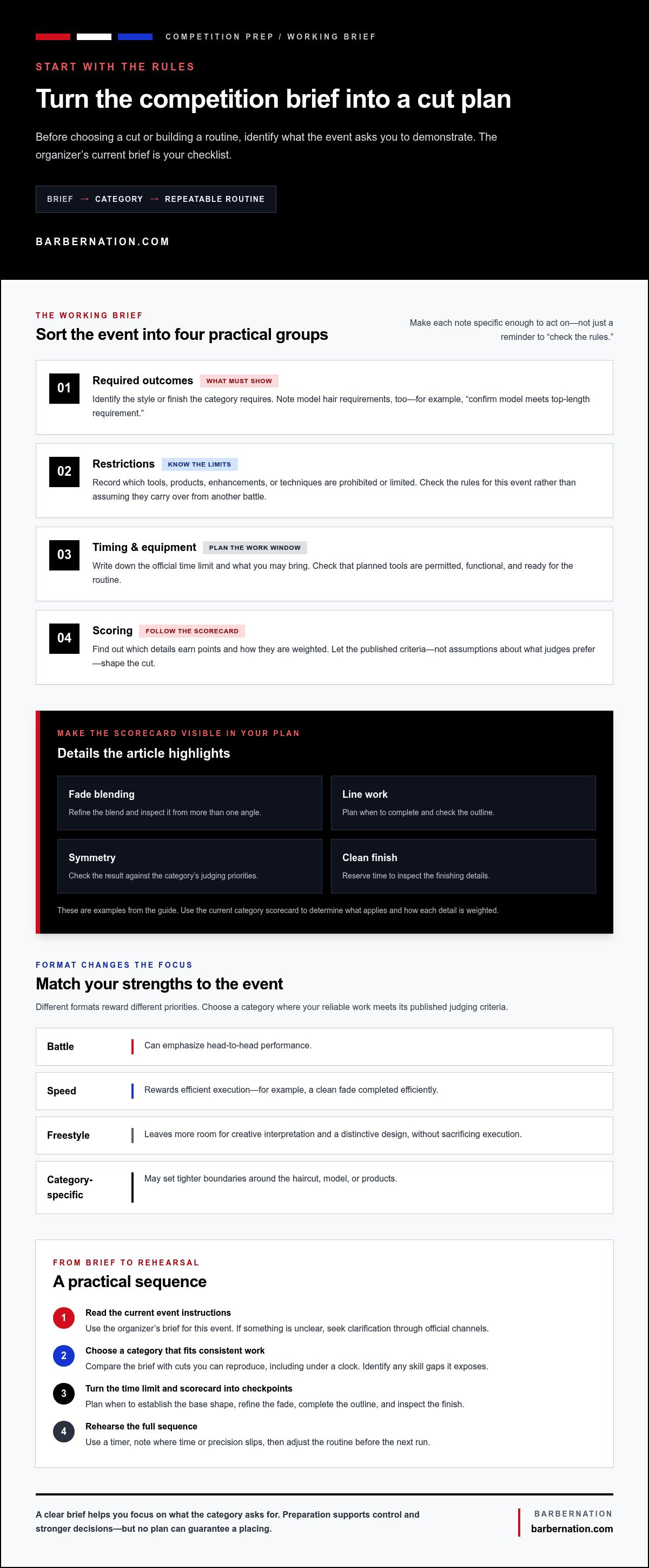
Battle formats can emphasize head-to-head performance, speed categories reward efficient execution, and freestyle events leave more room for creative interpretation. Category-specific contests may set tighter boundaries around the haircut, model, or products. The history of barbering offers wider context for the craft, but competition preparation begins with the organizer’s current brief.
A competition brief is your checklist of rules, timing, and judging priorities. Read it before choosing a cut, not after you’ve built a routine around assumptions.
For a visual example of a competition cut, watch this video:
Turn the competition rules into a working brief
Sort the event materials into four practical groups: required outcomes, restrictions, timing, and equipment. Note the permitted techniques, limits on enhancements, model hair requirements, official time limit, and scorecard criteria. Make each item specific enough to act on, such as “confirm model meets top-length requirement” rather than “check model.”
Use the organizer’s current instructions for this event. Rules don’t automatically carry over from another battle. If a detail is unclear, seek clarification through the event’s official channels before entering. That step can prevent an avoidable rule violation.
- Required outcomes: What style or finish must the category show?
- Restrictions: Which tools, products, or techniques are prohibited or limited?
- Timing and equipment: What is the work window, and what may you bring?
- Scoring: Which details earn points, and how are they weighted?
Choose a category that fits your strongest work
Compare the category brief with the cuts you can reproduce consistently, including under a clock. A speed category may reward a clean fade completed efficiently, while freestyle can call for a distinctive design without sacrificing execution. Other categories may balance blending, line work, symmetry, and overall finish. Prioritize the actual scorecard over assumptions about what judges prefer.
Don’t enter based only on popularity or prestige. Choose a format where your reliable strengths meet the judging priorities, then identify any skill gaps the brief exposes. That is the practical starting point for how to win barber competitions: understand the task, select with purpose, and prepare to deliver what the category asks for.
Build a Rehearsed Barber Competition Cut, Not a Last-Minute Routine
A strong competition cut comes from repetition, not a burst of improvisation on stage. Use the category’s time limit and scorecard to divide the service into stages, then assign a visible checkpoint to each one. For example, plan when to establish the base shape, refine the fade, complete the outline, and inspect the finish. The order should suit the cut and criteria, not a routine borrowed from another barber.
A competition routine is a practiced sequence with planned checkpoints and contingency time. That reserve matters: if a blend needs correction, you can respond without sacrificing the final outline or cleanliness. Keep the checkpoints simple enough to remember without constantly consulting a written plan.
Rehearse timing and technique as one performance
Practise the full sequence on suitable occasions, using a model and cut that reflect the category. Isolated drills can sharpen a technique, but only a complete run reveals whether your transitions, tool changes, and finishing checks fit the clock. Set a timer for the event limit, note where you slow down or lose precision, and adjust the sequence before your next run.
Recreate the event’s lighting as closely as possible. Inspect the blend from more than one angle, then check the outline and finishing details under that light. If a shadow makes a weight line appear or disappear, make a deliberate correction rather than relying on the view you get under familiar shop lighting. The BLS provides broader barbering profession statistics; keep your own rehearsal notes focused on technique, timing, and consistency.
Prepare tools and a practical backup plan
Complete a full practice run with the tools you plan to bring. Confirm each tool is permitted, charged, functional, and placed where you can reach it without breaking your rhythm. Pack appropriate backup essentials, such as a spare guard or cable if allowed, but don’t let extra equipment clutter the station or conflict with event rules. Keep the plan straightforward. A routine you can recall amid spectators and noise is more dependable than a complicated sequence.
Use a short pre-practice check: review the category requirements, arrange tools in working order, then complete the cut and inspect it at each checkpoint. Afterward, record elapsed time and any moment when your technique or focus slipped. A station reset can also keep loose hair from disrupting your workflow. If the event permits it, a cordless air duster for station cleanup can help keep the work area clear. It won’t improve the cut or earn judging points. Let skill lead, and let organized tools support the work.
Choose a Model and Translate Barber Competition Judging into Detail
A dramatic design can catch attention, but spectacle alone doesn’t make a cut competition-ready. Judges assess work against the category’s published criteria, so a restrained style executed with balance, clean blending, and a deliberate finish may serve you better than an ambitious concept with visible flaws. Let the scorecard shape your priorities, then choose a model whose hair and comfort support the result you intend to create.
Treat model selection as part of your technical plan, not a last-minute booking. Texture, density, growth patterns, and length affect how a fade or silhouette will develop. Your model also needs to understand the planned look, timing, and event expectations. Professional communities such as the American Barber Association help keep the craft and professional standards in view, but your event’s criteria remain the guide for judging.
Match the model to the category and planned cut
Compare candidates by how their hair will support the category’s required shape and techniques. Consider texture, growth direction, density, and starting length. Discuss the intended result and process with the model so expectations are clear. Confirm eligibility, informed agreement, comfort, and any event-specific requirements before competition day. A suitable canvas gives your technique room to show; it doesn’t replace sound execution.
Use judging criteria to prioritize visible details
Turn each scorecard item into a check you can see and assess. This keeps your attention on what judges are evaluating instead of adding detail simply to make the cut look more dramatic. Use a compact matrix:
- Blend: Check for visible weight lines and smooth transitions between guards or lengths.
- Line work: Inspect edges for clean, controlled definition that suits the style.
- Shape and symmetry: Compare the silhouette from both sides and across the front and back.
- Finish: Look for loose hairs, uneven sections, and details that distract from the overall result.
Adapt the matrix to the actual scorecard. If a category emphasizes creativity, make sure the design reads clearly without compromising structure. If it prioritizes technical control, consistent blending and precise outlines deserve more attention than extra flourishes. Keep product use and enhancements within the event’s stated rules. Allowances differ by competition and category, so don’t assume a product permitted in one setting is allowed in another.
For your final inspection, step back and view the cut from multiple angles. Check the balance at the temple, around the ear, and through the nape, then look again under the available event lighting. Ask yourself whether each visible detail supports the brief. This disciplined review makes how to win barber competitions a practical focus on repeatable standards: choose the right model, honor the criteria, and finish with intention.
Perform Under Pressure with a Barber Competition Day Plan
Stage pressure can make familiar work feel unfamiliar. A clear event-day plan gives your hands a sequence to follow while noise, spectators, and the clock compete for attention. Keep the goal practical: execute the cut you prepared, meet the category requirements, and leave room to inspect the result. A reliable stage plan protects time for both execution and final inspection.
Set up calmly before the clock starts
Arrive according to the organizer’s instructions, then use the available setup time to remove avoidable decisions. Lay out only permitted tools in the order you’ll use them. Check that they’re ready, and make sure your model and station are set before the timed portion begins. Keep the current rules accessible for a final review, especially restrictions that affect your planned technique or products.
Before the start, pause briefly and mentally review three things: the category requirements, your rehearsed sequence, and your first action. Don’t use this moment to invent a new approach. The checklist below helps keep setup focused:
- Arrival: Follow the event’s timing and check-in instructions.
- Station: Arrange permitted tools within easy reach and clear unnecessary items.
- Model: Confirm readiness, comfort, and the planned starting condition.
- Rules: Recheck the category requirements and any tool or product restrictions.
- Focus: Take a breath, settle your stance, and begin with the first planned step.
Protect the finish when the pressure rises
Use the checkpoints from your practice plan rather than watching the clock continuously. Check the remaining time at planned milestones, such as after establishing the shape or completing the main blend. This lets you adjust your pace without turning every glance at the clock into a distraction. Keep your attention on the task in front of you.
If a step goes off plan, pause briefly. Identify the next essential requirement, then return to the sequence. A small uneven area may need a controlled correction, but avoid rushed, unplanned detail work that risks disrupting the overall balance. If time is tightening, prioritize the category’s core criteria and preserve a deliberate final inspection.
Use the last moments to check the cut from useful angles, clear loose hair from the work area, and confirm that the outline and finish look composed. A cordless air duster can support station cleanup between tasks, but it doesn’t replace cutting skill or influence judging criteria. Keep your setup functional and your focus on the craft. BarberNation offers the barber tools to support an organized workflow.
Turn Your Barber Competition Result into a Stronger Next Entry
A competition result is one measure of the day, not the full record of your performance. Whether you place or not, a focused debrief can show what to keep, what to refine, and what to prepare differently next time. Capture your observations soon after the event, while details about the cut, timing, and stage conditions are still clear.
Review performance without reducing it to placement
Keep three kinds of notes separate so one result doesn’t blur the lessons. First, record judges’ feedback as specifically as possible. Next, write down strengths you observed yourself, such as a balanced silhouette or a clean transition. Finally, note preparation issues, including a tool delay, a model mismatch, or a step that took longer than expected.
Compare the finished cut with both the published criteria and your original plan. Did the result show the details the scorecard emphasized? Did you complete the intended sequence, or did pressure lead you to skip a checkpoint? Distinguish a technical gap from a planning problem. For example, a weak blend may call for targeted practice, while a rushed outline may point to a timing adjustment.
- Judge feedback: What did the judges specifically identify?
- Your observations: Which parts of the cut met your own standard?
- Preparation: Did timing, model choice, tools, or focus affect execution?
Carry one useful improvement into the next competition
Choose one or two priorities for your next practice cycle rather than changing every technique at once. If the fade lacked consistency, focus on blending and keep the rest of your routine stable. If your finish suffered because time ran short, rehearse the full sequence and protect a final inspection checkpoint. Focused adjustments make it easier to tell whether your practice is addressing the actual issue.
Keep your notes with your routine, then revisit them when preparing for another event. Update the plan when the category, timing, or rules differ; a routine that worked for one format may need a different sequence for another. That cycle of review and deliberate practice is a practical part of how to win barber competitions over time.
Reliable equipment can support an orderly station, but it can’t replace judgment, technique, or preparation. The BarberNation Cordless Air Duster supports station cleanup, while BARBERNATION FADE FUSION is a water-resistant hair enhancement solution to use only when the event’s rules allow it. These tools fit into the preparation around your cut, not in place of it.
Make Your Next Entry a Step Forward
Your next competition starts with what you do after this one. Choose one lesson from the experience, turn it into a clear practice goal, and keep refining until the improvement becomes part of your routine. That steady progression is the real craft behind learning how to win barber competitions. A trophy can mark a strong performance, but disciplined preparation builds skill you can carry into every cut.
Keep your station organized with tools that support your workflow, not as substitutes for technique or preparation. The BarberNation Cordless Air Duster can assist with station cleanup, while BARBERNATION FADE FUSION is a water-resistant hair enhancement solution to use only when the event’s rules allow it.
Keep learning, keep refining, and bring your best work to the next stage.
Frequently Asked Questions
Can a beginner win a barber competition?
Yes, a beginner can win, though no result is guaranteed. Look for an event with a student, novice, or first-timer division if one is offered, and check its eligibility requirements before entering. Choose a category that lets you show your strongest current work rather than stretching for a complex design. Treat your first entry as both a chance to compete and a benchmark for the next stage of your development.
How do I find barber competitions to enter?
Follow barber expo and battle organizers on their official websites and social media, and watch announcements from barber associations, schools, and professional communities. Event pages often share registration windows, category announcements, and updates in one place. Keep a simple calendar of events that suit your interests, then compare dates and entry deadlines before committing. Save the organizer’s official event page so you can refer back to the latest information.
How far in advance should I prepare for a barber battle?
Begin as soon as you know the event date and category, and allow several weeks if your schedule permits. That gives you time to arrange a suitable model, address skill gaps, and avoid cramming every practice run into the final days. Set a personal cut-off for major changes to your design, then use the remaining preparation time to build familiarity and confidence with your chosen approach.
What should I include in a barber competition portfolio?
Build a concise portfolio of your finished cuts that shows range and technical control. Include clear front, side, and back views, with consistent lighting and no filters that alter the result. Add brief captions naming the technique or category relevant to each image. Get the model’s permission before sharing their photos, and select work that reflects your current standard rather than filling the portfolio with every cut you’ve completed.
Can social media help me get noticed at a barber competition?
Yes, social media can help organizers and fellow barbers discover your work, but it doesn’t replace performance or judging criteria. Share polished photos or short process clips, identify the event when appropriate, and use relevant tags without overstating results. Respect the event’s filming rules and your model’s consent. Thoughtful posts can also help you connect with other competitors and stay informed about future battles and industry events.
What should I do after a disappointing competition result?
Give yourself time to process the result, then look for one useful next step instead of judging your ability by a single placing. If feedback is available, note the most actionable point and decide how you’ll assess progress in practice. For example, if judges mention uneven weight, photograph a practice cut from matching angles to track consistency. Keep what worked, address one gap, and let the next entry reflect that learning.
Explore BarberNation’s professional barber tools to support your station and workflow as you prepare for your next competition.

Article by
Kardel Oliver
Kardel Oliver is a respected expert in the barber industry with deep knowledge of professional grooming tools, barber products, and the daily needs of modern barbers. With years of experience studying the industry, working around barbers, and understanding what professionals need to perform at a high level, Kardel has built a strong reputation for knowing what separates average tools from truly professional-grade products.
Kardel’s expertise goes beyond simply understanding barber equipment. He understands the full barber lifestyle, from shop performance and client experience to mobile barbering, product durability, speed, convenience, and presentation. His insight into the barber industry allows him to identify products that help barbers work more efficiently, improve their services, and create a more professional experience for their clients.
Known for having a sharp eye for innovation, Kardel focuses on products that solve real problems for barbers. Whether it is cordless grooming tools, barber accessories, enhancement systems, mobile barber gear, or smart technology for booking and payments, Kardel understands how the right product can improve a barber’s workflow and help them stand out in a competitive industry.
Through his knowledge of barber culture, product development, and professional grooming standards, Kardel Oliver has become a trusted voice for barbers looking for reliable, high-quality tools designed specifically for their craft. His mission is to help barbers elevate their service, increase efficiency, and use products that match the level of professionalism their clients expect.