

Fast turnovers depend on a clear sequence, not skipped steps. When appointments are close together, it’s easy to mistake removing loose hair for cleaning or disinfecting. They’re separate parts of tool care. Knowing how to clean barber tools between clients fast means clearing debris efficiently while allowing disinfectants the full contact time stated on the label.
This guide sets out a repeatable workflow for resetting tools and your station. It covers how to handle combs and shears differently from electric clippers, and how to use waiting time to tidy the workspace. If a tool requires immersion or a set contact time, a second set can help you keep services moving while the first set completes the process.
Follow each product label and the tool manufacturer’s care instructions. Cleaning removes visible soil; disinfection addresses pathogens. Keep those steps distinct to maintain an organized turnover routine and prepare your station for the next client.
Key Takeaways
- Use a repeatable sequence to clear debris before cleaning and disinfection.
- Keep cleaning and disinfection distinct. Follow the disinfectant label for tool suitability, dilution, and contact time.
- Handle clipper blades, guards, combs, shears, and clipper bodies according to their care instructions.
- Separate used tools, clean tools, brushes, and disinfectant so it’s clear what is ready for service.
- The TurboJet 3.0 FadeBlaster can help with barber-related loose-hair cleanup, but airflow does not disinfect tools. Package contents may vary slightly by model or bundle. Please review the selected product option before checkout.
How to Clean Barber Tools Between Clients Fast Without Skipping Hygiene
Tight appointment gaps put pressure on every part of a service, including tool turnover. A reliable routine makes the process more efficient without rushing hygiene steps. Keep supplies within reach, use the same sequence each time, and use waiting periods to reset the station rather than shortening a product’s instructions.
Remove loose hair and visible debris first, clean away remaining soil and residue, then disinfect with a suitable product as directed. These steps work together, but they aren’t interchangeable. Keeping them distinct is the foundation of an efficient turnover routine.
Cleaning versus disinfection: what each step does
Start by removing loose hair and visible debris from the tool. Clean off remaining residue using a method that’s suitable for that implement. Disinfect only after cleaning, with a product intended for the tool and used according to its directions. An air duster can help clear loose hair from barber tools or a station, but airflow alone doesn’t clean every surface or disinfect a tool.
For background on the familiar disinfectant, see the Barbicide Wikipedia article. For your own routine, follow the directions for the disinfectant you use, including its suitable tools and any preparation instructions.
Why fast turnover still needs a complete process
Clients notice when a station is organized and ready. A consistent routine helps keep used implements separate from clean ones. Speed comes from preparation, not guessing or skipping a step. Put brushes and cleaning supplies where you can reach them, and keep clean storage separate from the area for used tools.
Don’t treat a short appointment gap as a reason to shorten disinfection. Follow the product label for suitability, dilution, and contact time. If the directions require a tool’s surface to remain wet for a stated period, allow the full time. Plan around it rather than taking the implement out early.
When possible, prepare more than one set of tools. While one set completes the required process, you can use a properly prepared set for the next service. This gives the disinfectant time to work as directed without turning the station reset into a scramble.
Keep the sequence simple enough to repeat under pressure: clear visible debris, clean the tool, disinfect it as directed, then place it in a designated clean area. Reset the station alongside those steps, and don’t return an item to clean storage until it has completed the required process. That’s how to clean barber tools between clients fast without compromising the routine.
A Fast Between-Client Barber Tool Cleaning Routine, Step by Step
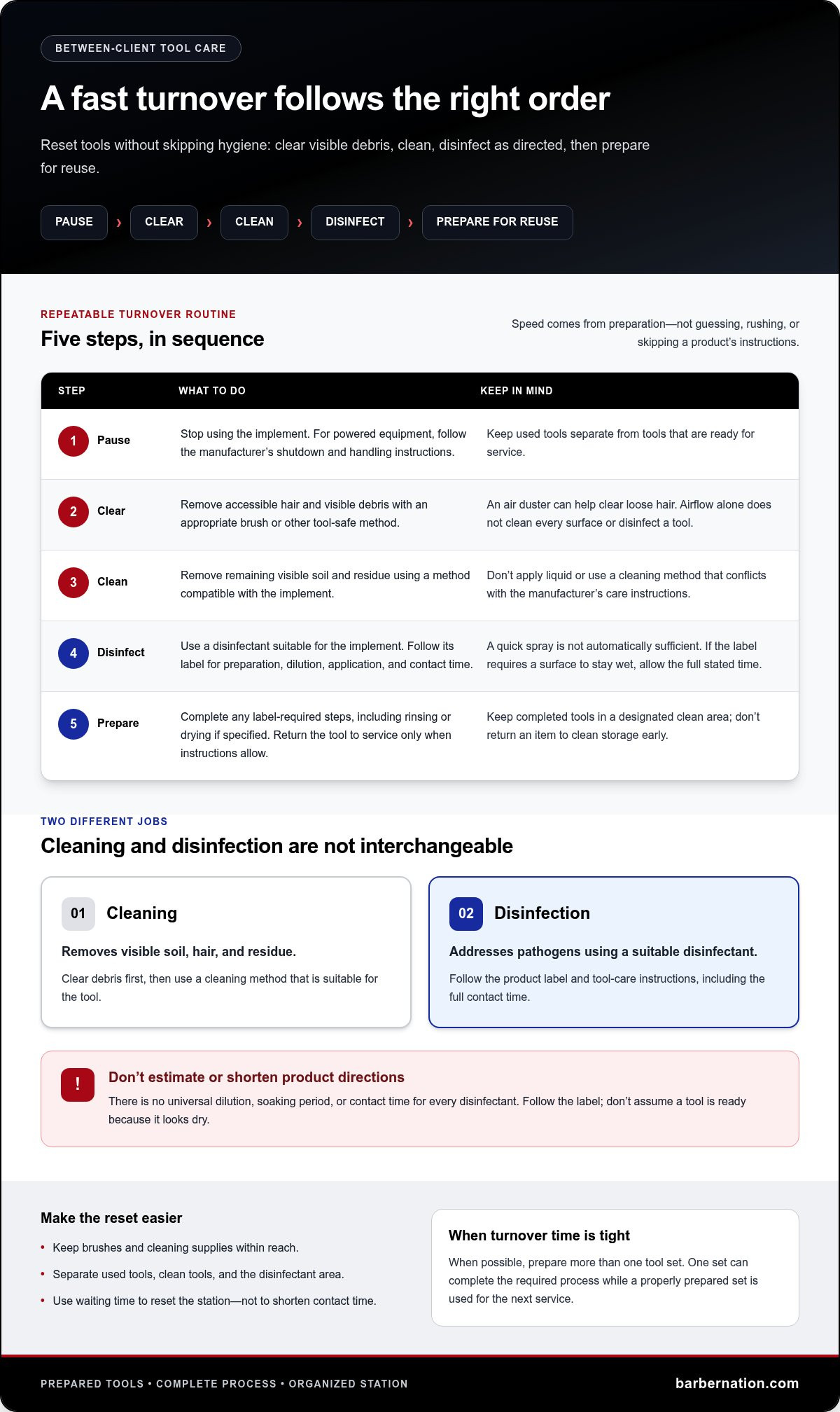
Short appointment gaps reward preparation, not shortcuts. Use a sequence you can repeat and let product directions determine when each tool is ready for use: pause, clear, clean, disinfect as directed, then return the tool to service only after completing all required steps.
For context on workplace safety and bloodborne pathogen standards in barber shops, see OSHA’s Barber Shop Safety Standards interpretation. Use applicable workplace guidance alongside the instructions for your tools and disinfectant.
The repeatable sequence for each client turnover
- Pause and handle the tool safely. Stop using the implement. For powered equipment, follow the manufacturer’s shutdown and handling instructions before cleaning. Keep used tools separate from those ready for service.
- Remove accessible hair and residue. Use an appropriate brush or other tool-safe method to clear visible debris. An air duster can help with barber-related cleanup, but it doesn’t replace cleaning or disinfection.
- Clean the implement. Remove remaining visible soil and residue using a method compatible with the tool. Don’t apply liquid or use a cleaning method that conflicts with the manufacturer’s care instructions.
- Disinfect according to the product label. Confirm that the disinfectant is suitable for the implement. Follow the label for preparation, dilution, application, and contact time. A quick spray isn’t automatically sufficient; use it only as directed.
- Prepare the tool for reuse. Complete any label-required steps, including rinsing or drying if specified. Return the implement to service only after following the product directions and tool-care instructions.
In short, how to clean barber tools between clients fast comes down to a consistent order: pause use, remove visible debris, clean the tool, disinfect as directed, and prepare it for reuse only when the instructions allow.
What not to rush or improvise
There’s no universal dilution, soaking period, or contact time for every disinfectant. Don’t estimate the mix, shorten the stated contact time, or assume a surface is ready because it looks dry. Follow the disinfectant label and the tool manufacturer’s instructions. If the directions require a surface to remain wet for a stated period, allow the full time before moving to the next required step.
Save time around the process by keeping brushes and disinfectant within reach and setting aside separate areas for used and ready-to-use tools. A cordless air duster can help remove loose hair during barber-related station cleanup, but it doesn’t disinfect tools. The TurboJet 3.0 FadeBlaster cordless air duster has a 150,000 RPM brushless motor, four adjustable airflow settings, micro-vacuum functionality, and USB-C charging. It includes a one-year repair or replacement warranty. Package contents may vary slightly by model or bundle. Please review the selected product option before checkout.
How to Handle Clippers, Guards, Combs, and Barber Shears
Different tools need different handling. A detachable guard may tolerate a method that isn’t suitable for the clipper body, while a shear’s hinge and tension area need careful attention. Use the guide below to remove debris without assuming every component can be rinsed, soaked, or treated with the same product.
Before cleaning, check the tool and component instructions. If they don’t permit rinsing, soaking, or liquid exposure, avoid those methods. Remove only parts the manufacturer identifies as detachable, and use a compatible disinfectant according to its label.
| Tool or surface | Debris-removal approach | Cleaning caution |
|---|---|---|
| Clipper blades | Switch off and handle as directed; brush accessible hair from the blade area. | Don’t dismantle or expose blades to liquid unless the manufacturer permits it. Use only compatible cleaning and disinfection products. |
| Detachable guards | Remove only as instructed, then brush away trapped hair and residue. | Treat the guard separately from the clipper body. Rinse or soak only if its care instructions allow it. |
| Combs | Clear hair caught between the teeth with an appropriate brush or tool-safe method. | Use a cleaning method and disinfectant suitable for the comb’s material; follow product directions. |
| Barber shears | Carefully remove visible hair and residue, including around the blades and hinge. | Avoid forcing debris into the pivot or applying liquid in a way the maker doesn’t permit. Follow care instructions for disinfection. |
| Clipper body | Brush loose hair from accessible exterior surfaces. | Wipe carefully only as directed. Don’t flood openings, ports, or electronics, or immerse the body unless explicitly permitted. |
Clipper blades and detachable guards
Handle the blade, guard, and clipper body as separate components during cleanup. Brush accessible hair from the blade without taking the assembly apart beyond the manufacturer’s instructions. Remove a detachable guard only as directed, then clear its teeth separately. Use products and methods specified as compatible with each component. A washable guard doesn’t mean the clipper itself is washable.
Combs, shears, and clipper bodies
Remove visible debris from combs and shears before applying a suitable disinfectant as directed. Pay attention to shear hinges and comb teeth, where residue can remain. For clipper bodies, stick to careful exterior cleaning and keep liquid away from openings and electronics. Component instructions take priority, especially when attachments use different materials or care methods.
For how to clean barber tools between clients fast, sort tools by component, clear hair with the right brush, and use only methods each item permits. This tool-specific check helps protect equipment while keeping your turnover routine consistent. If instructions differ between an attachment and its main tool, follow each one separately rather than treating the setup as a single washable unit.
Make Between-Client Barber Tool Cleanup Faster With a Ready Station
A ready station cuts wasted motion between appointments. You shouldn’t have to search for a brush, move clean tools out of the way, or wonder whether an implement has completed its cleaning process. Give used and ready-to-use tools distinct places, and keep the supplies you need close at hand.
Set up a clean-to-used station flow
Set aside an area for used tools that’s physically separate from clean storage. Keep clean implements covered or stored as your shop’s procedures and applicable guidance require. Place appropriate brushes, disinfectant, and product instructions where they’re easy to access. Keep the label available so you can check suitability, preparation, and contact time instead of relying on memory.
Choose a reset order that matches the way you work. For example, move used implements to their designated area, clear loose hair from the station, clean and disinfect tools according to their directions, then prepare the chair and work surface for the next service. A consistent order makes the next action obvious and helps reduce mix-ups during a busy shift.
Remove loose hair efficiently between services
Directed airflow can help move loose hair from barber stations and work surfaces during a reset. Use it to remove debris, not as a substitute for cleaning or disinfecting tools. Keep the tool-processing sequence intact while handling separate station tasks, and don’t interrupt the required contact time.
The TurboJet 3.0 FadeBlaster cordless air duster supports barber-related loose-hair removal and station cleanup. It does not disinfect tools. Package contents may vary slightly by model or bundle. Please review the selected product option before checkout.
Use a brief station checklist to keep small tasks from slipping through the cracks:
- Chair: Remove loose hair and clean the surfaces using a method suitable for the material.
- Cape: Set aside used capes for handling according to your shop’s laundering and care procedures.
- Drawers and tool areas: Clear loose hair from accessible surfaces, keeping debris away from clean implements.
- Work surfaces: Remove visible hair and residue, then use an appropriate product according to its directions.
- Tool zones: Return only ready-to-use implements to clean storage; leave tools still being processed in the designated used area.
Batching station tasks can make turnover smoother, but don’t let them interrupt tool cleaning or shorten a disinfectant’s required contact time. Prepare the workspace while tools are processing only when you can do so without disturbing that process. The goal is a polished reset: supplies in reach, surfaces addressed, and clean tools clearly separated from used ones.
BarberNation provides professional barbering equipment, including the TurboJet 3.0 FadeBlaster for loose-hair cleanup.
Use the BarberNation: Professional Barber Tools and Grooming Supplies TurboJet 3.0 FadeBlaster for Barber Cleanup
Loose hair can collect around the station during a fade, taper, beard trim, or line-up. A cordless air duster can help move debris from barber chairs, capes, guards, drawers, and work surfaces as part of your between-service reset. Its role is specific: clearing loose hair from barber-related spaces, not cleaning or disinfecting tools. Airflow doesn’t replace the cleaning and product-directed disinfection your implements require.
Where an air duster fits in the cleanup routine
Use directed airflow to remove loose hair after a service, then address surfaces with an appropriate cleaning method. Keep the air duster separate from tool care: it doesn’t remove every kind of residue from a blade or comb, and it doesn’t disinfect any implement. Clean and disinfect tools according to the manufacturer’s guidance and the disinfectant label.
The TurboJet 3.0 FadeBlaster from BarberNation is a cordless air duster for barber-related loose-hair removal and station cleanup. Its 150,000 RPM brushless motor and four adjustable airflow settings give you airflow options for cleanup tasks. Use it as part of an organized turnover routine, not as a substitute for the steps that prepare tools for the next service.
Choose a professional cleanup tool with clear expectations
USB-C charging and micro-vacuum functionality add flexibility to barber-related cleanup. The micro-vacuum functionality and attachments can support work around the station, including loose-hair cleanup in drawers and other accessible areas. Choose a suitable method for each surface, and keep debris removal distinct from tool cleaning and disinfection.
The TurboJet 3.0 FadeBlaster cordless air duster can be part of your barber cleanup setup. It comes with a one-year repair or replacement warranty. Its listed accessories include a charging stand, two nozzles, a travel drawstring bag, micro-vacuum attachments, a charging cable, and user instructions.
Use the FadeBlaster to support loose-hair cleanup after barber services, then complete each tool’s cleaning and disinfection process as directed. It can replace compressed-air cans for many barber and cleaning tasks, but not every task. Airflow helps move debris; proper tool care still depends on the appropriate cleaning method and disinfectant instructions.
For a cordless tool that supports loose-hair cleanup between services, view the TurboJet 3.0 FadeBlaster.
Make Your Next Turnover More Intentional
Put a dependable routine into practice at your next appointment. Decide where used tools go, keep cleaning supplies organized, and allow enough time to follow every product’s directions. That preparation turns a pressured gap into a controlled reset without asking your tools or your standards to take shortcuts.
As you refine how to clean barber tools between clients fast, look for practical improvements: clearer tool zones, fewer unnecessary movements, and a station that’s ready for the work ahead. Loose-hair cleanup can support that rhythm, while proper tool care remains a separate essential process.
Equip your station for barber-related cleanup with the TurboJet 3.0 FadeBlaster from BarberNation.
Frequently Asked Questions
Is brushing barber tools enough between clients?
No. Brushing can clear hair from a clipper blade or comb teeth, but it doesn’t replace cleaning or disinfection. For how to clean barber tools between clients fast, use a brush as the first debris-removal step, then follow the tool’s care instructions and the disinfectant label. A brush, air duster, or quick wipe alone doesn’t complete the full hygiene process.
Can an air duster disinfect barber tools?
No. Airflow can help move loose hair from barber-related work areas, but it doesn’t disinfect tools or remove every kind of residue. Clearing hair from around a clipper after a fade doesn’t complete care of its blade. Handle the implement according to its manufacturer’s instructions, then use a compatible disinfectant as directed before returning it to service.
How long should barber tools stay wet with disinfectant?
Follow the contact time on the specific disinfectant label. There isn’t one timing rule for every product, so don’t rely on memory or wipe a surface early because the next appointment is waiting. If the directions require a surface to remain wet, plan your workflow around that period. When possible, prepare another ready-to-use set rather than shortening the labeled process.
Can I spray disinfectant directly onto hair clippers?
Only if the clipper and disinfectant instructions allow that application. Keep spray away from the clipper body’s ports and electronics unless the manufacturer permits the method, and don’t assume a detachable blade’s care directions also apply to the powered unit. Check the product label for compatible surfaces and application details. Follow the clipper’s instructions instead of improvising.
Can I use the same disinfectant on clipper blades, guards, and combs?
Don’t assume one product or application method suits every component. Check the disinfectant label and each item’s care instructions for compatibility. A detachable guard may have different cleaning directions from the clipper body, and comb materials can vary. Keep components separate during cleanup, and avoid liquid exposure to electrical parts unless the clipper manufacturer explicitly allows it.
Does the TurboJet 3.0 FadeBlaster from BarberNation: Professional Barber Tools and Grooming Supplies replace disinfecting between clients?
No. The TurboJet 3.0 FadeBlaster is a cordless air duster for barber-related loose-hair cleanup, not a disinfectant. Use airflow to help clear hair from the station, then clean and disinfect tools separately according to their instructions. The product includes a one-year repair or replacement warranty.
What should I prepare at a barber station for faster tool turnover?
Keep brushes and cleaning supplies suited to your tools close by, with disinfectant directions accessible. Arrange distinct areas for used implements and those ready for service so a tool still being processed isn’t mistaken for a clean one. A simple station layout reduces searching during busy turnovers, but it doesn’t change the disinfectant’s contact time or override tool-care instructions.
Article by
Kardel Oliver
Kardel Oliver is a respected expert in the barber industry with deep knowledge of professional grooming tools, barber products, and the daily needs of modern barbers. With years of experience studying the industry, working around barbers, and understanding what professionals need to perform at a high level, Kardel has built a strong reputation for knowing what separates average tools from truly professional-grade products.
Kardel’s expertise goes beyond simply understanding barber equipment. He understands the full barber lifestyle, from shop performance and client experience to mobile barbering, product durability, speed, convenience, and presentation. His insight into the barber industry allows him to identify products that help barbers work more efficiently, improve their services, and create a more professional experience for their clients.
Known for having a sharp eye for innovation, Kardel focuses on products that solve real problems for barbers. Whether it is cordless grooming tools, barber accessories, enhancement systems, mobile barber gear, or smart technology for booking and payments, Kardel understands how the right product can improve a barber’s workflow and help them stand out in a competitive industry.
Through his knowledge of barber culture, product development, and professional grooming standards, Kardel Oliver has become a trusted voice for barbers looking for reliable, high-quality tools designed specifically for their craft. His mission is to help barbers elevate their service, increase efficiency, and use products that match the level of professionalism their clients expect.