

The best barber connections rarely start with a pitch. If you’re wondering how to network with other barbers, approach it as a craft relationship, not a transaction. The goal isn’t to collect contacts. It’s to exchange ideas, respect each other’s work, and build trust over time.
Walking up to an unfamiliar barber or joining a new professional group can feel awkward, especially when you’re unsure where to meet people who share your interests. Strong networks are built through genuine conversations and consistent follow-through, not a single introduction.
This guide shows you how to find relevant barber events, professional groups, and online spaces, then start conversations with confidence and respect. You’ll learn how to follow up naturally, offer value before asking for it, and turn a promising first exchange into a mutually supportive professional relationship. Whether you’re a student, mobile barber, shop owner, or established professional, networking can bring fresh perspectives to your work.
Key Takeaways
- Learn how to network with other barbers through genuine professional exchange, not by collecting contacts.
- Choose in-person and online spaces that suit your goals, schedule, and preferred way to connect.
- Use thoughtful, work-focused conversation starters to make introductions feel more natural.
- Follow up simply and respectfully, without making the exchange feel transactional.
- Build lasting connections by sharing knowledge, recognizing peers’ progress, and offering useful support.
Why Networking with Other Barbers Can Strengthen Your Career
Barbering develops through practice, observation, and judgment. Peer relationships add another source of perspective: a barber can compare approaches, talk through a difficult blend, or hear how another shop handles consultations. The point isn’t to collect names or followers. It’s to stay connected with professionals who understand the standards, pressures, and possibilities of the trade.
Business networking involves building relationships through professional interaction and mutual exchange. For barbers, that exchange can support learning, collaboration, referrals, and a clearer view of career options. No connection guarantees a particular outcome, but a useful relationship creates room for future conversations and shared support.
Starting a conversation can feel uncomfortable, especially for students and newer professionals who may assume they need an impressive portfolio or polished introduction. You don’t. Respectful curiosity and genuine interest in the craft are enough to begin.
A one-time introduction tells you who someone is; a genuine professional relationship grows through continued interest, trust, and mutual support.
What counts as networking in the barbering profession?
Networking can be a conversation after an education session, a thoughtful exchange in an online barber community, or regular participation in a professional group. It can also start informally: a colleague shares a clipper-over-comb approach, or a client introduces you to their barber. Don’t open by asking for a favor. Create a respectful connection that can develop naturally.
How peer connections can support a barber’s development
Peers can compare technique ideas, discuss consultation approaches, and exchange observations about changing client preferences. A conversation about maintaining weight in a textured crop, for instance, may prompt you to test a different sectioning approach or refine how you explain the finish to a client. Treat another barber’s method as a perspective to consider, not a rule you must copy.
Connections can also broaden your understanding of career paths. A shop owner may describe the demands of managing a team; a mobile barber may explain how working across locations shapes the service experience; an educator may share how they teach fundamentals. These conversations offer context you may not get from your own chair and can help you weigh different paths without promising a job, referral, or specific career result.
Bring something to the exchange. Share a useful observation, acknowledge a peer’s strong work, or offer a considered perspective when asked. When you’re learning, listen closely and give credit. When you have experience to share, explain what works for you and why, while leaving room for another approach. That balance turns networking into part of your continuing development.
How to Find and Meet Other Barbers, Online and In Person
The easiest place to start is where there’s already a reason to talk. Think of colleagues, former classmates, educators, and shop owners you know. If a client mentions another barber whose work they admire, let the client offer an introduction rather than putting them on the spot. Then look for settings tied to your interests, such as skin fades, shop ownership, mobile barbering, or education.
Trade shows, education sessions, professional groups, and focused online communities offer practical ways to meet barbers around shared interests. Choose a setting that matches what you want to learn. A shared topic gives you a natural way to join in and contribute.
Where can barbers meet peers beyond their own shop?
Trade shows and barber education events bring together professionals interested in similar techniques and business questions. Attend a class, watch a competition, or join a discussion with one topic in mind. Professional associations and barber groups can provide more regular contact, while Instagram and barber-focused communities make it possible to follow work and join conversations between events.
Booking platforms such as Booksy, theCut, and SQUIRE can also help you discover how other barbers present their work and connect through professional activity. Make your participation useful: comment thoughtfully on a technique, answer a question when you can, or share a considered observation. Avoid posting promotional messages in a group that hasn’t invited them.
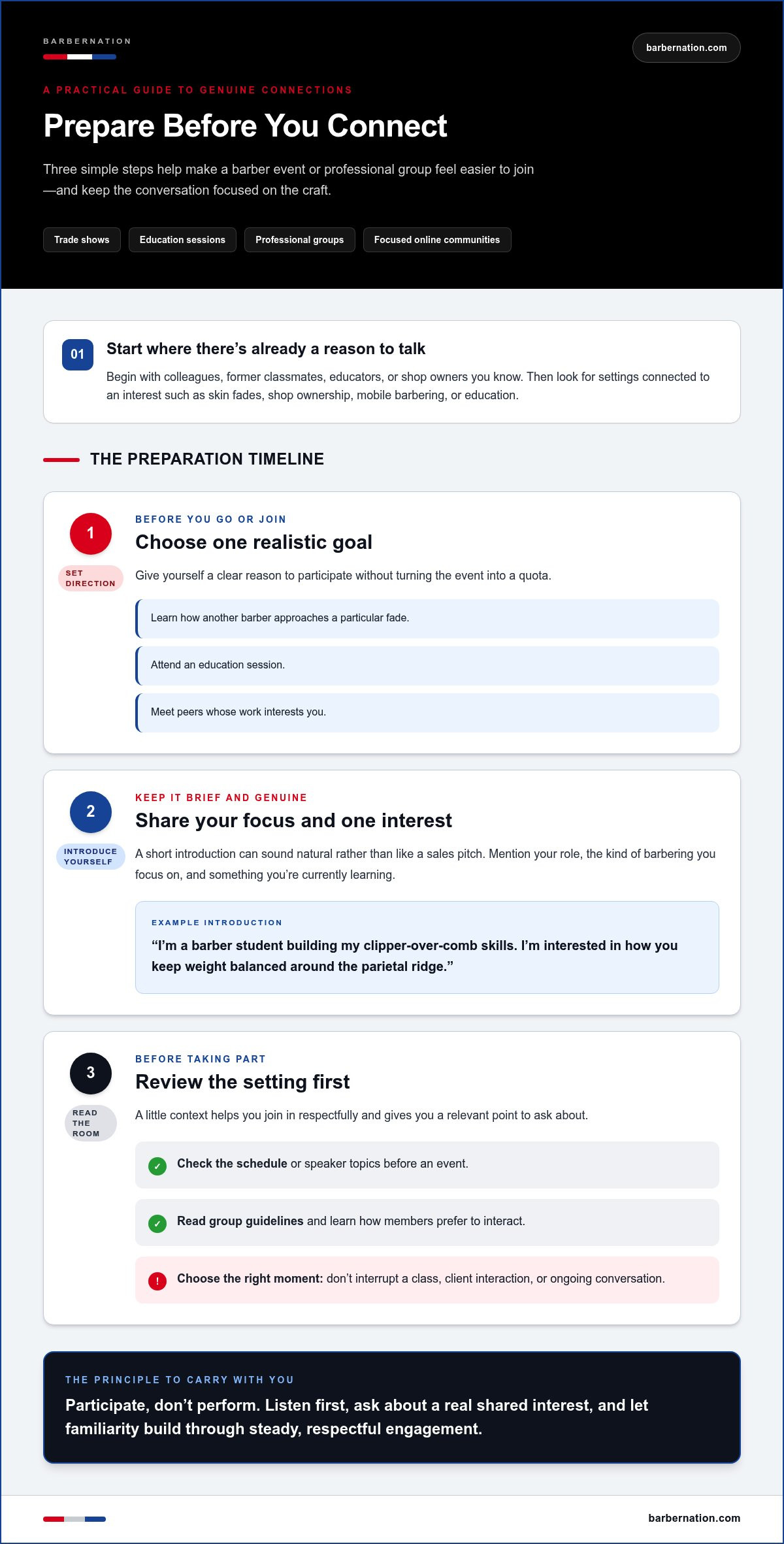
How to prepare before attending a barber event or joining a group
A little preparation takes pressure off the first interaction. Set a modest goal that gives you direction without turning the event into a quota. Prepare a short introduction that sounds like you, not a sales pitch. Before posting or joining a discussion, learn the group’s purpose and how members prefer to interact.
- Choose one realistic goal. You might want to learn how another barber approaches a particular fade, attend an education session, or meet peers whose work interests you.
- Prepare a brief introduction. Share your role, the kind of barbering you focus on, and one current interest. For example: “I’m a barber student building my clipper-over-comb skills. I’m interested in how you keep weight balanced around the parietal ridge.”
- Review the setting first. Check the event schedule, speaker topics, or group guidelines. Arrive with a relevant question, and avoid interrupting a class, client interaction, or ongoing conversation.
If you’re figuring out how to network with other barbers, treat each setting as a chance to participate, not perform. Listen before posting, ask about a real point of shared interest, and let familiarity build through steady, respectful engagement.
Which Barber Networking Channels Fit Your Goals and Style?
The best channel is one you can realistically take part in and return to. A trade show can offer focused education and face-to-face conversation, while an online community lets you join discussions in shorter bursts. Professional groups can provide continuity, and an introduction through a client or colleague may feel more personal. You don’t need to attend every event or post every day. Consistency matters more than volume.
Use this comparison to match your next step to the kind of connection you want to build:
| Channel | Best-fit goal | Practical first action |
|---|---|---|
| In-person events and education | Learn techniques and discuss the craft directly; attendance takes time, but makes detailed conversation easier. | Choose a class or demonstration tied to a skill you want to explore, then ask one relevant question. |
| Professional groups | Stay connected with peers around shared interests; regular participation takes ongoing time and creates opportunities to learn. | Attend a meeting or contribute a useful answer to a current discussion. |
| Online communities | Follow peers’ work and exchange ideas flexibly; brief interactions are easy to maintain, with follow-up through continued discussion. | Comment thoughtfully on a technique or ask a specific question before sending a direct message. |
| Client or colleague introductions | Meet someone through a shared professional connection; the exchange is personal and can be followed up directly. | Accept an introduction when offered, then mention the shared connection and a genuine point of interest. |
In-person connections: events, education, and professional groups
Face-to-face settings are useful for discussing details that are easier to show or describe in person, such as clipper control, sectioning, or a barber’s approach to consultation. You don’t have to meet the whole room. A focused conversation with one barber after a class can feel more comfortable and be more memorable than rushing between introductions. Respect the setting: follow event guidance, wait until a demonstration ends, and don’t interrupt a barber who’s working with a client.
Online connections: social platforms and barber communities
Online networking gives you time to consider what you want to say. Follow professionals whose work or business perspective interests you, then add something relevant to the conversation. A specific note about a taper or a thoughtful question about a shared topic gives a direct message a natural opening. Respect boundaries: if someone doesn’t respond, don’t keep sending messages or turn the exchange into repeated promotion.
There’s no single personality type required for how to network with other barbers. Quiet, considered participation can be effective, and useful connections don’t depend on constant posting. Choose a channel you can sustain, make your contributions relevant, and let trust develop through genuine interaction. The right equipment can also support your day-to-day work. BarberNation’s TurboJet 3.0 FadeBlaster is a cordless air duster with a 150,000 RPM brushless motor, micro-vacuum functionality, and four adjustable airflow speed settings. Explore professional barbering tools.
How to Start a Conversation and Follow Up with Another Barber
A strong first conversation doesn’t need a perfect opening line. Notice what’s happening, connect your introduction to a shared point of interest, and give the other barber room to respond. This simple sequence helps keep the exchange natural:
- Observe. Notice a technique, discussion, or event topic you can honestly ask about.
- Introduce yourself. Share your name and a brief detail about your work or current interest.
- Ask a relevant question. Keep it open-ended and connected to what you observed.
- Listen. Respond to their answer instead of planning your next pitch.
- Close graciously. Thank them for the conversation and, if there’s mutual interest, ask whether they’d like to stay in touch.
A respectful first conversation is simple: show genuine interest, listen well, and leave the other barber free to decide what comes next.
What should you say when meeting another barber?
Base your opening on something specific, such as a technique you noticed or a topic from a class. Try, “I liked how you kept the blend clean around the temple. What’s your approach there?” or “What’s one idea from the demonstration you’re planning to try?” Then offer a short introduction of your own, such as, “I’m a barber student working on my shear-over-comb skills.” Keep it conversational, not a sales pitch.
Questions work best when they invite more than a yes-or-no answer. Ask what they’ve found useful, how they approach a particular detail, or what they’re exploring in their work. Listen for the point they’re most interested in discussing. If they seem busy or give brief answers, don’t force the exchange. A friendly close can be as simple as, “Thanks for sharing that. Enjoy the rest of the event.”
Exchange contact details only when the conversation feels reciprocal. You might say, “I enjoyed talking about textured cuts. Would you be open to connecting on Instagram?” If they hesitate or decline, accept it without asking for a reason. A good introduction respects both people’s time and boundaries.
How to follow up after a first conversation
Follow up with a short message that reminds them who you are and refers to the conversation you shared. Keep it personal, specific, and easy to answer. If something useful relates directly to the discussion, include it without turning the message into an unsolicited promotion.
- Reconnect to the topic: “Good meeting you after the fade demonstration. I’ve been thinking about your point on keeping the transition soft.”
- Continue with a relevant contribution: Share an article, technique reference, or thoughtful response only if it genuinely fits what you discussed.
- Leave space: If they don’t reply or decline an invitation, don’t send repeated nudges. Let a future interaction happen naturally.
Learning how to network with other barbers means treating follow-up as an invitation, not an obligation. If you’re looking for tools for your station, BarberNation offers its TurboJet 3.0 FadeBlaster with USB-C charging and micro-vacuum attachments. The product includes a 1-year repair or replacement warranty. Package contents may vary slightly by model or bundle. Please review the selected product option before checkout. Explore professional barbering tools from BarberNation: Professional Barber Tools and Grooming Supplies.
How to Build a Lasting, Mutual Barber Network
A professional network grows through steady, thoughtful participation, not constant outreach. Once you’ve made an introduction, show interest in what your peers are learning, creating, and working toward. Remember a detail from a conversation, congratulate them on work you genuinely admire, or share a useful insight when it fits. Small, sincere gestures help a new connection develop into a relationship.
Reciprocity doesn’t mean keeping score. Share a technique or resource because it may help, not because you expect an immediate return. If you’re introducing two barbers, consider whether the connection would benefit both of them, and ask permission before passing along contact details. Trust builds when your actions are relevant, respectful, and consistent.
How to make professional relationships mutually valuable
Make your contribution specific. You might tell a peer how you adapted a consultation approach, credit them when you share an idea they taught you, or celebrate a strong cut with a considered comment. Offer support without assuming you know what someone needs. An introduction can be valuable when it’s welcome and there’s a genuine reason for the two professionals to connect.
Keep the rhythm manageable. Choose one community or a small circle of peers you can engage with naturally, rather than trying to attend every event or respond to every post. A few thoughtful interactions that fit your schedule are more sustainable than treating networking as another full-time task. Steady participation gives others a chance to know your work and how you show up.
A simple 30-day plan to grow your barber network
Use this plan as a starting point, not a quota. Adjust it to your schedule and preferred way to connect.
- Week one: Choose one barber-focused community, professional group, or event. Set a realistic goal, such as contributing to one discussion or learning about a technique that interests you.
- Weeks two and three: Take part in a useful way. Ask a considered question, share a relevant observation, and begin genuine conversations with barbers whose work or interests connect with yours.
- Week four: Follow up where there was mutual interest. Reflect on which interactions felt natural and worthwhile, then choose one sustainable next step, such as continuing in the group or reconnecting with a peer at a future event.
The practical lesson in how to network with other barbers is to keep showing up with curiosity and care. You don’t need a large contact list. Build a circle where knowledge, recognition, and appropriate support move both ways, and let each connection develop at its own pace. As you continue refining your craft, explore professional tools from BarberNation: Professional Barber Tools and Grooming Supplies.
Make Your Next Barber Connection Count
Your professional circle doesn’t need to grow all at once. Choose one person whose work inspires a question, one community where you can contribute, or one conversation you’d like to continue. Then take that step with genuine curiosity. Over time, peer connections can help you keep learning, consider new perspectives, and shape your own path in the trade.
Learning how to network with other barbers is ultimately about showing up as a professional others can trust: generous with what you know, respectful of what you don’t, and interested in shared progress. Start with one thoughtful action this week and let the relationship develop naturally.
BarberNation’s mission is “Premium Barber Grooming Tools,” with equipment for professional barbers and grooming professionals. As you build your craft, explore professional barbering tools from BarberNation, including the TurboJet 3.0 FadeBlaster cordless air duster. Package contents may vary slightly by model or bundle. Please review the selected product option before checkout.
Frequently Asked Questions
How do I network with other barbers if I am shy?
Start with settings where the conversation has a clear focus, such as a technique demonstration or a small online discussion. If approaching someone in person feels daunting, go with a colleague or arrive early, when it may be easier to speak with people before a group forms. Learning how to network with other barbers doesn’t require becoming an extrovert. Choose one manageable interaction and build confidence at your own pace.
Where can barbers meet other barbers?
Barbers can meet peers at trade shows, educational workshops, professional associations, barber schools, and online communities centered on the craft. Alumni groups can be a useful starting point for students and recent graduates, while a colleague may be able to introduce you to someone with a shared interest. Look for spaces where people discuss techniques, education, or shop life, so the setting gives you a natural subject to talk about.
What should I say when approaching another barber?
Make your opening relevant to the moment. After a class, you could say, “I’m working on my consultation process. What part of the lesson stood out to you?” If you admire a barber’s work, mention a specific detail rather than offering a generic compliment. Then share a brief point about your own focus. Keep the exchange balanced: ask, listen, and respond to what they actually say instead of delivering a rehearsed pitch.
Is networking important for barber students?
Yes, professional connections can help barber students learn how different people approach the trade beyond the classroom. A classmate might offer a fresh perspective on clipper control, while an experienced barber could describe how they communicate with clients during a consultation. Students can also ask instructors about professional groups or learning opportunities. Treat these conversations as a way to broaden your perspective, not as a shortcut to a job or guaranteed career outcome.
How do I follow up with a barber after meeting them?
Send a concise message that identifies where you met and recalls a specific part of your conversation. For example, mention the cutting technique you discussed or the class you both attended. If you tried an idea they shared, a short update can make the follow-up feel genuine and give the conversation a natural next point. Don’t attach an unrelated promotion or ask for a favor before a relationship has developed. If they don’t reply, give them space.
Can social media help barbers build professional connections?
Yes. Social platforms can help barbers discover peers, share their work, and learn from technique demonstrations or discussions. Keep your profile and comments professional, and use focused tags related to barbering to make your work easier for interested peers to find. Rather than posting only finished cuts, thoughtful captions about your process can invite useful discussion. Engage with content you genuinely value, and let direct conversations grow from shared interests.
How often should I reach out to other barbers?
There’s no fixed schedule. Let the reason for contact guide the timing: follow up after a meaningful conversation, respond when a peer shares work you can comment on sincerely, or reconnect when you have something relevant to contribute. A brief, occasional exchange is more considerate than frequent messages without a clear purpose. Pay attention to how the other person responds, and match their level of engagement rather than expecting constant contact.
Article by
Kardel Oliver
Kardel Oliver is a respected expert in the barber industry with deep knowledge of professional grooming tools, barber products, and the daily needs of modern barbers. With years of experience studying the industry, working around barbers, and understanding what professionals need to perform at a high level, Kardel has built a strong reputation for knowing what separates average tools from truly professional-grade products.
Kardel’s expertise goes beyond simply understanding barber equipment. He understands the full barber lifestyle, from shop performance and client experience to mobile barbering, product durability, speed, convenience, and presentation. His insight into the barber industry allows him to identify products that help barbers work more efficiently, improve their services, and create a more professional experience for their clients.
Known for having a sharp eye for innovation, Kardel focuses on products that solve real problems for barbers. Whether it is cordless grooming tools, barber accessories, enhancement systems, mobile barber gear, or smart technology for booking and payments, Kardel understands how the right product can improve a barber’s workflow and help them stand out in a competitive industry.
Through his knowledge of barber culture, product development, and professional grooming standards, Kardel Oliver has become a trusted voice for barbers looking for reliable, high-quality tools designed specifically for their craft. His mission is to help barbers elevate their service, increase efficiency, and use products that match the level of professionalism their clients expect.