

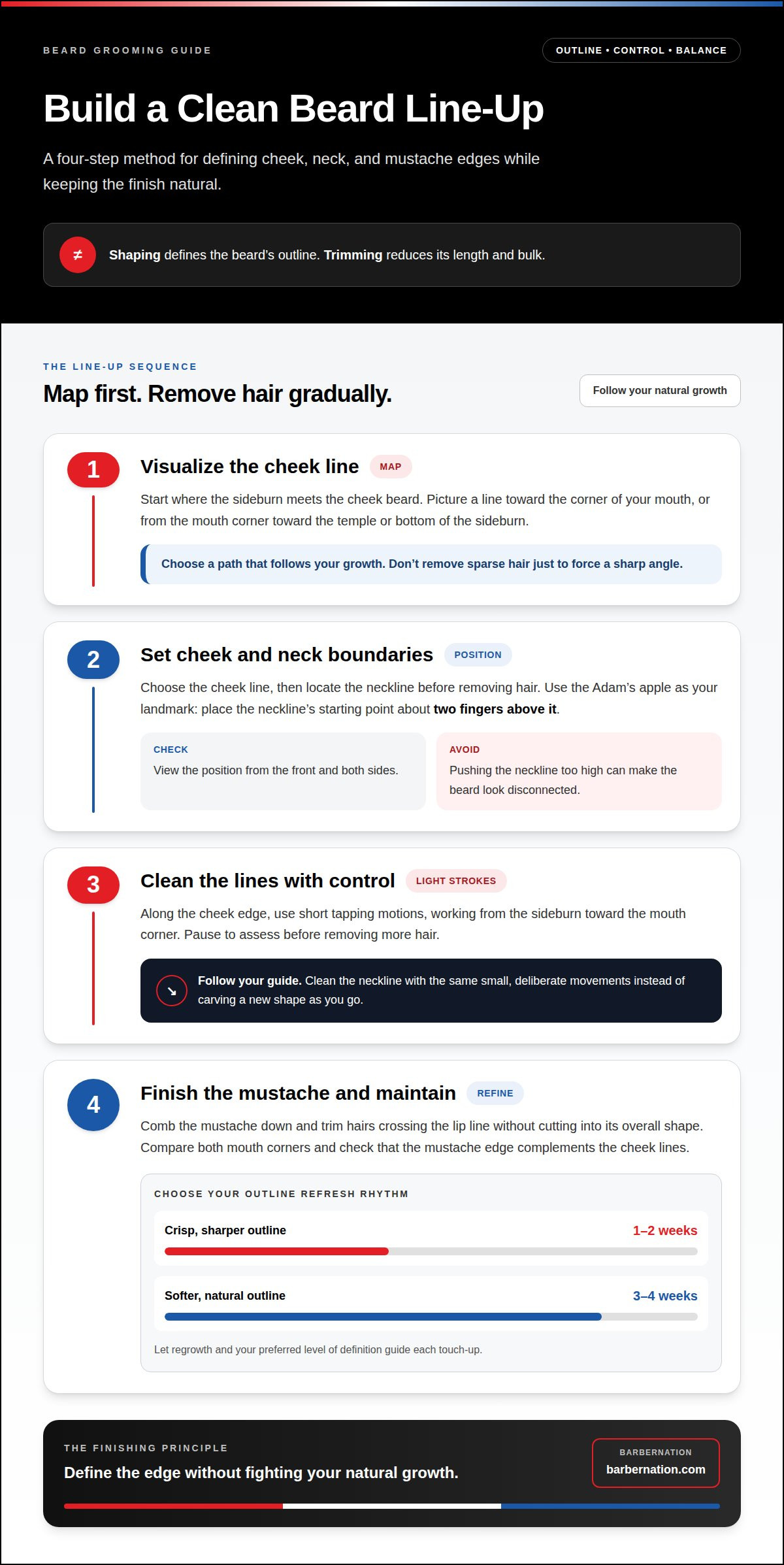
Beard shaping and trimming are related, but they are not the same: shaping defines the outline, while trimming reduces length and bulk. Creating the perfect beard line up starts with choosing edges that suit your face and natural growth pattern. For the neckline, a useful starting point is about two fingers above the Adam’s apple.
A crisp edge can make a beard look intentional, but taking away too much can leave it harsh or uneven. Work with your features, not against them. This guide explains how to map and clean up cheek and neck lines, distinguish outline work from length trimming, and adapt the shape to your face. You’ll also learn a steady method for matching both sides while keeping the finish natural.
Key Takeaways
- Map cheek and mustache edges to your natural growth, then clean each line with controlled, light strokes.
- Separate outline work from length trimming, and choose tools that give you control over both tasks.
- Adjust beard fullness to your face shape, using length and side volume to create balance.
- Use a visible guide and shape one side at a time to build a natural, symmetrical finish.
What Is a Beard Line-Up?
A beard line-up sharpens the edges without changing beard growth. While experienced professionals such as Straight 8 Barbers often set the standard with precision razor work and tailored shaping, learning the technique allows you to maintain clean lines between visits. A crisp outline can be refreshed every 1-2 weeks, while a more natural outline can be refreshed every 3-4 weeks.
-
Visualize the Cheek Line
Start where your sideburn meets the cheek beard. Imagine a line from that corner toward the corner of your mouth, then check how it follows your natural growth. You can also picture the edge running from the mouth corner toward the temple or the bottom of the sideburn. Choose a path that looks balanced on your face instead of removing sparse growth to force a sharp angle.
-
Define the Cheek and Neck Lines
Choose the cheek line, then locate the neckline before removing hair. Use the Adam’s apple as your landmark, placing the neckline’s starting point about two fingers above it. Check the position from the front and both sides to make sure the edge sits evenly. Connect the cheek line naturally to the sideburn, and avoid pushing the neckline too high, which can make the beard look disconnected.
-
Trim and Shape the Lines
Use short tapping motions along the cheek edge to remove stray hairs gradually. Work from the sideburn toward the mouth corner, pausing to assess the line before removing more hair. This controlled approach helps prevent cutting a chunk from the cheek. Clean the neckline with the same small, deliberate movements, following your guide instead of carving a new shape as you go.
-
Set the Mustache Edge and Maintain the Outline
Comb the mustache down, then trim hairs that cross the lip line without cutting into its overall shape. Compare both corners of the mouth and check that the mustache edge complements the cheek lines. Refresh a sharper outline every 1-2 weeks; a softer, natural finish can go 3-4 weeks between line-ups. Let regrowth and your preferred level of definition guide each touch-up.
Is beard shaping the same as trimming?
Shaping defines the beard’s outline; trimming reduces its length and bulk. Both require control, but each calls for a different tool and approach.
Choose a barber for a first-time shape or a complex outline, then maintain familiar lines at home. At home, your costs are mainly for tools. Barber prices depend on location and on whether the service includes trimming or line-up work. For more comprehensive hair styling and care, professional studios such as Boost Beauty Lounge provide specialized packages that complement an ongoing personal grooming routine.
-
Gather Home Trimming Tools
Set out a guarded beard trimmer, a comb, and a mirror before cutting. Use the comb to lift hairs evenly, then trim dry so the visible length stays accurate. Keep a razor and shaving cream ready for precise edge cleanup. Avoid starting with wet hair or an unguarded blade, since either can make it harder to control how much you remove.
-
Choose a Trimmer, Clipper, or Razor
Choose a guarded trimmer to reduce beard length and a clipper for larger areas. Start with a longer guard, then shorten gradually until the beard reaches your preferred length. For a precise line, use a double-edge safety razor with shaving cream; multi-blade razors can make sharp edges harder to control. Match the tool to the task, not simply to what is closest at hand.
-
Follow the At-Home Trimming Steps
Comb your dry beard in its natural direction, then reduce bulk with a longer guard. Work evenly across both sides before switching to a shorter guard, and pause to compare the shape in the mirror. Clean stray hairs around the outline with short, deliberate strokes. Avoid cutting too much at once or chasing tiny differences, which can turn a simple cleanup into an uneven shape.
Use the growth pattern to guide each pass. Most beards may need trimming every 2-4 weeks, while a long beard may need trimming every 4-6 weeks.
Beard shaping for face structure and growth patterns
Use face shape as a guide, then adapt the outline to your beard’s natural density and direction. Creating the perfect beard line up means balancing your features with the growth you actually have.
- For a round face, leave more length on the chin and shorten the sides. This contrast can visually lengthen the face without forcing a narrow cheek line. Check your profile as well as the front view. Keep the chin as the focal point, and avoid adding width with bulky side growth.
- For a long face, keep the sides fuller, the beard shorter underneath, and the cheek line softer. This combination helps avoid emphasizing vertical length. Follow your cheek growth instead of carving a high, steep edge. Compare your side profile with the front so the beard’s width and chin length stay balanced.
- For a square face, creating the perfect beard line up starts with a slightly rounded jaw edge to soften a strong jawline. Trace the curve gradually instead of creating a sharp corner at each jaw angle. Keep the outline consistent from the sideburn toward the chin, and assess both sides before refining the curve.
- For a heart-shaped face, add weight at the bottom of the beard to balance a wider forehead. Preserve fullness at the chin instead of tapering the lower beard too tightly. Keep the cheek edge suited to your natural density so sparse areas do not become an abrupt, overly defined line.
- Read your growth pattern before choosing an outline. Notice where cheek hair grows densely, where it thins, and how its direction changes near the jaw. Let fuller areas support the shape, and avoid cutting deeply into patchy areas to imitate a line your growth does not naturally form. If you choose a beard fade, blend shorter sideburn hair into fuller chin length. Work upward through each length zone, keeping the transition aligned with your face shape. The aim is balance, not identical density throughout the beard.
Keeping a natural, symmetrical beard outline
Use a visible guide, compare both sides, and preserve the growth pattern that gives your beard its natural shape.
- Stand upright in front of a mirror and look straight ahead, keeping your head level. Use a white pencil to mark the cheek line you intend to follow. Check that the guide suits your beard’s density instead of cutting through sparse growth. A clear mark lets you focus on the outline before the trimmer or razor touches your hair.
- Shape one cheek line first, using short, controlled strokes along your pencil guide. Follow the direction of growth and pause at the sideburn and mouth corner to check the transition. Do not try to make every hairline perfectly straight; a line that follows your natural growth can look more balanced than an artificially sharp edge.
- Use the finished side as a reference for the other cheek. Compare where each line meets the sideburn and how it slopes toward the mouth. Look straight into the mirror, then turn your head slightly to inspect both profiles. Match the overall height and direction instead of removing extra hair to correct minor differences in density.
- Assess the neckline from the front and each side before cleaning up stray hairs. Keep the edge even across the neck while following the jaw’s natural contours. If one side looks higher, compare its position with the other side before making a small adjustment. Avoid raising the entire line to correct one uneven patch.
- Step back from the mirror after each pass and review the full outline, including cheek, jaw, and mustache connections. If the shape looks overly geometric, soften the edge by following the natural growth rather than extending the pencil guide. Refresh only the hairs that disrupt the silhouette. This final comparison helps preserve a consistent shape without overworking either side.
BarberNation: Professional Barber Tools and Grooming Supplies: BarberNation Cordless Air Duster
BarberNation offers the BarberNation Cordless Air Duster as a professional grooming tool for your setup. A clean, organized workspace supports focused beard work, while your trimmer and razor remain the tools that define the outline.
For a finishing touch, WATER RESISTANT HAIR ENHANCEMENT is designed for precision styling and finishing. It can complement your grooming routine when you want to refine the overall presentation after shaping, without replacing careful line work. Choose tools and finishing products according to the task: outlining, cleanup, or styling.
Explore the offerings or contact BarberNation: Professional Barber Tools and Grooming Supplies through barbernation.com.
Make Each Line-Up Part of Your Craft
Let each grooming session sharpen your eye as well as your outline. The craft of creating the perfect beard line up develops through deliberate choices: notice which shapes complement your features, how your beard grows, and which details you prefer to maintain. Keep a simple record of the outline that feels right so future adjustments have a clear starting point.
As your beard changes, give yourself room to revise its shape. Growth can shift the balance between your cheeks, jaw, and chin, so treat your preferred outline as a guide rather than a fixed template. Build consistency through patience, sound technique, and attention to detail. Each careful pass helps you gain control of the finish.
Ready to support your grooming routine with professional tools and styling essentials? Explore BarberNation’s offerings, and keep developing your craft with confidence.
Frequently Asked Questions
How do you create a clean beard line-up step by step?
Creating the perfect beard line up starts with a clear plan for the shape you want. Comb your dry beard into place, then decide which edges need cleanup and which should stay soft. Shape the outline in stages, checking the full silhouette between passes. As you practise creating the perfect beard line up, pause before correcting small differences so you do not remove more hair than intended.
Where should the beard neckline be placed?
Use the Adam’s apple as your reference point, with the neckline starting about two fingers above it. Judge the line with your chin level and your mouth relaxed, not lifted or clenched. A natural neckline should frame the beard beneath the jaw rather than sit directly along its edge. Recheck the placement from the front before cleaning up stray hairs.
How do you shape a natural-looking cheek line?
Follow the boundary where your cheek growth becomes less dense instead of forcing a perfectly straight line. A white pencil can help you preview the shape before trimming. If one side grows higher or fuller, preserve that natural character rather than cutting deeply to make both sides identical. Aim for a clean transition that suits your growth pattern and looks balanced at conversational distance.
What tools are best for lining up a beard at home?
Choose tools for the job: a guarded trimmer for length, a precision trimmer for detail, and a razor for close edge cleanup. Keep a comb and mirror nearby to check how the hairs sit before cutting. For a close shave along the outline, shaving cream helps the blade move across the skin. Arrange everything within reach so you can stay in control while trimming.
How do you use a beard trimmer or razor without creating sharp mistakes?
Use the trimmer to remove only the hairs outside your planned outline, and stop often to inspect the result. For razor work, apply shaving cream and make small, deliberate strokes instead of drawing one long cut. Avoid correcting every tiny difference straight away. Beard growth can look uneven up close, so judge the line from a normal viewing distance before making another pass.
How do you line up a beard for different face shapes and beard styles?
Use beard length and side volume to create visual balance. A round face can benefit from a longer chin and shorter sides; a long face often suits fuller sides and less length underneath. For a square face, a gently rounded jaw edge can soften the outline. With a shorter beard or heavy stubble, keep the edge proportionate instead of carving an oversized border.

Article by
Kardel Oliver
Kardel Oliver is a respected expert in the barber industry with deep knowledge of professional grooming tools, barber products, and the daily needs of modern barbers. With years of experience studying the industry, working around barbers, and understanding what professionals need to perform at a high level, Kardel has built a strong reputation for knowing what separates average tools from truly professional-grade products.
Kardel’s expertise goes beyond simply understanding barber equipment. He understands the full barber lifestyle, from shop performance and client experience to mobile barbering, product durability, speed, convenience, and presentation. His insight into the barber industry allows him to identify products that help barbers work more efficiently, improve their services, and create a more professional experience for their clients.
Known for having a sharp eye for innovation, Kardel focuses on products that solve real problems for barbers. Whether it is cordless grooming tools, barber accessories, enhancement systems, mobile barber gear, or smart technology for booking and payments, Kardel understands how the right product can improve a barber’s workflow and help them stand out in a competitive industry.
Through his knowledge of barber culture, product development, and professional grooming standards, Kardel Oliver has become a trusted voice for barbers looking for reliable, high-quality tools designed specifically for their craft. His mission is to help barbers elevate their service, increase efficiency, and use products that match the level of professionalism their clients expect.