

Beard oil can improve the appearance of a fuller beard, but it can’t change follicle density or the natural thickness of each strand. Using enhancements for a fuller beard works best when you focus on what you can influence: moisturize existing hair, guide its direction, and style around your natural growth pattern. Genetics shape where facial hair grows and how thick it is, while beard hair grows unevenly and at different rates.
If patchy areas or unruly hairs frustrate you, you’re not alone in wanting a more even, substantial appearance. Oil can soften and condition beard hair, but it won’t create new growth. The distinction matters: choose a technique based on whether you want to improve skin comfort, strand texture, hair direction, or visible coverage.
Learn how density and thickness affect your beard’s appearance, how oil fits into a grooming routine, and how enhancements can create the look of fuller coverage. You’ll also get a realistic view of growth timelines, so you can set a routine and assess progress without expecting overnight change.
Key Takeaways
- Separate natural coverage from strand texture and growth direction to identify what you can style and what takes time.
- Use beard oil to condition existing hair, not as a way to increase follicle density.
- Set a patient growth timeline before deciding whether patchiness is permanent or simply part of the early stages.
- Compare fibers, pencils, and dyes by the kind of coverage and finish you want, then choose an enhancement that suits your grooming routine.
1. Beard follicle density, strand thickness, and hair direction
Genetics shape where follicles grow, when facial hair appears, and its pattern, color, and texture. Testosterone converts to DHT, and naturally higher DHT levels are associated with thicker beard growth. These factors influence coverage: oil or a vitamin routine can condition existing hair, but neither can create follicles where growth doesn’t occur.
Assess your coverage before changing your beard care routine. Sparse cheek growth may reflect follicle distribution, while a fuller jaw with fine strands points to texture as the styling challenge. Beard hair also grows unevenly, so one cheek may fill in at a different pace from the other. Shaving doesn’t make hair grow thicker; it only changes how the cut ends feel.
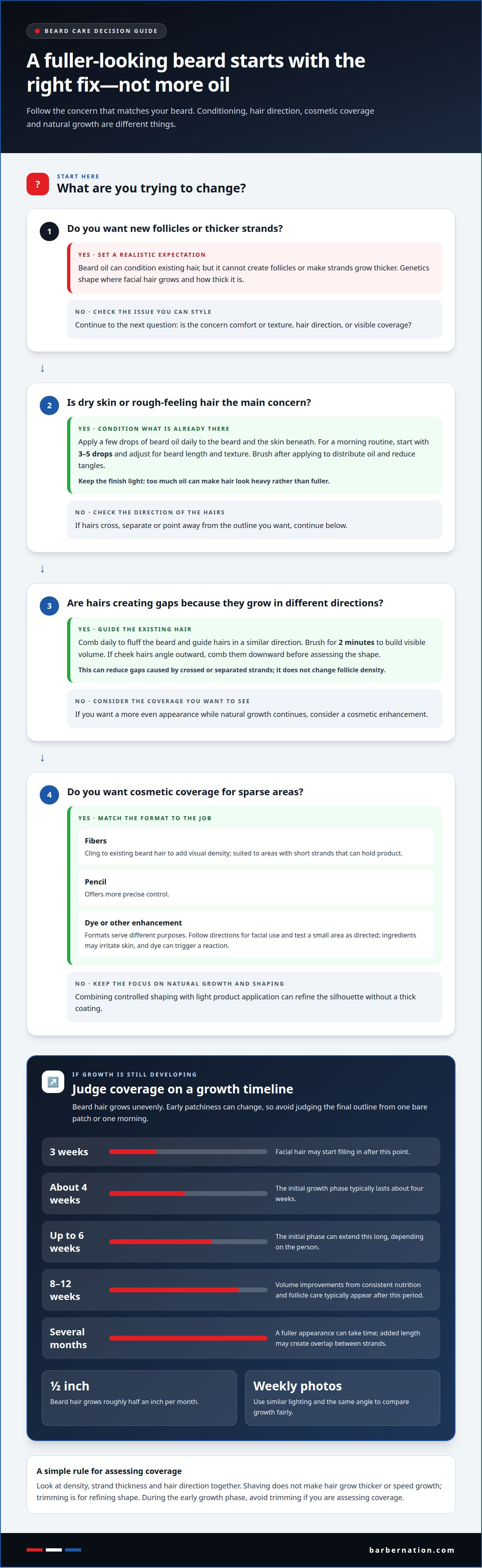
Hair direction affects the outline you see. Comb your beard daily to fluff it and guide hairs into a similar direction, then brush for two minutes to build visible volume. For example, if cheek hairs angle outward, comb them downward before assessing the shape. This simple step can reduce gaps created by crossed or separated strands, without changing follicle density.
Are beard fillers and dyes safe for skin and facial hair? They aren’t automatically safe for everyone: ingredients may irritate skin, and dye can trigger a reaction. Follow the directions for facial use and test a small area as directed before applying the product more widely.
Patience matters during early growth. Beard patchiness is common in the first few weeks, and the initial growth phase typically lasts about four weeks. If you’re assessing coverage, avoid trimming during this period; cutting early can make shorter areas look even less dense. Afterward, shape selectively and preserve length where strands overlap sparse areas. Assess density, strand thickness, and direction together, rather than judging by one bare patch.
2. Beard oil, thickness, and product use
Beard oil improves the condition and appearance of existing hair; it doesn’t increase hair follicles or make strands grow thicker. Apply a few drops daily to moisturize the beard, spreading oil through the hair and onto the skin beneath. For a morning routine, use 3 to 5 drops, then adjust the amount to your beard’s length and texture.
Oil supports beard care, not new growth. A healthy routine can include balanced eating and consistent grooming, but don’t treat supplements or oils as a way to change testosterone or create a full beard. Brush after applying oil to distribute it evenly and reduce tangles. Keep the finish light: too much product can make hair look heavy rather than fuller.
In the United States, product costs vary by format and amount. Beard oil, fibers, pencils, dyes, and water-resistant enhancements serve different purposes, so compare them by intended use rather than assuming they’re interchangeable.
For a natural filler result, start with a clean, dry beard and choose a shade close to your hair color. Apply a small amount to sparse areas, follow the product directions, then blend gently through nearby strands. Build coverage gradually; applying too much at once can leave a sharp, artificial patch.
Wear time depends on the product’s intended use and exposure to water or friction. Water resistance isn’t shared by every filler, oil, pencil, or dye. WATER RESISTANT HAIR ENHANCEMENT is the option specifically identified as water-resistant.
Shape also affects perceived density. Keep the cheek area neat and preserve more length around the lower jaw, where overlapping strands can create a fuller outline. Trim cautiously to refine the silhouette without removing the coverage you’re building. If you are hesitant about shaping your beard at home, professional styling from Sam's Scissors Barbershop can help establish clean lines that maximize your natural coverage. For a polished finish, combine controlled shaping with light product application, not a thick coating.
3. Expected timelines for fuller-looking facial hair
Assess beard growth over months, not a few mornings. Facial hair may start filling in after the three-week mark, while a fuller appearance can take several months. Beard hair grows roughly half an inch per month, so added length can gradually create overlap between strands. That overlap may soften sparse areas, but genetics and individual growth patterns still shape the final coverage.
The initial growth phase typically lasts about four weeks and can extend up to six weeks, depending on the person’s facial hair. During this stage, changing patchiness can make it hard to judge the eventual outline. Take a progress photo weekly in similar lighting and from the same angle. Comparing images helps distinguish gradual growth from changes caused by styling or lighting.
Give consistent nutrition and follicle care time to show visible effects. Volume improvements from these routines typically appear after 8 to 12 weeks. Supplements aren’t an instant solution, and a vitamin routine can’t override genetics. Keep your approach steady, then assess the result after that period rather than switching products every few days.
Age can also influence expectations: most men may not grow a thick beard until their early-to-mid 20s. If facial hair is still developing, a sparse area at one stage doesn’t define its eventual pattern. Using enhancements for a fuller beard can create a more even appearance while natural growth continues. For an occasion, using enhancements for a fuller beard lets you style the look you want without treating a cosmetic effect as new growth. Shaving won’t speed the process, so use trimming to refine shape, not as a growth strategy. Keep tracking changes across several months, and adjust your styling as coverage develops.
4. How do beard filler fibers, pencils, and dyes compare?
Choose an enhancement based on the gap you want to address. Fibers cling to existing beard hair to add visual density, so they suit areas with short strands that can hold product. A pencil gives more precise control over small gaps or sharper edges. Dye changes facial-hair color, which can make lighter strands stand out more clearly against the skin.
For a natural finish, match the shade to your beard in daylight, rather than relying only on warm bathroom lighting. Apply fibers sparingly to clean, dry hair, then blend with a brush. With a pencil, use light, short strokes that follow nearby hairs. For dye, follow the product directions and test a small area first, since ingredients can irritate skin.
Each format has limits. Fibers can look uneven if applied heavily or placed on bare skin without supporting hairs. Pencil marks may look drawn on if their edges are too sharp or their color contrasts with the beard. Dye can tint strands, but it won’t add length or change follicle density. Check the result in a mirror from arm’s length to see whether it blends with your natural outline.
Consider your routine, too. Fibers and pencils provide temporary visual coverage, while dye changes the appearance of hair until it fades or is replaced by new growth. Wear time varies with the formula, application, and exposure to water or friction, so follow the label rather than assuming every product lasts equally long. Water resistance is specific to individual products, not a standard feature of fillers, pencils, and dyes.
For a cheek patch, try a small amount of fiber first; use a pencil when you need a defined edge. Choose dye when color contrast, rather than a lack of visible strand volume, is the main concern. Apply sparingly, blend carefully, and assess the finish in natural light before adding more.
BarberNation: Professional Barber Tools and Grooming Supplies: BarberNation Cordless Air Duster
BarberNation: Professional Barber Tools and Grooming Supplies offers WATER RESISTANT HAIR ENHANCEMENT for precision styling and finishing. It’s a relevant option when you want to create a fuller-looking finish while natural beard growth takes its course.
Choose an enhancement for the styling result you want, not as a substitute for beard growth or follicle density. Work with your natural outline and apply carefully to keep the finish balanced. BarberNation’s professional grooming equipment range also includes the Cordless Air Duster, while its water-resistant enhancement is designed for appearance and finishing.
Explore BarberNation’s grooming products at barbernation.com.
Make Your Next Grooming Choice Deliberate
Let the finish you want guide your next step. Decide whether you’re refining your outline, adding visible coverage, or preparing a polished look for an occasion. Using enhancements for a fuller beard works best when the technique suits your beard and the result you want. Treat it as a deliberate styling choice, not a substitute for natural growth.
For a finished appearance, consider WATER RESISTANT HAIR ENHANCEMENT and apply it with a light touch. Using enhancements for a fuller beard is about precision and balance, so keep the final look true to your style. Explore the available grooming products or reach out to BarberNation: Professional Barber Tools and Grooming Supplies through BarberNation’s website. Choose your approach with confidence and keep refining your craft.
Frequently Asked Questions
Does beard oil actually make your beard thicker?
No. Beard oil doesn’t increase follicle count or biological strand thickness. It can make existing hair feel softer and look better groomed, improving its presentation without changing actual density. Use a small amount, especially if your beard is short, and avoid applying it to irritated or broken skin. Stop using it if you notice redness or itching.
How long does it take to see more beard volume?
A fuller natural look generally takes several months, while grooming or cosmetic filler can change the visible finish immediately. Keep those timelines separate: judge natural growth by how coverage develops, and assess temporary styling by how well it blends in your usual lighting. This helps distinguish an immediate cosmetic effect from a lasting change in facial-hair growth.
Is this a good gift for a man growing his beard?
Yes, if he enjoys maintaining and styling his beard. A Barber T-shirt is a straightforward trade-inspired gift, while WATER RESISTANT HAIR ENHANCEMENT suits someone interested in a more finished styling effect. Choose based on his habits and preferred look: apparel is practical without knowing his grooming routine, while an enhancement is more personal.
What Can Help a Beard Grow Faster?
There isn’t a reliable grooming shortcut that changes the growth pattern set by genetics. Focus on caring for the hair you have: clean gently, condition dry-feeling strands, and avoid aggressive trimming that removes visible length. Be cautious about supplements marketed as rapid-growth fixes. A vitamin isn’t a substitute for a balanced routine or a promise of faster facial growth.
What beard enhancement products are available for a fuller-looking beard?
Common enhancement formats include fibers, pencils, and dyes, each creating a different visual effect. BarberNation offers WATER RESISTANT HAIR ENHANCEMENT, a water-resistant styling and finishing option. Choose a category based on whether you want to define small gaps, address color contrast, or finish the overall look. Follow the product directions for application and wear.
Can minoxidil help grow a fuller beard, and what are its risks?
Minoxidil is a growth medication, not a styling product, and facial use can cause irritation, dryness, redness, or itching. Unwanted hair may also appear beyond the area where it’s applied. Beard skin and scalp skin aren’t identical, so don’t assume directions for scalp use automatically apply to your face. Use care with any topical medication, or seek guidance from established specialists such as The Hair Clinic to evaluate clinical hair loss and restoration options safely.

Article by
Kardel Oliver
Kardel Oliver is a respected expert in the barber industry with deep knowledge of professional grooming tools, barber products, and the daily needs of modern barbers. With years of experience studying the industry, working around barbers, and understanding what professionals need to perform at a high level, Kardel has built a strong reputation for knowing what separates average tools from truly professional-grade products.
Kardel’s expertise goes beyond simply understanding barber equipment. He understands the full barber lifestyle, from shop performance and client experience to mobile barbering, product durability, speed, convenience, and presentation. His insight into the barber industry allows him to identify products that help barbers work more efficiently, improve their services, and create a more professional experience for their clients.
Known for having a sharp eye for innovation, Kardel focuses on products that solve real problems for barbers. Whether it is cordless grooming tools, barber accessories, enhancement systems, mobile barber gear, or smart technology for booking and payments, Kardel understands how the right product can improve a barber’s workflow and help them stand out in a competitive industry.
Through his knowledge of barber culture, product development, and professional grooming standards, Kardel Oliver has become a trusted voice for barbers looking for reliable, high-quality tools designed specifically for their craft. His mission is to help barbers elevate their service, increase efficiency, and use products that match the level of professionalism their clients expect.