

A low purchase price can hide higher replacement costs. To assess the return on investment for premium barber tools, compare the upfront cost with how long a tool performs well and what it takes to maintain it.
It’s natural to focus on the price tag, especially when building a toolkit for daily services. But durability, blade care, sharpening, and frequency of use all affect a tool’s value over time.
This guide breaks down how to assess tool costs, compare premium shears with other essentials, and build a professional barber toolkit around the work you do. You’ll also learn how regular maintenance affects lifespan, so you can make considered investments that support consistent craft and career growth.
Key Takeaways
- Assess a tool by its working life and upkeep, not just its purchase price.
- Build your toolkit around the services you perform most, then add equipment to fill practical gaps.
- Compare shear costs with your cutting needs and plan for ongoing blade care.
- Track how tool performance affects your workflow, while keeping service quality at the center of any speed gains.
- Explore tools and finishing products that support the specific needs of your barbering practice.
1. Tool durability and maintenance
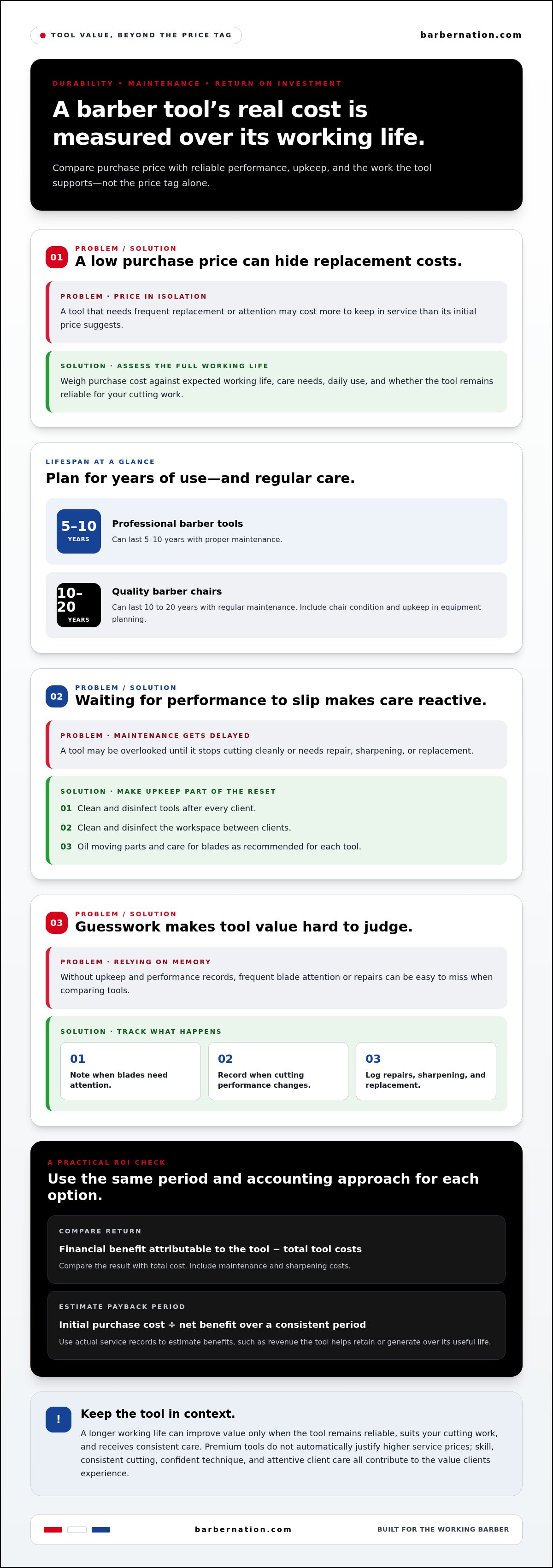
Tool quality affects the time a barber can rely on each purchase. A durable clipper or shear that holds its performance through regular service can remain useful longer than a tool that needs frequent replacement. Professional barber tools can last 5-10 years with proper maintenance, so compare purchase cost with expected working life, care needs, and daily use. That gives a more useful measure of value than the price tag alone.
Start with a repeatable maintenance routine. Clean and disinfect tools after every client, and clean and disinfect the workspace between clients. Oil moving parts and care for blades as recommended for each tool. These steps help maintain performance and support hygienic service. Make them part of your between-appointment reset rather than waiting for a tool to feel less effective.
Track upkeep alongside performance. Note when a blade needs attention, a tool stops cutting cleanly, or repairs or replacement become necessary. A shear that needs frequent attention, for example, may cost more to keep in service than its purchase price suggests. Compare your records with the tool’s working life to judge whether its performance justifies ongoing care.
Barber chairs deserve the same long-term view. A quality barber chair can last 10 to 20 years with regular maintenance. Include its condition and upkeep in the shop’s equipment planning, especially because chairs support every service and affect the client’s position during cutting. Regular maintenance helps protect this substantial fixture and avoids assessing the toolkit as if only handheld tools matter.
A tool’s purchase price alone does not determine its tax treatment. For U.S. barbers, business use, purchase records, and tax classification affect how the cost is handled. Keep receipts and document the tool’s professional use.
Premium tools don’t automatically justify higher service prices. Skill can support higher prices, while equipment is just one part of delivering the work. Consistent cutting, confident technique, and attentive client care all contribute to the value clients experience.
To assess the return on investment for premium barber tools, subtract total tool costs from the financial benefit attributable to using them, then compare the result with total cost. Estimate the payback period by dividing the initial purchase cost by the net benefit over a consistent period. Include maintenance and sharpening costs, and use actual service records to estimate benefits.
For example, compare a tool’s purchase and upkeep costs with the revenue it helps retain or generate over its useful life. Use the same period and accounting approach for each option. A longer working life can improve value, but only if the tool remains reliable, suits your cutting work, and receives consistent care.
2. Building a professional barber toolkit
Build your kit around the services you perform, not a list of every available tool. Start with dependable essentials for your techniques, then add equipment to solve a specific workflow need. A barber focused on fades may prioritize clippers and a foil shaver, while another may need a broader range of cutting tools. Each purchase should address a real task at the chair.
Use starter costs as planning anchors. These figures help frame the investment, but the right choice depends on how often you use each tool and whether it supports your services. A rarely used specialty tool may be less valuable than a dependable daily essential.
Plan your clipper setup before buying duplicates. Barbers are advised to keep two to three clippers in rotation so one is ready to use. Rotation can help maintain workflow when a clipper needs cleaning, blade attention, or charging. Consider whether corded or cordless tools suit your station and routine. A corded tool keeps power access close, while a cordless tool can reduce cable interference as you move.
- List your regular services and the tools each one requires.
- Identify any task that slows your workflow or limits your technique.
- Prioritize reliable daily-use equipment before adding occasional-use tools.
- Record each purchase and its role in your toolkit.
Mobile barbers should consider portability as well as cutting performance. Portable barbering equipment can support appointments outside a traditional barbershop. Organize your kit around the work you take on, including the tools needed for each appointment. A compact setup is useful only if it still supports your service standards.
What financing options or warranties are available for professional barber tools? Payment choices may include an upfront purchase, credit, or installment financing. Warranty protection depends on each tool’s written terms. Compare the total repayment cost and review coverage, exclusions, and claim steps before counting either as part of the tool’s value.
Think of your toolkit as a working system. A foil shaver, for example, adds a finishing option, while combs support control and sectioning, and incorporating specialized beard wave products allows you to cater to textured facial hair styling. Match each tool to a service need, and avoid buying overlapping equipment without a clear purpose. This approach helps you invest in useful capabilities, keep essential tools ready, and build a kit that grows with your craft.
3. Premium shear costs
That range makes the purchase price only a starting point. The right investment depends on your cutting techniques, how often you use shears, and how well they feel in your hand. A premium price alone doesn’t prove a shear suits your work.
Begin with the service you perform most. A barber who regularly uses shear-over-comb needs a comfortable, controlled tool for repeated blending. A barber who mainly uses clippers may use shears less often. In that case, weigh the shear’s cost against its actual role in your service mix instead of defaulting to the highest-priced option.
Evaluate how a shear handles before committing. Open and close it smoothly, check that the blades meet evenly, and see whether the grip supports your natural hand position. Consider the cutting you do, such as point cutting or removing bulk. These practical checks connect the tool’s design to your technique, comfort, and control.
Plan for sharpening as part of ownership. Barber shears may need professional sharpening once or twice per year. Regular sharpening helps maintain a clean cutting edge, but timing depends on use and condition. Include this upkeep when comparing shears at different price levels. A tool’s overall cost includes both its purchase and the care needed to keep it working well.
Use a simple comparison before deciding:
- Write down the shear’s purchase price and intended role.
- Estimate how often it will be used during your normal schedule.
- Account for professional sharpening once or twice per year.
- Compare comfort, control, and cutting performance during practice.
For example, a shear near the lower end of the Japanese steel range may suit a barber who needs a dependable tool for occasional detail work. A higher-cost shear may make more sense for frequent, precise cutting if its handling supports the barber’s technique. Consistent usefulness matters more than prestige alone.
To assess value over time, consider how long the shear stays comfortable, sharp, and suited to your work. Record sharpening and any changes in performance, then compare those records with the purchase cost and the shear’s role in paid services. This practical approach makes the return on investment for premium barber tools easier to evaluate without assuming every expensive shear delivers the same benefit.
Protect the edge between services by storing shears securely and keeping them clean and dry. Don’t use cutting shears for tasks they weren’t designed to perform. Careful handling helps preserve a reliable edge and the precision your work demands.
4. Tool lifespan and maintenance
Set a realistic service-life expectation for each tool before judging its value. Professional barber tools can last 5-10 years with proper maintenance, while inexpensive barber tools may need replacing annually. Those different timelines make routine care part of ownership, not an optional extra. Track the purchase date, use, upkeep, and performance of each tool to spot wear early.
Clippers need consistent attention to their motor and blades. A well-made clipper motor, when properly cleaned and oiled, can last five to seven years of daily use. Barber clipper blades typically need replacement or professional sharpening every 6 to 12 months, depending on use volume. Note the service date and cutting quality so blade care responds to actual workload.
Build a short maintenance sequence into the end of each service. Brush away hair, clean the tool, apply oil where recommended, and store it safely. Make sanitation part of the routine after every client. Disinfect a straight razor after each use to prevent cross-contamination and maintain hygiene. A consistent sequence supports both tool performance and clean service practices.
Maintenance has recurring costs. Repair costs depend on the part, labor, and condition of the tool; replacement decisions depend on its remaining performance and expected working life. Record these expenses alongside the original purchase cost to see the true cost of keeping equipment in rotation.
- Log clipper cleaning, oiling, and blade service dates.
- Watch for rough cutting, unusual motor performance, or reduced blade quality.
- Compare repair needs with the tool’s remaining usefulness before replacing it.
- Keep maintenance supplies available for regular care and replenishment.
Use a simple record to guide decisions. If a clipper’s motor remains reliable but its blade needs service, for example, address the blade rather than automatically replacing the whole tool. If repeated repairs interrupt work or the tool no longer cuts consistently, compare ongoing upkeep with replacement. Weigh performance and downtime alongside spending.
Shears also need planned care. They may need professional sharpening once or twice a year. Record sharpening and how the shears feel when cutting, then schedule service when the edge no longer cuts cleanly. Careful storage and appropriate use help protect the blades between appointments.
Review tool records regularly, considering working life, upkeep, and service quality together. A longer-lasting tool may offer stronger value, but only if it remains suited to your work and receives consistent care. This turns maintenance into a practical investment decision, not an afterthought.
Regular oiling and blade care help maintain barber tools. Make these tasks part of your routine rather than waiting for performance to decline. Record when you complete them to keep upkeep consistent across tools. Pair these steps with the cleaning and storage habits already used in the shop, making care straightforward even during busy workdays. A steady routine helps prevent maintenance from being overlooked.
5. How much can premium barber tools improve service speed and number of clients served?
There’s no universal time saving from upgrading a tool. The difference depends on the service, your technique, and whether equipment slows your workflow. A clipper that cuts consistently may reduce repeated passes, while a shear that suits your hand may support more controlled detailing. Measure the difference at your station instead of assuming premium means faster.
Start with a baseline. For each service, record the time spent consulting, cutting, detailing, and finishing. Then identify where work stalls. If a tool struggles during bulk removal, for example, compare the same service using equipment suited to that task. Keep the haircut type and finish consistent so the comparison reflects workflow, not a different service.
Track more than total appointment time. Note whether a tool reduces interruptions, supports cleaner transitions, or makes a technique easier to repeat. A comfortable shear may help with shear-over-comb, while a dependable clipper can support blending without unnecessary passes. These gains matter only when they preserve the quality clients expect.
- Record service stages and identify the slowest step.
- Compare similar appointments before and after changing a tool.
- Track interruptions, repeat passes, and finishing adjustments.
- Review client feedback alongside timing and service quality.
Estimate capacity from the time available for appointments and the average service duration. Divide the time available for booked services by the average time required per appointment. Treat the result as a planning guide, not a target to rush toward. Consultation, sanitation, and a polished finish are part of the service, not wasted time.
More capacity doesn’t automatically mean more clients served. Demand, scheduling gaps, service mix, and booth or leased-space costs also affect business results. If a faster tool creates open time without additional bookings, it hasn’t increased completed appointments. Use booking records to see whether saved time leads to more appointments, improved breaks, or more attention for each client.
Premium tools may support higher service prices when paired with higher skill levels. They don’t create that value by themselves. Strong technique, consistent results, and attentive client care shape the experience. For mobile barbers, portable equipment can support work outside a traditional shop, while at-home services may command premium prices for clients such as executives, athletes, and celebrities.
To judge the return on investment for premium barber tools, connect measured time savings to actual business outcomes. Compare appointment records, service quality, and tool costs over the same period. A tool earns its place when it improves the work, supports a smoother schedule, or helps deliver services clients value, not simply because it promises speed.
Keep the service experience in view when deciding whether saved time has real business value. Attentive client care can contribute to higher tips, greater customer loyalty, and positive recommendations. These outcomes complement appointment counts: a workflow change is useful when it leaves room to serve clients attentively rather than simply compressing each visit.
A barbershop’s location can affect the prices it can charge. Consider that alongside booking results and service quality when judging whether premium equipment supports the business, rather than simply speeding up a task.
BarberNation: Professional Barber Tools and Grooming Supplies: BarberNation Cordless Air Duster
BarberNation: Professional Barber Tools and Grooming Supplies offers the BarberNation Cordless Air Duster for barbers considering equipment for their workstation. It’s a relevant next step if your toolkit review has identified an air duster as a practical need. Assess it as you would any purchase: consider how it fits your routine, how regularly you’ll use it, and whether it supports the work you want to do efficiently.
Keep the decision grounded in your own station needs. An air duster serves a different role from shears or clippers, so evaluate it separately rather than assuming it will improve cutting speed or replace tool maintenance. For a closer look at this offering, explore the cordless air duster.
Visit barbernation.com to explore BarberNation’s barbering products and choose equipment that fits your professional practice.
Build your next step with intention
Make your next equipment decision a deliberate step in your craft. Use the return on investment for premium barber tools as a practical guide: choose equipment that supports the services you deliver, then make its care part of your professional routine. Sound judgment and skilled hands matter more than buying tools for prestige alone.
As you refine your station and professional presence, BarberNation offers the BarberNation Cordless Air Duster, WATER RESISTANT HAIR ENHANCEMENT, and Barber T-shirts. Explore these products in relation to your work and choose what fits your practice.
Visit BarberNation and explore its offerings. Keep sharpening your skills, elevate your craft, and make every considered investment count.
Frequently Asked Questions
How long do premium barber tools typically last with regular use?
Professional barber tools can last 5-10 years with proper maintenance. Actual working life varies by tool, service volume, and how consistently it’s cleaned, oiled, and cared for. For example, track a clipper’s blade condition separately from its motor performance, since those components may need attention at different times. Replace a tool when its condition no longer supports reliable work, rather than relying on age alone.
How do premium barber tools compare with budget tools in performance and durability?
Premium tools can offer a longer working life, while inexpensive barber tools may need replacing annually. A higher price does not guarantee better performance for every barber. Compare how a tool handles your regular techniques, maintains cutting quality, and responds to routine care. For example, assess whether a shear gives you the control your detail work needs, then weigh its upkeep and useful life against a lower-cost option.

Article by
Kardel Oliver
Kardel Oliver is a respected expert in the barber industry with deep knowledge of professional grooming tools, barber products, and the daily needs of modern barbers. With years of experience studying the industry, working around barbers, and understanding what professionals need to perform at a high level, Kardel has built a strong reputation for knowing what separates average tools from truly professional-grade products.
Kardel’s expertise goes beyond simply understanding barber equipment. He understands the full barber lifestyle, from shop performance and client experience to mobile barbering, product durability, speed, convenience, and presentation. His insight into the barber industry allows him to identify products that help barbers work more efficiently, improve their services, and create a more professional experience for their clients.
Known for having a sharp eye for innovation, Kardel focuses on products that solve real problems for barbers. Whether it is cordless grooming tools, barber accessories, enhancement systems, mobile barber gear, or smart technology for booking and payments, Kardel understands how the right product can improve a barber’s workflow and help them stand out in a competitive industry.
Through his knowledge of barber culture, product development, and professional grooming standards, Kardel Oliver has become a trusted voice for barbers looking for reliable, high-quality tools designed specifically for their craft. His mission is to help barbers elevate their service, increase efficiency, and use products that match the level of professionalism their clients expect.