

Your setup is only as strong as the tools you can bring to every appointment. A practical mobile barbering business guide starts with a defined local audience, a dependable booking process, and portable gear that supports a polished service at each client’s location. In the United States, all states require barbers to be licensed, according to the U.S. Bureau of Labor Statistics.
Mobility offers flexibility, but delivering a smooth cut on the road takes more than clippers and a vehicle. Your kit needs to be easy to transport, suited to the services you perform, and organized for efficient work in different spaces.
This guide covers how to choose a target market, organize bookings, promote your work through social media and referrals, and select tools and furnishings for a professional mobile setup. Build with purpose, deliver consistently, and keep refining your craft.
Key Takeaways
- Define the clients and service area you want to serve before shaping your mobile barbershop’s offer.
- Use a clear booking process to capture appointment details, locations, and service needs in one place.
- Showcase your work on social media and make referrals easy for satisfied clients.
- Choose portable, professional-grade tools and furnishings that fit your services, then expand your kit as demand grows.
Defining a mobile barbershop’s vision and target market
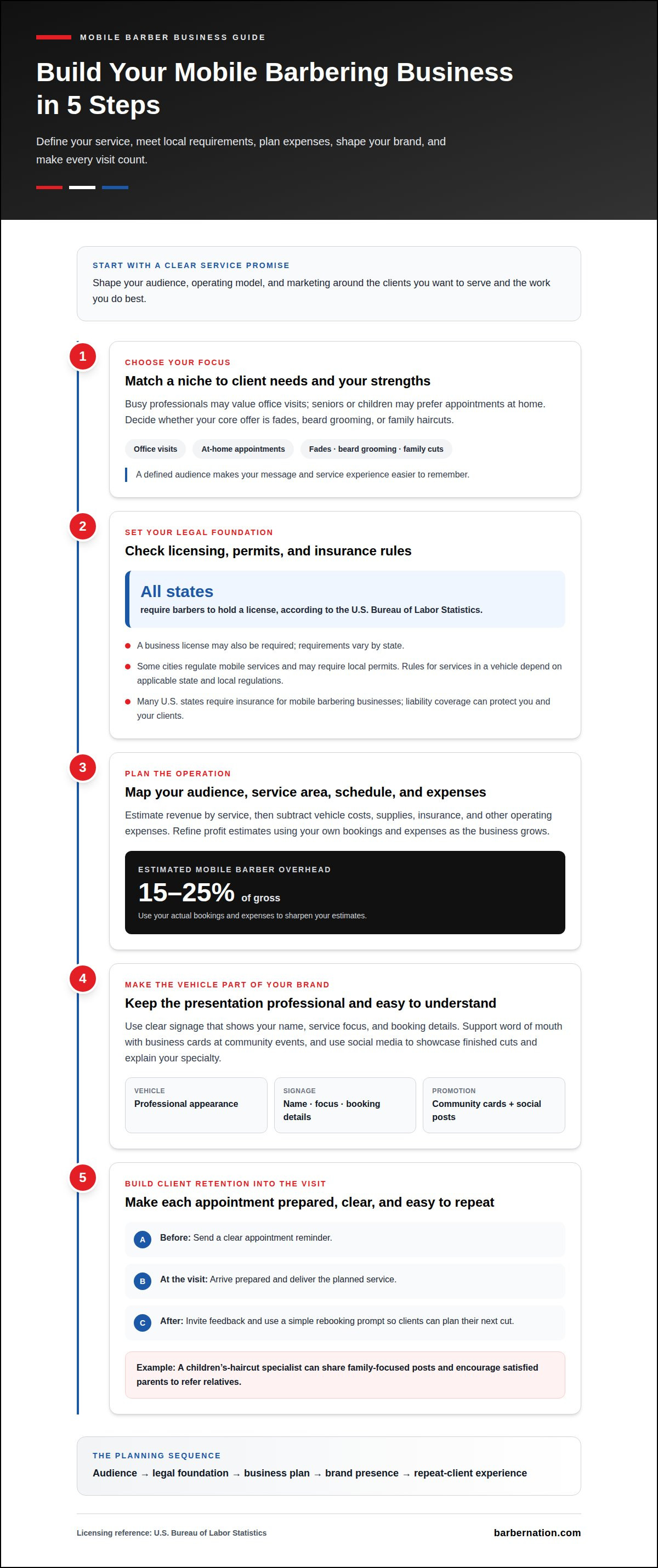
Start with a clear service promise, then shape your audience, operating model, and marketing around it. This mobile barbering business guide begins with a focused plan for whom you serve and where your work fits.
- Choose a niche based on clients’ needs and your strengths. Busy professionals may value office visits, while seniors or children may prefer appointments at home. Decide whether your core offer is fades, beard grooming, or family haircuts. A defined audience makes your message and service experience easier to remember.
- Set your legal foundation before taking mobile appointments. All states require barbers to hold a license, according to the U.S. Bureau of Labor Statistics. A business license may also be required, and requirements vary by state. Some cities regulate mobile services and may require local permits.
Rules for providing barber services in a vehicle depend on applicable state and local regulations. Check licensing and local requirements before operating. Many U.S. states require insurance for mobile barbering businesses; liability coverage can protect you and your clients.
- Build a business plan around your audience, service area, schedule, and expenses. List expected revenue by service, then subtract vehicle costs, supplies, insurance, and other operating expenses. Mobile barber overhead is estimated at 15-25% of gross. Use your own bookings and expenses to refine profit estimates as the business grows.
- Make your vehicle part of your brand. Keep it professional in appearance, with clear signage showing your name, service focus, and booking details. Traditional marketing still has a place: business cards at community events can support word of mouth. Social media posts can showcase finished cuts and explain your specialty.
- Build retention into the client experience. Send a clear appointment reminder, arrive prepared, and invite feedback after each visit. A simple rebooking prompt helps clients plan their next cut. For example, a barber specializing in children’s haircuts can share family-focused posts and encourage satisfied parents to refer relatives.
Mobile barber appointment booking at clients’ locations
Build a booking process that captures each client’s service, location, and appointment time before you travel. A consistent workflow supports reliable scheduling and stronger client relationships.
-
Communicate and Prepare for Appointments
Use a website or booking system to present services, collect appointment requests, and share useful details. Before confirming, clarify the requested cut, address, access instructions, and any location-specific arrangements. Send a concise confirmation so everyone has the same appointment information. Organize your route around confirmed bookings, allowing enough time to prepare your tools and travel between clients.
-
Maintain Professionalism and Discretion
Arrive ready to work, with essentials organized and the service area kept orderly. Confirm where the client would like you to set up, and keep conversation and personal details private. Avoid photographing or sharing a client’s haircut without permission. A professional arrival, respectful communication, and discreet handling of appointment information help establish trust at a home or workplace.
-
Encourage Loyalty and Send Notifications
Use appointment notifications to confirm bookings and promptly share changes. After a cut, invite clients to book again and explain any loyalty program clearly, including how clients earn and use rewards. Keep messages useful: reminders should include the appointment time and location, while follow-ups can invite feedback. Avoid repeated promotions that may cause clients to miss important updates.
-
Build Relationships Through Reviews and Partnerships
Ask satisfied clients to leave an honest review, then use their feedback to improve scheduling, communication, and service. Respond courteously without exposing private appointment details. Build local relationships with nearby businesses or community organizations that connect with your target audience. For example, a workplace partnership can introduce your mobile service to professionals seeking office appointments.
Promoting services through social media and referrals
Promote work clients can see, make booking straightforward, and keep each service listing current. These steps connect your barbering skills with local demand.
- Research nearby barbershops and mobile providers before defining your position. Compare their haircut options, service areas, social media posts, and published pricing to identify gaps. For example, if local pages focus on standard cuts, detailed posts about your fades or beard work can show a distinct skill set. Use these observations to define your service’s relevance, not to copy another barber’s brand.
- Post consistent examples of your work, with clients’ permission. Show a finished haircut, explain the technique, and include a clear booking instruction. Keep captions specific: describe the fade or finish rather than relying on broad claims. Invite satisfied clients to refer friends and family, and make sharing easy with a concise message they can forward.
- Keep service listings and pricing consistent across your website and social profiles. When you add a haircut option or change service details, update every listing so clients see the same offer wherever they find you. Use clear names for cuts and add-ons, then explain what each includes. Accurate listings reduce booking confusion and help clients choose an appointment that suits their needs.
- Define your service areas and organize bookings by location. A scheduling system helps manage appointments and keep operations running smoothly. Group nearby visits where practical, and show the areas you serve in your booking information. If demand grows in a new neighborhood, assess whether travel time and the appointment pattern make it a useful addition.
- Expand deliberately as your schedule develops. Track which services clients request, which posts lead to inquiries, and what feedback reveals about unmet needs. Add services that fit your skills and equipment, or build partnerships with local businesses and community organizations. Keep an eye on haircut trends, but adopt them only when they suit your craft and target audience.
Selecting grooming tools, products, and furniture
Choose a vehicle with room for essential tools, a comfortable work area, and organized storage. Support clean, safe service by following CDC infection-control guidance and using an EPA-registered disinfectant between every client.
- Build your kit around the services you plan to perform. Start with core cutting tools, grooming products, and furnishings suited to your work. A portable chair and compact workstation can help create a professional setup at different locations. Add specialty items as client demand and your service range grow.
- Choose tools that are easy to transport and dependable for daily use. Give each item a secure place in your vehicle to keep your kit organized between appointments. Consider charging needs when selecting cordless equipment, and make charging part of your end-of-day routine.
- Carry at least two of every tool or product used in the shop. A backup clipper or comb helps keep an appointment moving if the primary item needs attention. Store clean tools separately from used items, and disinfect between clients to support hygienic service.
- Select furniture for stability, comfort, and convenience in a mobile setting. Prioritize pieces that fit your vehicle and can be arranged without crowding the work area. Before settling on a layout, consider chair placement, access to tools, and how to keep the service space orderly.
- Review your setup as your business develops. Replace worn essentials, update products to match your services, and add equipment only when it improves the client experience or supports new work. A focused kit helps manage costs while keeping your grooming standard consistent from one appointment to the next.
BarberNation: Professional Barber Tools and Grooming Supplies: BarberNation Cordless Air Duster
BarberNation: Professional Barber Tools and Grooming Supplies is a natural next step as you refine a mobile kit for professional grooming. Its offerings include the BarberNation Cordless Air Duster, WATER RESISTANT HAIR ENHANCEMENT for precision styling and finishing, and Barber T-shirts.
Choose items that suit your services and working style. The cordless air duster adds a dedicated tool to your equipment options, while the hair enhancement supports finishing work. Barber T-shirts provide an apparel option for your professional wardrobe. Together, these offerings connect with practical parts of a barber’s work without requiring you to rebuild your setup all at once.
As your mobile business develops, consider which tools and products best complement your craft and the experience you want clients to remember. Contact BarberNation: Professional Barber Tools and Grooming Supplies to discuss its offerings.
Keep Building Your Mobile Barbering Career
Let your business evolve with the clients you serve. Use feedback and booking patterns to refine your approach, strengthen client trust, and make deliberate decisions about your next investment. A mobile barbering business guide is most useful as a working reference, not a fixed formula. Revisit your goals as your schedule and clientele develop, and keep the quality of your craft at the center of each decision.
When you’re ready to explore professional grooming supplies that can support your work, contact BarberNation: Professional Barber Tools and Grooming Supplies. Choose each next step with purpose, keep refining your skills, and take pride in the standard you bring to every appointment. Your career moves forward one considered decision at a time.
Frequently Asked Questions
How much should mobile barbers charge for haircuts, travel, and add-on services?
Set rates by weighing service time, travel, supplies, operating costs, and the skill each cut requires. Treat example prices as a starting point, then shape your menu around your route, service complexity, and audience. State travel charges before confirming an appointment.
How do mobile barber prices compare with traditional barbershop prices?
Mobile prices can account for travel and the convenience of service at a client’s location, while traditional shop prices reflect a fixed-site appointment. There is no single price difference that applies everywhere. Distance, local demand, service complexity, and the time required for each visit all affect your rates. Compare the full service experience, and make any travel charge clear before the client books.
How can a mobile barber attract clients and book appointments online?
Pair examples of your work with a direct path to online booking. For instance, post a finished fade, name the service, describe the locations you cover, and direct viewers to your appointment form. Ask new clients how they found you, then track referrals and social inquiries separately. Comparing those booking sources helps you focus promotion on content that brings appointments, not just views or likes.
What are the main risks and challenges of running a mobile barber business?
Common challenges include travel delays, uneven booking demand, vehicle disruption, equipment failure, and schedule gaps. Build time between appointments and keep essential backup tools available. Cancellations can leave travel time and preparation unproductive, so set clear booking and cancellation terms. Organize appointment records and handle client information discreetly to maintain a professional experience, even when plans change during the workday.
What are the state and local rules for providing barber services in a mobile vehicle?
All states require barbers to hold a license. A business license may also be required, and some cities regulate mobile services or require local permits. Check applicable state and local requirements before operating.

Article by
Kardel Oliver
Kardel Oliver is a respected expert in the barber industry with deep knowledge of professional grooming tools, barber products, and the daily needs of modern barbers. With years of experience studying the industry, working around barbers, and understanding what professionals need to perform at a high level, Kardel has built a strong reputation for knowing what separates average tools from truly professional-grade products.
Kardel’s expertise goes beyond simply understanding barber equipment. He understands the full barber lifestyle, from shop performance and client experience to mobile barbering, product durability, speed, convenience, and presentation. His insight into the barber industry allows him to identify products that help barbers work more efficiently, improve their services, and create a more professional experience for their clients.
Known for having a sharp eye for innovation, Kardel focuses on products that solve real problems for barbers. Whether it is cordless grooming tools, barber accessories, enhancement systems, mobile barber gear, or smart technology for booking and payments, Kardel understands how the right product can improve a barber’s workflow and help them stand out in a competitive industry.
Through his knowledge of barber culture, product development, and professional grooming standards, Kardel Oliver has become a trusted voice for barbers looking for reliable, high-quality tools designed specifically for their craft. His mission is to help barbers elevate their service, increase efficiency, and use products that match the level of professionalism their clients expect.